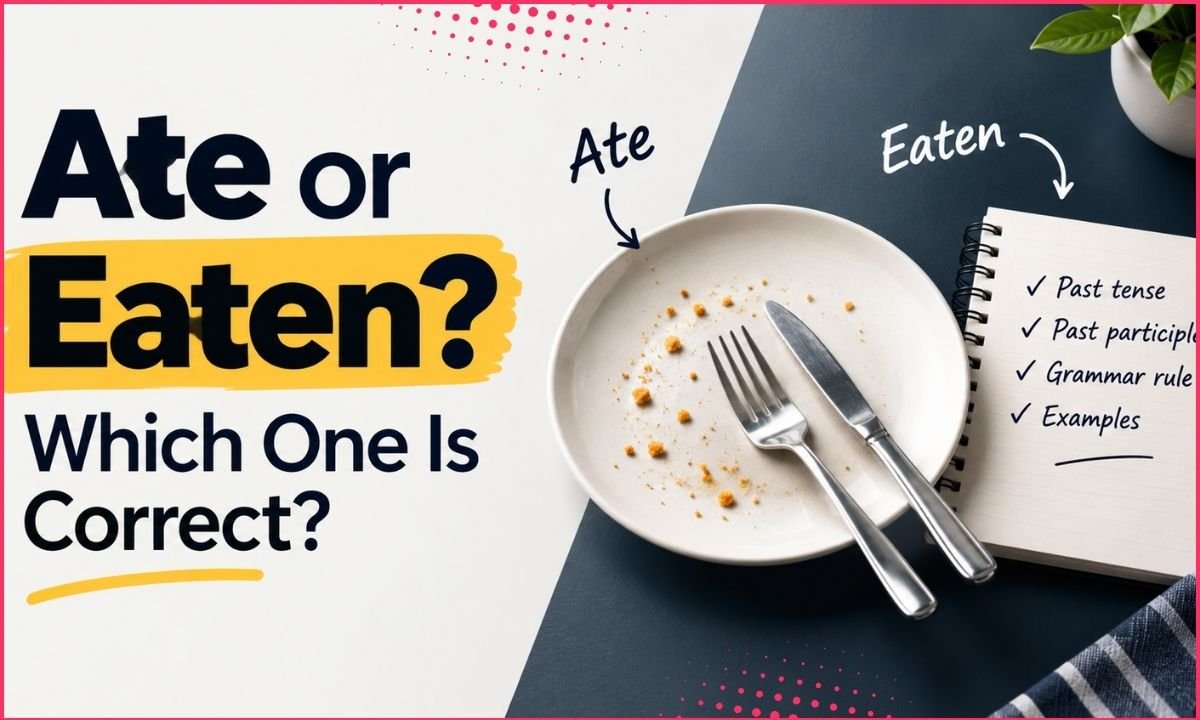
Both are correct, but they are different verb forms. “Ate” is the simple past tense of “eat,” and “eaten” is the past participle. Use “ate” when there is no helping verb (“I ate lunch”). Use “eaten” after “have,” “has,” “had,” or “be” (“I have eaten lunch”).
This is a common point of confusion because many verbs use one form for both jobs, like “walked” or “played.” “Eat” does not. It has three different forms, and mixing them up leads to mistakes like “have you ate” or “I haven’t ate.” The fix is simple once you see the pattern.
The Quick Answer
Here is the rule in one place.
Eat: is the base form: “I eat breakfast every day.”
Ate: is the simple past: “I ate breakfast an hour ago.”
Eaten: is the past participle: “I have eaten breakfast already.”
💡 Tip: If you see have, has, had, was, were, or been before the verb, use “eaten.” If nothing like that comes before it, use “ate.”
Read More: Hooves or Hoofs
Ate or Eaten Grammar: How the Rule Works
“Eat” is an irregular verb. A regular verb adds “ed” to make its past forms, like “talk, talked, talked.” Irregular verbs change in less predictable ways. “Eat, ate, eaten” follows the same pattern as “give, gave, given,” “take, took, taken,” and “write, wrote, written.”
When to use “ate”
Use “ate” for a finished action in the past, when the sentence has no helping verb.
- She ate dinner at six.
- We ate at that restaurant last week.
- What did you eat? I ate a sandwich.
Notice that “did” in the last question is the helping verb, but it takes the base form “eat.” The answer, with no helper, uses “ate.”
When to use “eaten”
Use “eaten” after a form of “have” (perfect tenses) or a form of “be” (passive voice).
Perfect tenses:
- I have eaten already.
- She has eaten here before.
- They had eaten by the time we arrived.
Passive voice:
- The cake was eaten in minutes.
- Rice is eaten all over the world.
In a passive sentence, the thing being eaten is the subject. Nobody has to be named as the eater.
Quick comparison
Ate:
Form: simple past
Needs a helping verb? No
Example: “He ate the whole pizza.”
Eaten:
Form: past participle
Needs a helping verb? Yes
Example: “He has eaten the whole pizza.”
Common Mistakes with Ate and Eaten
Most errors fall into one pattern: using “ate” after a helping verb. A few use “eaten” with no helping verb.
❌ Have you ate yet?
✅ Have you eaten yet?
❌ I haven’t ate all day.
✅ I haven’t eaten all day.
❌ I have already ate.
✅ I have already eaten.
❌ She had ate before we got there.
✅ She had eaten before we got there.
❌ I should have ate earlier.
✅ I should have eaten earlier.
❌ I eaten lunch an hour ago.
✅ I ate lunch an hour ago.
Why do these fixes work? Every “have” or “had” needs a past participle after it, and the participle of “eat” is “eaten.” In the last example, there is no helping verb at all, so the simple past “ate” is the right choice.
⚠️ Common mistake: “Ate” and “eaten” are not interchangeable. You cannot swap them freely, even in casual speech. Spoken English can blur the difference, but writing needs the correct form.
Read More: Reply or Reply All
Is “Ate or Eaten” Correct in Questions Like “Have You Eaten”?
The correct question is “Have you eaten?” It uses “have” as the helping verb, so it needs the participle. The same applies to related forms.
- Have you eaten yet?
- Have you ever eaten sushi?
- What have you eaten today?
- You haven’t eaten all day.
- I never eaten anything like it is wrong. Say “I have never eaten anything like it.”
If you want the simple past instead, change the structure: “Did you eat yet?” This is informal but acceptable. Notice that after “did,” the verb goes back to the base form “eat.” So “did you ate” is also wrong.
Ate or Eaten Past Tense: What Each Form Is Called
Learners often ask which one is the “past tense.” Technically, “ate” is the past tense. “Eaten” is not a tense by itself. It is a participle, which helps form tenses.
Present perfect: I have eaten.
Past perfect: I had eaten.
Future perfect: I will have eaten.
Passive present: It is eaten.
Passive past: It was eaten.
So when someone searches for the past tense of “eat,” the direct answer is “ate.” The past participle is “eaten.”
How to Pronounce Ate and Eaten
Ate: In American English, it sounds like the letter “A” followed by a “t.” The IPA is /eɪt/, and it rhymes with “late.” Some British speakers say it like “et” (/ɛt/). Both pronunciations appear in major dictionaries, though the spelling stays the same.
Eaten: It has two syllables, with the stress on the first. The IPA is /ˈiːtən/. It sounds like “EE ten.”
Many people say “ate” and “eight” the same way. They are homophones, which means they sound alike but have different spellings and meanings.
Origin of Ate and Eaten
“Eat” comes from the Old English verb “etan.” The past tense “ate” developed from the Old English form “æt.” The participle “eaten” developed from “eten.” The pattern of changing the vowel in the past tense and adding “en” in the participle is very old. It comes from Germanic verbs, which is why you see it in other irregular verbs too.
“Ate” as Slang
In recent years, “ate” has taken on a slang meaning. If someone says “she ate” or “you ate that,” they mean the person did something extremely well. A common version is “ate and left no crumbs.” This usage grew out of Black and LGBTQ ballroom culture and spread through social media.
Example: “Her performance was perfect. She ate.”
In this sense, the grammar stays the same. “Ate” is still the simple past tense, and “eaten” would sound wrong in the same slang sentence.
Ate or Eaten in Common Phrases
Several well-known phrases use these words. Their grammar follows the same rule.
Eaten alive: Being attacked and consumed, or overwhelmed in a difficult situation. “I was eaten alive by mosquitoes.” This is passive voice, so “eaten” is correct. Eaten Alive is also the title of a 1976 horror film by Tobe Hooper.
Ate up / eaten up: To consume completely, or to be affected by strong emotion. “She ate up the compliment.” “He was eaten up with guilt.”
Off the eaten path: A pun on “off the beaten path.” It plays on the sound of “beaten” and “eaten” and often appears in food branding.
Dingo ate my baby: A famous pop culture line connected to the 1980 disappearance of Azaria Chamberlain in Australia. The phrase is a paraphrase of what her mother said, and it became a joke in comedy and television. Be mindful that the case was a real tragedy. A coroner’s inquest in 2012 concluded that a dingo was responsible.
Zombies Ate My Neighbors: A video game released in the early 1990s for the Super Nintendo and Sega Genesis. It uses “ate” because the action is in the simple past.
Who Ate the Apple, Adam or Eve?
According to the Book of Genesis, Eve ate the fruit first, then gave some to Adam, who also ate. The Bible does not name the fruit as an apple. It simply says “fruit.” The apple tradition developed later in art and Western culture, partly because of a Latin wordplay on “malum,” which can mean both “evil” and “apple.”
Questions About Food That Use “Eaten”
Many searches use “eaten” in passive food questions. The grammar is the same: a form of “be” plus “eaten.”
Can beets be eaten raw?
Yes. Raw beets are safe to eat and are often grated into salads. They are firmer and earthier than cooked beets.
Can zucchini be eaten raw?
Yes. It is commonly sliced or spiralized and eaten raw.
Can overgrown broccoli be eaten?
Yes, in most cases. It may be tougher or more bitter, so peel the thick stalk and cook it well.
What is the most eaten food in the world?
Rice is widely described as a staple food for more than half the world’s population. Exact rankings depend on how researchers count and which data they use, so treat any single number with care.
My Dog Ate Chocolate: What Does “Ate” Mean Here?
Here “ate” is simple past: the dog finished the action. This is also a safety question, since chocolate can be toxic to dogs. The risk depends on the type of chocolate, the amount, and your dog’s size. Dark chocolate and baking chocolate are more dangerous than milk chocolate.
If this has happened, contact your veterinarian or a pet poison helpline right away. Do not wait for symptoms, and do not guess a safe amount. Cooked chicken bones can also splinter and cause serious injury, so call a vet if a dog has eaten them.
Read More: Spiraled or Spiralled
Ate vs Eaten: Easy Ways to Remember
- Look for a helper: If “have,” “has,” “had,” “was,” or “were” is nearby, use “eaten.”
- Try the swap test: Replace “ate/eaten” with “taken” or “took.” If “took” fits (“I took lunch”), use “ate.” If “taken” fits (“I have taken lunch”), use “eaten.”
- Remember the “en” ending: Many participles end in “en”: eaten, taken, given, written.
- Say it with “have: If “have ate” sounds odd next to “have taken,” that is your clue.
Other Confusing Pairs Like Ate and Eaten
If this topic is tricky, these verbs follow a similar pattern.
Give: gave (simple past), given (participle)
Take: took (simple past), taken (participle)
See: saw (simple past), seen (participle)
Write: wrote (simple past), written (participle)
Drive: drove (simple past), driven (participle)
In each case, the participle is the one that follows “have.”
Frequently Asked Questions
Is it “have you ate” or “have you eaten”?
“Have you eaten” is correct. “Have” needs a past participle, and the participle of “eat” is “eaten.”
Is “eaten” a word?
Yes. It is the standard past participle of “eat.”
Is “I haven’t ate” correct?
No. Say “I haven’t eaten.” The word “haven’t” is a form of “have,” so it requires “eaten.”
Can I say “I have already ate”?
No. The correct sentence is “I have already eaten.”
What is the past tense of eat?
The simple past tense is “ate.” The past participle is “eaten.”
What is the difference between eaten and ate?
“Ate” stands alone as a past action. “Eaten” needs a helping verb like “have” or “was.”
Is “had ate” correct?
No. Use “had eaten.” Past perfect needs a participle.
Is “ate” slang?
Not in its normal meaning. In slang, “she ate” means she did something impressively well.
Is “aten” a word?
No. It is a common misspelling of “eaten.”
Conclusion
The answer to ate or eaten comes down to one rule. “Ate” is the simple past tense, used alone. “Eaten” is the past participle, used after helping verbs like “have,” “has,” “had,” “was,” and “were.” That is why “have you eaten” is correct and “have you ate” is not.
When you are unsure, look for a helping verb right before the word. If one is there, choose “eaten.” If not, choose “ate.” Practice with a few sentences, and the pattern will soon feel natural.

Danish Raza is the author of Grammavio, a trusted resource for simple and easy-to-understand English grammar guides. He creates helpful content covering grammar rules, word meanings, vocabulary, and common grammar mistakes to help readers improve their English skills.