
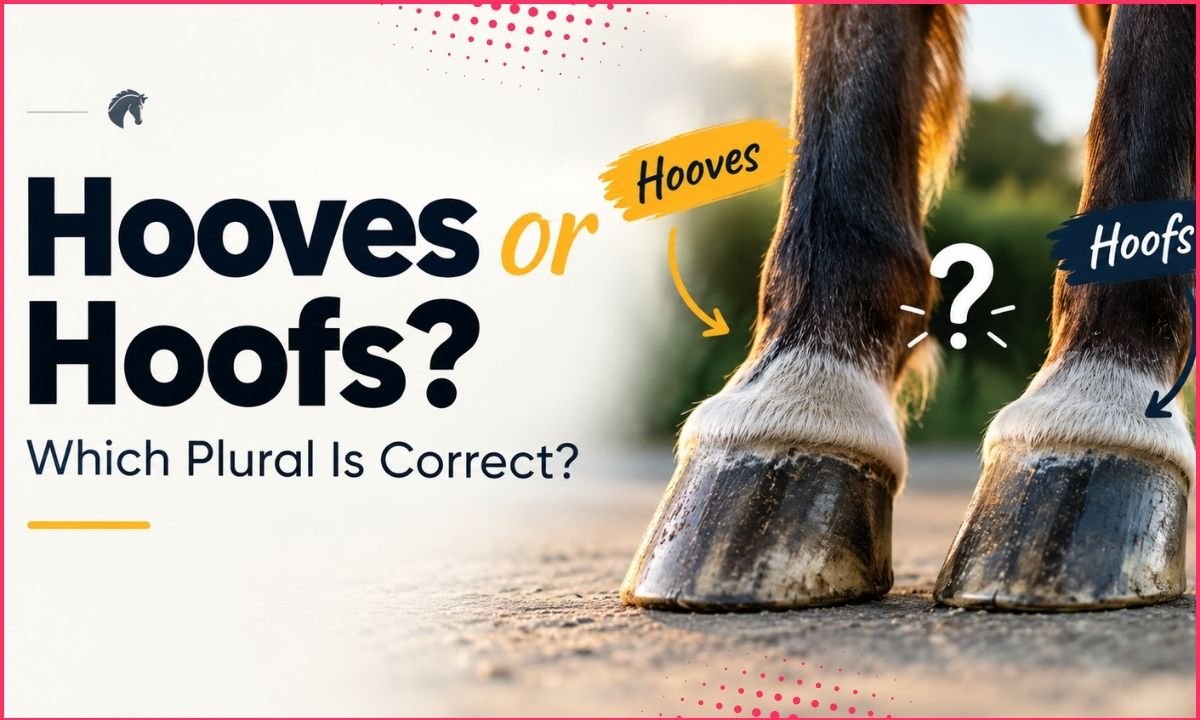
Both hooves and hoofs are correct plurals of the word hoof. Dictionaries list both spellings, so neither one is a mistake. In modern American English, hooves is the more common choice, while hoofs is still widely used and fully accepted.
The confusion happens because the word follows an older English spelling pattern. Some words ending in f change to ves in the plural, like wolf and wolves. Hoof joined that group over time, but it never fully left the regular pattern. That is why you will see both forms in books, news stories, and everyday writing.
Quick Answer: Hooves or Hoofs?
Use either one. If you want a simple rule, choose hooves for most writing in the USA. Choose hoofs if you like the regular plural or if your style guide asks for it. Just stay consistent within one piece of writing.
| Form | Status | Common Use |
| Hooves | Correct, more common | General writing, books, animal care |
| Hoofs | Correct, less common | Older texts, some style guides, verb forms |
💡 Tip: Pick one plural and stick with it. Switching between hooves and hoofs in the same article looks careless.
Read More: Catchup or Catch Up
Is It Hooves or Hoofs in American English?
In American English, hooves is the usual plural. Major dictionaries list both forms, and many give hooves first. Writers in farming, veterinary care, and horse sports mostly use hooves.
You will still meet hoofs in print. Some writers prefer it because it follows the plain rule of adding s. Neither form will cost you credibility.
Hooves or Hoofs in the UK and Australia
British and Australian English accept both plurals too. Searches like “hooves or hoofs UK” and “hoofs or hooves Australia” come up often, but the answer does not change by country. Hooves is common there as well, and hoofs appears in both places.
The difference between countries is small. Your choice should depend on your audience’s habits and your style guide, not on geography.
What Does Hoof Mean?
A hoof is the hard covering on the foot of certain animals. It is made mostly of keratin, the same protein found in human fingernails and hair. The hoof protects the toe bones and helps the animal walk, run, and carry weight.
Here are the main meanings of the word:
- Meaning 1, the animal part: The hard foot covering of animals like horses, cows, and deer. Example: The horse lifted its front hoof.
- Meaning 2, the animal itself: In some farm talk, “on the hoof” means a live animal, as in “cattle sold on the hoof.”
- Meaning 3, informal verb: “To hoof it” means to go on foot. Example: The bus broke down, so we hoofed it home.
- Meaning 4, dance slang: “To hoof” can mean to dance, especially in old show business talk.
Most readers searching this topic want the first meaning.
Grammar of Hoof: Noun, Verb, and Word Forms
Hoof is mainly a noun. It can also work as a verb in informal speech. The adjective form is hoofed, as in “a hoofed animal.”
| Form | Example | Part of Speech |
| Hoof | The hoof was clean. | Noun, singular |
| Hooves | The hooves were clean. | Noun, plural |
| Hoofs | The hoofs were clean. | Noun, plural |
| Hoofs | He hoofs it to work. | Verb, present |
| Hoofed | She hoofed it home. | Verb, past |
| Hoofing | They are hoofing it now. | Verb, present participle |
Notice that hoofs can be a plural noun or a verb form. Context tells you which one it is. The word hooves is only ever a plural noun, which makes it clearer in writing about animals.
How to Pronounce Hooves and Hoofs
Both words have two common sounds for the vowel part. You may hear them said with a short oo like in “book” or a long oo like in “food.” Both are accepted.
- Hoof: /hʊf/ or /huːf/
- Hooves: /hʊvz/ or /huːvz/
- Hoofs: /hʊfs/ or /huːfs/
Each word has one syllable. Your accent decides which vowel sound feels natural, so you do not need to change it.
Why Does the Plural Change from F to V?
This pattern goes back to Old English. Over centuries, some words that ended in an f sound began to take a v sound in the plural. We still see it in words like knife and knives, leaf and leaves, and calf and calves.
Not every word followed the pattern. Roof and roofs stayed regular, while hoof ended up with two accepted forms. That split is why the debate exists at all.
Origin of the Word Hoof
Hoof comes from the Old English word hōf. It traces back to older Germanic roots and is related to similar words in other Germanic languages, such as Dutch hoef and German Huf. The meaning has stayed close to the original for over a thousand years.
The old plural was hōfas, which became hoofs. The v form, hooves, developed later through the same sound shift that affected other f words.
Read More: Requester or Requestor
Do Horses Have Hooves or Hoofs?
Horses have hooves, or hoofs if you prefer. Each horse foot ends in one solid hoof. Horses are called odd toed animals because they walk on a single toe, the middle one, covered by that hoof.
A healthy horse hoof has several parts:
- Hoof wall: The hard outer layer you see.
- Sole: The underside of the hoof.
- Frog: The soft, V-shaped part that absorbs shock.
- Bars and white line: Structures that add support and hold the hoof together.
So when someone asks, “do horses have hooves or hoofs?”, the answer is yes to both spellings. The animal has one hoof on each foot.
Baby Horse and Newborn Horse Hooves
Newborn foals have an unusual feature. Their hooves are covered by a soft, rubbery material often called “golden slippers” or “fairy slippers.” It protects the mare’s body during birth. The covering wears away within hours or days as the foal stands and walks.
How Wild Horses Trim and Maintain Their Hooves
Wild horses do not get trimmed by people. Their hooves wear down naturally as they travel long distances over rocks, hard ground, and rough terrain. This steady movement keeps the hooves at a healthy length and shape.
Hooves grow constantly, much like fingernails. Wild horses usually keep pace through wear. Domestic horses often live on soft pastures or in stalls, so they do not get that natural wear. That is why most pet horses need regular care from a farrier, commonly every six to eight weeks.
Do Cows Have Hooves or Hoofs?
Yes, cows have hooves. Cow hooves are cloven, which means split into two parts. Each foot has two main toes, and each toe has its own hoof section.
Cows are even toed animals. Farmers often check and trim cow hooves to prevent lameness and discomfort.
Cloven Hooves: Which Animals Have Them?
Cloven hooves, also written cloven hoofs, are split into two toes. Many familiar animals have them. Here is a quick guide.
| Animal | Hoof Type | Notes |
| Cow | Cloven | Two main toes on each foot |
| Deer | Cloven | Also have small dewclaws higher up the leg |
| Goat | Cloven | Hooves may need trimming in captivity |
| Sheep | Cloven | Regular hoof care helps prevent disease |
| Pig | Cloven | Four toes, but two carry most of the weight |
| Horse | Single hoof | One toe, one hoof |
Do Pigs Have Hooves or Hoofs?
Yes, pigs have hooves. They walk on two main toes, with two smaller toes higher up that touch the ground less. When pork is sold or cooked, the feet are often called trotters.
Deer, Goat, and Sheep Hooves
Deer, goats, and sheep all have cloven hooves. Deer use theirs for fast running and quiet movement. Goats have hooves with a firm outer edge and a softer inner pad, which helps them climb steep ground. Sheep hooves are similar, though they grow more steadily on soft ground and often need trimming.
Animals With Hooves
Animals with hooves are called ungulates. They fall into two main groups:
- Odd toed ungulates: Horses, zebras, donkeys, rhinoceroses, and tapirs.
- Even toed ungulates: Cows, deer, goats, sheep, pigs, camels, giraffes, and hippos.
If an animal has a hard covering on its feet and walks on the tips of its toes, it likely belongs to one of these groups.
Hooves and Paws: What Is the Difference?
Hooves and paws are different kinds of feet. Hooves are hard and made for running on open ground. Paws are softer, often padded, and usually have claws.
| Feature | Hooves | Paws |
| Material | Hard keratin | Soft pads with fur or skin |
| Common animals | Horses, cows, deer | Dogs, cats, bears |
| Main use | Running, carrying weight | Gripping, digging, stalking |
| Claws | No | Yes, usually |
So a horse has hooves, and a dog has paws. Animals do not have both on the same foot.
How to Clean Hooves
People who keep horses clean their hooves often. The goal is to remove mud, stones, and packed dirt that can cause pain or infection. You will see the phrase “hoofs cleaning” in searches, and it means the same thing.
- Stand beside the horse and gently lift one foot.
- Use a hoof pick to remove dirt from the sole, starting at the heel and moving toward the toe.
- Brush away loose debris.
- Check for stones, cracks, bad smells, or soft spots.
- Place the foot down and repeat on each leg.
⚠️ Note: If you notice swelling, heat, limping, or a strong odor, call a vet or farrier. Hoof problems can get worse quickly.
Read More: Ahold or A Hold
Common Mistakes With Hooves and Hoofs
Most mistakes come from believing one spelling is wrong. Here are the common ones.
❌ Incorrect: Hooves is wrong; only hoofs is allowed.
✅ Correct: Both hooves and hoofs are accepted plurals.
❌ Incorrect: The horse’s hooves was sore.
✅ Correct: The horse’s hooves were sore.
The plural noun needs a plural verb. The same rule applies to hoofs.
❌ Incorrect: Horses have paws.
✅ Correct: Horses have hooves.
Hooves in Pop Culture and Names
The word also appears in names and entertainment. “Derpy Hooves” is a well-known fan name for a background character from the animated series My Little Pony. People also search for hooves art, which usually means artwork featuring hooves or animal-themed designs. These are uses of the word, not changes to its meaning.
Similar Words and Related Terms
| Word | Meaning | Difference |
| Hoof | Hard foot covering | The main word |
| Trotter | A pig’s foot, often used in cooking | Used for food, not general animal talk |
| Cloven | Split into two parts | Describes a type of hoof |
| Ungulate | Animal with hooves | Scientific group name |
| Paw | Soft, clawed foot | Used for dogs, cats, bears |
| Dewclaw | Small toe higher on the leg | Not a full hoof |
Frequently Asked Questions
Is it hooves or hoofs?
Both are correct. Hooves is more common today, and hoofs is still accepted.
Is it hooves or hoofs in the UK?
Both are used in British English. There is no strict rule that separates the UK from the USA.
What is the singular of hooves?
The singular is hoof.
Do horses have hooves or hoofs?
Horses have either, depending on your spelling choice. Each foot has one solid hoof.
Do cows have hooves?
Yes. Cows have cloven hooves, split into two toes.
Do pigs have hooves?
Yes. Pigs have cloven hooves, and their feet are sometimes called trotters in cooking.
Is hoofs a verb?
Yes. In informal English, “he hoofs it” means he walks quickly or goes on foot.
What is the difference between hooves and paws?
Hooves are hard and used for running. Paws are padded and often have claws.
How do wild horses keep their hooves short?
They wear them down by walking long distances over hard and rough ground.
Conclusion
The plural of hoof can be written as hooves or hoofs, and both are correct. Hooves is the more common form in American English, while hoofs stays acceptable in print and in verb use. The choice does not change by country in any strict way.
For a simple takeaway, use hooves for animals and stay consistent through your writing. If you are unsure whether an animal has hooves or paws, think about the foot: a hard, nail-like covering means hooves, and soft pads with claws mean paws.

Danish Raza is the author of Grammavio, a trusted resource for simple and easy-to-understand English grammar guides. He creates helpful content covering grammar rules, word meanings, vocabulary, and common grammar mistakes to help readers improve their English skills.



4 Comments