
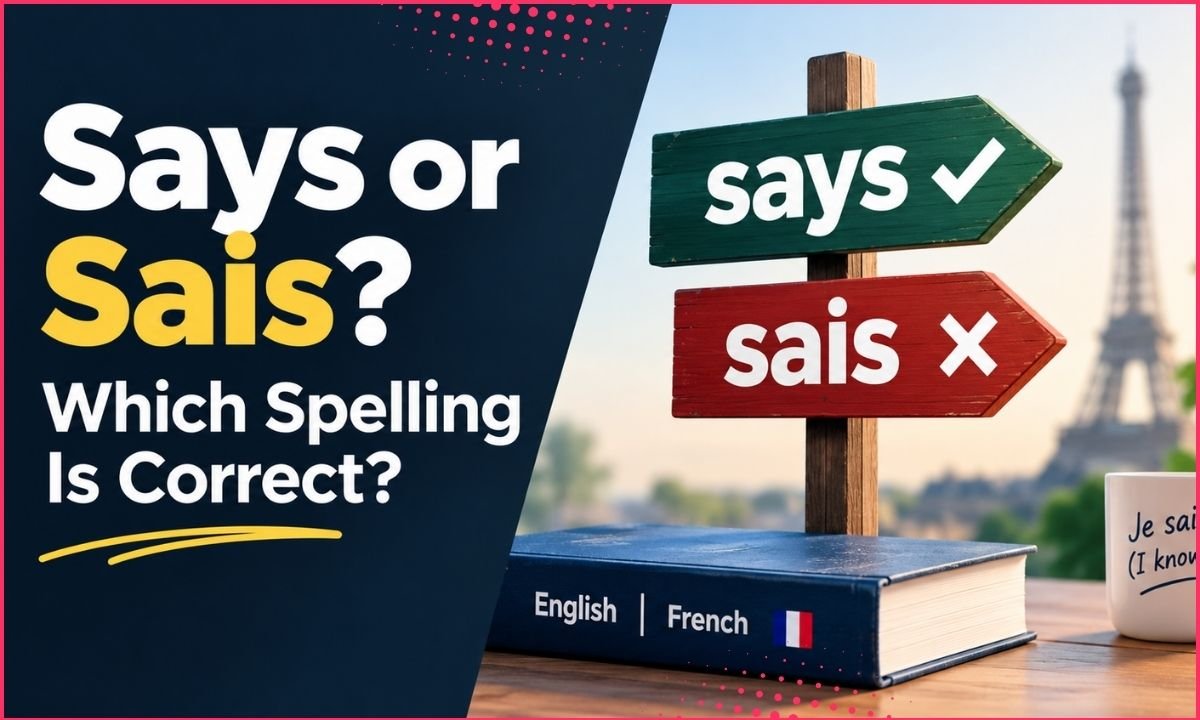
The correct English spelling is says. It is the third-person singular present form of the verb “say,” as in “She says hello.” The spelling “sais” is not an English word. It belongs to French, where “sais” means “I know” or “you know.”
People mix up the two because “says” sounds like “sez,” and “sais” looks like a natural way to spell that sound. It is a fair guess, but English spells this word in an irregular way. Once you know the rule and the French link, the confusion goes away.
Quick Answer: Says or Sais
Use says in every normal English sentence. Use sais only when you are writing French or quoting a French phrase.
✅ Correct: He says he is ready.
❌ Incorrect: He sais he is ready.
💡 Tip: If you are writing about speaking, reporting, or what a sign or text states, the word you want is “says.”
Read More: Handsome or Hansom
What Does “Says” Mean?
“Says” is the form of “say” that goes with he, she, it, or a single person or thing. It has a few common meanings.
Meaning 1: To speak words: This is the most common use.
Example: “My sister says she will call tonight.”
Meaning 2: To state or show information in writing: Signs, labels, and screens “say” things. Example: “The sign says the store closes at nine.”
Meaning 3: To express an opinion or claim:
Example: “The doctor says rest is the best cure.”
Meaning 4: To suggest or indicate something.
Example: “Her smile says she is happy.”
Says: Grammar and Word Forms
“Says” is a verb. It is the present tense form used with third-person singular subjects. Here are the main forms of the verb.
- Base form: say
- Third person singular present: says
- Past tense: said
- Past participle: said
- Present participle: saying
The subject decides which form you use. With “I,” “you,” “we,” and “they,” use “say.” With “he,” “she,” “it,” or one person or thing, use “says.”
- I say it every day.
- They say it every day.
- She says it every day.
- The manual says it every day.
He Says or He Said?
These two forms show different times. “He says” talks about the present. “He said” talks about the past.
- He says: “He says he is tired” means he is telling you now, or he keeps telling people.
- He said: “He said he was tired” means he told you earlier.
⚠️ Common mistake: Writers sometimes switch between the two in the same story. If you tell a story in the past, stay with “said.” Some writers use “says” in casual storytelling to make events feel more alive. That is a style choice, and it should stay consistent.
How to Pronounce “Says”
“Says” is one of the most irregular spellings in English. It does not rhyme with “plays” or “days.” It rhymes with “fez.”
- Simple pronunciation: sez
- IPA: /sɛz/
- American and British English: The same in both
Compare it with “said,” which is pronounced /sɛd/. The vowel sound in both words is the same short “e.” That is why people often spell “says” as “sez” in informal writing.
What Does “Sais” Mean?
“Sais” is not English. In French, it is a form of the verb savoir, which means “to know.” It is used with “je” (I) and “tu” (you).
- Je sais: I know
- Tu sais: You know
- Je ne sais pas: I do not know
French speakers say “sais” like the English word “say,” with a short sound at the end. That is another reason English writers mix it up with “says.”
Read More: Spiraled or Spiralled
Je Ne Sais Quoi: The Most Common Place You See “Sais”
Many English readers meet “sais” through the phrase je ne sais quoi. It is a French phrase that English has borrowed.
Literal meaning: “I do not know what.”
Everyday English meaning: A special quality that is hard to describe. Example: “She has a certain je ne sais quoi that makes her stand out.”
- Pronunciation: zhuh nuh say kwah
- IPA: /ʒə nə sɛ kwa/
- Part of speech in English: Noun phrase
Dictionaries trace the phrase in English to the 1600s. People usually use it for charm, style, or appeal that is difficult to explain. It is common in writing about fashion, food, art, and personality.
A quick note on the French. In “je ne sais quoi,” “sais” is the correct French spelling. English writers do not change it to “says” when they use the phrase.
Other Meanings of “Sais”
The word shows up in a few other places, so it helps to know them.
- Sais as a weapon: A sai is a short metal weapon from martial arts traditions in Okinawa. You may see “sais” used as a plural in English, though many writers use “sai” for both singular and plural.
- Sais in Welsh: In Welsh, “Sais” is a word for an English person. This is a separate word with no link to the French verb.
These meanings explain why “sais” appears in search results. None of them replace “says” in everyday English.
Says or Sais: Common Mistakes
Here are the errors people make most often.
Mistake 1: Using “sais” for the English verb.
❌ Incorrect: The report sais sales are up.
✅ Correct: The report says sales are up.
Mistake 2: Using “says” in French.
❌ Incorrect: Je says qu’il est là.
✅ Correct: Je sais qu’il est là. (I know he is there.)
Mistake 3: Spelling it “sez” in formal writing.
❌ Incorrect: The teacher sez the test is Friday.
✅ Correct: The teacher says the test is Friday.
“Sez” is fine for informal speech in dialogue or a joke. Do not use it in schoolwork, business writing, or articles.
Mistake 4: Using “say” with a single subject.
❌ Incorrect: She say it is fine.
✅ Correct: She says it is fine.
Common Phrases With “Says”
“Says” appears in many everyday expressions. Here are some that readers often search for.
- Says you: A casual way to show you doubt or disagree with what someone just said. Example: “That song is boring.” “Says you!”
- Says it all: Something expresses everything that needs to be said.
Example: “The look on his face says it all.” - Who says: A way to challenge a rule or claim.
Example: “Who says adults cannot learn to swim?” - Simon says: A children’s game where players follow commands only when they begin with “Simon says.”
- The sign says: A common way to report what written text states.
Synonyms for “Says”
Writers often want other words for “says,” especially to avoid repeating it. The best choice depends on the meaning.
- States: More formal, used for facts and official statements. Example: “The policy states that all staff must sign in.”
- Reads: Used for signs, notes, and messages. Example: “The note reads, ‘Back in ten minutes.'”
- Declares: Stronger, used for firm or public claims. Example: “The mayor declares the park open.”
- Mentions: Lighter, used for something said in passing. Example: “He mentions a new job in his email.”
- Tells: Used when someone gives information to another person. Example: “She tells me it will rain.”
- Remarks: Used for a short comment or observation. Example: “He remarks that the room is cold.”
- Claims: Used when the statement may not be proven. Example: “The company claims the product is safe.”
💡 Tip: Do not swap “says” for a fancier word every time. In most writing, “says” is clear, and readers barely notice it.
Read More: Hooves or Hoofs
A Simple Way to Remember Says or Sais
Use this short check each time you write the word.
- Are you writing English? Use says.
- Are you writing French and mean “I know” or “you know”? Use sais.
- Is it part of “je ne sais quoi”? Keep sais.
Another memory trick: “says” contains the word “say.” If you can swap in “speaks,” “states,” or “tells,” then “says” is the right choice.
Frequently Asked Questions
Is it says or sais?
In English, it is “says.” “Sais” is French for “I know” or “you know.”
Is “sais” a word in English?
Not as a regular word. It appears in the borrowed phrase “je ne sais quoi,” and in niche uses such as the plural of “sai,” a martial arts weapon.
Is “says” a noun or a verb?
It is a verb. It is the third-person singular present form of “say.”
How do you pronounce “says”?
Say “sez,” with the same vowel sound as in “fez” or “said.”
What is the difference between “says” and “said”?
“Says” is present tense. “Said” is past tense, and it is also the past participle.
What does “je ne sais quoi” mean?
It means a quality that is hard to explain or name. The literal French meaning is “I do not know what.”
What does “je ne sais pas” mean?
It means “I do not know” in French.
Is “sez” a correct spelling?
No. It is an informal spelling that shows how people speak. Use “says” in formal writing.
Can I say “she say” instead of “she says”?
In standard English, no. A single third-person subject takes “says.”
Conclusion
The question of says or sais has a simple answer. In English, the word is “says,” the present tense form of “say” used with he, she, it, or a single subject. “Sais” is a French form of “savoir,” meaning “I know” or “you know,” and it appears in English mainly through the phrase “je ne sais quoi.”
Next time you hesitate, ask yourself which language you are writing in. If it is English and you mean speaking, stating, or showing something, write “says” and pronounce it “sez.” Keep “sais” for French and for that one famous phrase.

Danish Raza is the author of Grammavio, a trusted resource for simple and easy-to-understand English grammar guides. He creates helpful content covering grammar rules, word meanings, vocabulary, and common grammar mistakes to help readers improve their English skills.