
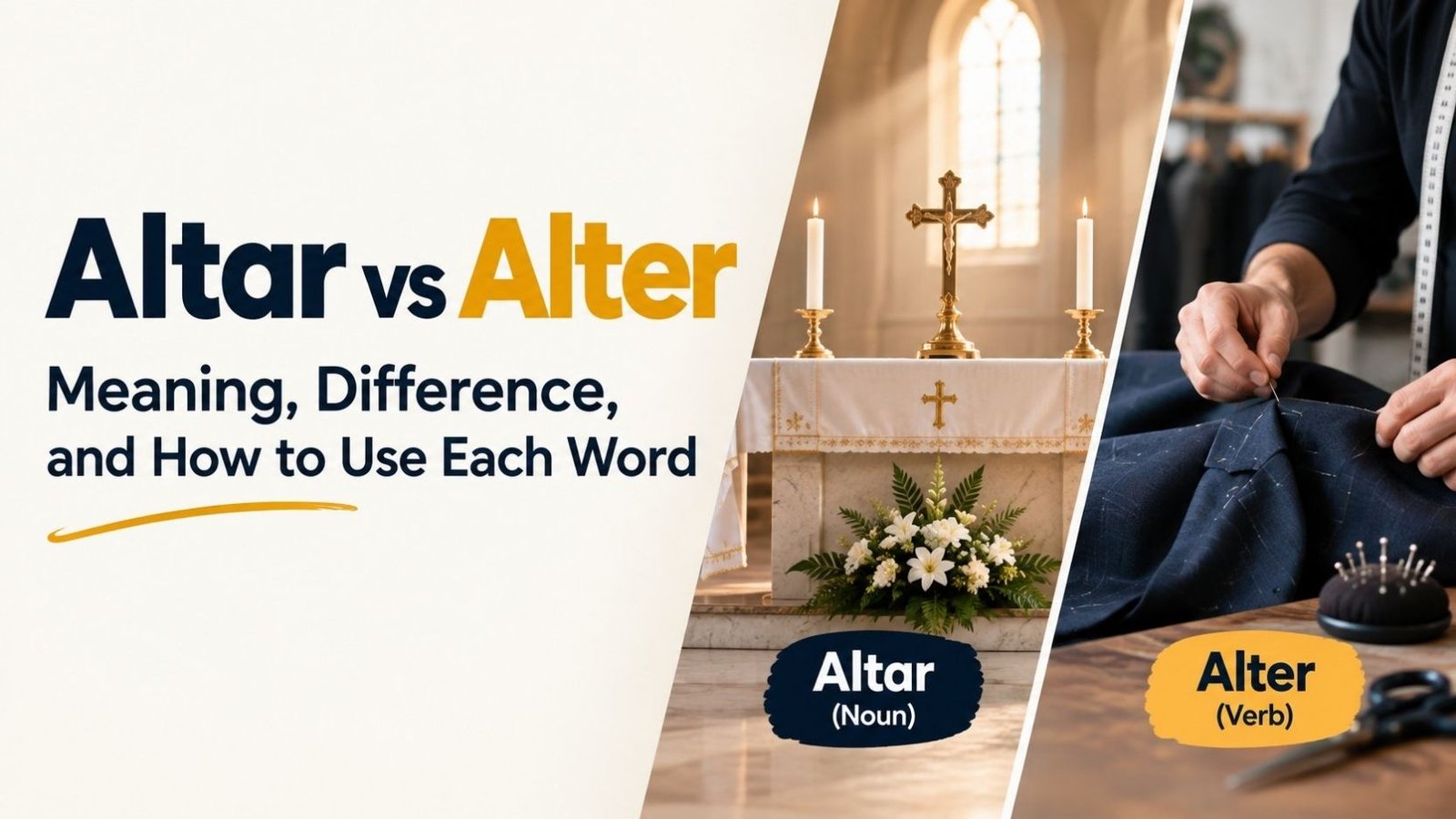
Altar vs alter comes down to one simple split. An altar is a noun for a table or raised structure used in worship. To alter is a verb that means to change something.
The two words sound the same in American English, and they differ by one letter. That is why people mix them up in wedding invitations, sermons, and everyday writing. This guide shows the difference, gives clear examples, and helps you never confuse them again.
Altar vs Alter: Quick Answer
| Word | Part of speech | Simple meaning | Example |
| Altar | Noun | A table or structure for worship, offerings, or ceremony | The bride walked to the altar. |
| Alter | Verb | To change or adjust something | The tailor will alter the dress. |
💡 Tip: If you can replace the word with “change,” you need alter. If you mean a place in a church or a ceremony, you need altar.
Read More: Ladder vs Latter
What Does Altar Mean?
An altar is a raised surface or structure where people worship, make offerings, or hold ceremonies. It is a noun. Its plural is altars.
Altars appear in many settings:
- Church altar: The table at the front of a church where communion or other rites take place.
- Wedding altar: The spot where a couple stands during the ceremony. People often say “at the altar” for the wedding itself.
- Day of the Dead altar: In Mexican tradition, families build an ofrenda, also called an altar de muertos or altar de muertos, to remember loved ones. It often holds photos, flowers, candles, and favorite foods.
- Ancient and religious altars: Many cultures have used altars for sacrifices and offerings. The Bible mentions altars often, which is why people search for altar Bible verses.
- Games and fiction: Names like Phyrexian Altar, Ashnod’s Altar, and the altars in Elden Ring or Ghost of Yōtei use the word in this same sense: a special object or place tied to ritual or power.
The song “O Come to the Altar” also uses altar in the worship sense. It refers to coming forward to pray.
What Does Alter Mean?
Alter is a verb. It means to change, adjust, or modify something. The changes can be big or small.
Its forms are:
| Form | Word | Example |
| Base | alter | We may alter the plan. |
| Third person | alters | She alters clothes for a living. |
| Past | altered | He altered his schedule. |
| Present participle | altering | They are altering the design. |
Common meanings of alter
- To change: The new law will alter how taxes work.
- To adjust clothing: She had the suit altered to fit better.
- To spay or neuter an animal: Vets use the word this way, as in “an altered cat.”
- In computing: SQL uses ALTER TABLE to change a table’s structure, such as adding a column.
Alter also appears in other set expressions and names:
- Alter ego: A second self, or a different side of a person’s personality. It comes from Latin and means “other self.” A writer might say a superhero’s alter ego is his everyday identity.
- Alter Bridge: An American rock band.
- Saber Alter and Jeanne Alter: Characters in the Fate franchise. Here “Alter” marks a darker version of a character.
- Alter Self: A spell in Dungeons & Dragons that changes a character’s appearance.
- Robert Alter: A scholar known for his translations of the Hebrew Bible. Here Alter is a surname, not the verb.
How to Pronounce Altar and Alter
In American English, both words are pronounced the same way. They are homophones.
- Pronunciation: AWL ter
- IPA (American): /ˈɔːltər/
Some speakers say the first vowel differently depending on region, but the two words still match each other. That is why context matters so much in speech. The difference only shows up in spelling.
Read More: Waste vs Waist
Where the Words Come From
The words have different roots, which helps explain why their meanings do not overlap.
- Altar: comes from Latin altare, a term for a structure used for offerings. Many dictionaries link it to Latin altus, meaning “high,” because altars were often raised. It reached English through Old English and later forms.
- Alter: comes from Medieval Latin alterare, which traces back to Latin alter, meaning “other.” To alter something is to make it “other,” or different.
Sources like Merriam-Webster and the Oxford English Dictionary cover these histories in more detail.
Common Mistakes: Altar vs Alter
The most frequent error is using alter when someone means altar. It shows up in wedding writing, church announcements, and sermons.
❌ Incorrect: She was left at the alter.
✅ Correct: She was left at the altar.
Why: The sentence refers to a place at a wedding.
❌ Incorrect: The tailor will altar my jacket.
✅ Correct: The tailor will alter my jacket.
Why: Altering a jacket means changing it.
❌ Incorrect: His altar ego is a shy artist.
✅ Correct: His alter ego is a shy artist.
Why: The phrase comes from Latin and means “other self.”
⚠️ Note: “Alter ego” is a fixed phrase, so never write “altar ego.”
Easy Ways to Remember the Difference
- Alter has an e, like “change”: Both contain that letter.
- Altar has an a, like “amen” or “aisle”: Think of church and ceremony.
- Try the swap test: Replace the word with “change.” If the sentence still works, use alter.
- Ask if it is a thing or an action: An altar is a thing. To alter is an action.
Altar vs Alter in a Sentence
Here are a few strong examples that show each word in real use.
Altar:
- The priest placed the candles on the altar.
- Families decorate a Day of the Dead altar with marigolds and photos.
Alter:
- Please do not alter the document without approval.
- Moving abroad can alter how you see your own culture.
Altar vs Alter in Religious Contexts
Many searches for this topic come from churches and Bible study groups. In that setting, the correct word is almost always altar.
- Biblical passages about building, offering, or approaching an altar use the noun.
- Sermons on “the altar” often use it symbolically, for a place of prayer or surrender.
- In Catholic and Protestant churches, the altar is the table used for communion, though traditions differ on its role and name.
If a title says “alter call,” it is usually a mistake. The common term is “altar call,” an invitation to come forward for prayer.
Altar vs Alter: Side by Side
| Feature | Altar | Alter |
| Type of word | Noun | Verb |
| Core idea | A place for worship or ceremony | To change something |
| Related words | Shrine, communion table, ofrenda | Change, modify, adjust |
| Plural or forms | altars | alters, altered, altering |
| Typical setting | Church, wedding, ritual | Clothing, plans, software |
| Sample phrase | Wedding altar | Alter the plan |
Read More: Allude vs Elude
Similar Words to Know
- Altered: is the past form of alter, not a form of altar.
- Alteration: is a noun for a change, often to clothes.
- Alternate: shares the Latin root alter and relates to “other” or “in turns.”
- Shrine and sanctuary: are related to altar in meaning but are not exact synonyms.
- Change, modify, adjust, revise: are common synonyms for alter.
Frequently Asked Questions
What is the difference between altar and alter?
Altar is a noun for a structure used in worship or ceremony. Alter is a verb meaning to change.
Is it “altar” or “alter” at a wedding?
It is altar. Couples stand at the altar during the ceremony.
Are altar and alter pronounced the same?
Yes. In American English, they sound the same.
Is alter a noun or a verb?
Alter is a verb. It only appears as part of names or the phrase alter ego, which comes from Latin.
What does alter ego mean?
It means a second self or a different side of a person’s identity. It is a phrase borrowed from Latin.
What does ALTER TABLE mean in SQL?
It is a command that changes the structure of a database table, such as adding a column.
Is “alter call” correct?
The usual phrase is “altar call.” It refers to an invitation to come to the altar for prayer.
What is a Day of the Dead altar?
It is an ofrenda, a display built to honor deceased loved ones with items such as photos, flowers, and food.
Conclusion
Altar and alter sound the same but do different jobs. An altar is a noun for a place of worship or ceremony, such as a church table or a wedding spot. Alter is a verb that means to change something.
When you are unsure, use the swap test. If “change” fits the sentence, write alter. If you mean a place in a ceremony, write altar. Keeping this simple check in mind makes the altar vs alter choice quick and reliable.

Danish Raza is the author of Grammavio, a trusted resource for simple and easy-to-understand English grammar guides. He creates helpful content covering grammar rules, word meanings, vocabulary, and common grammar mistakes to help readers improve their English skills.


