
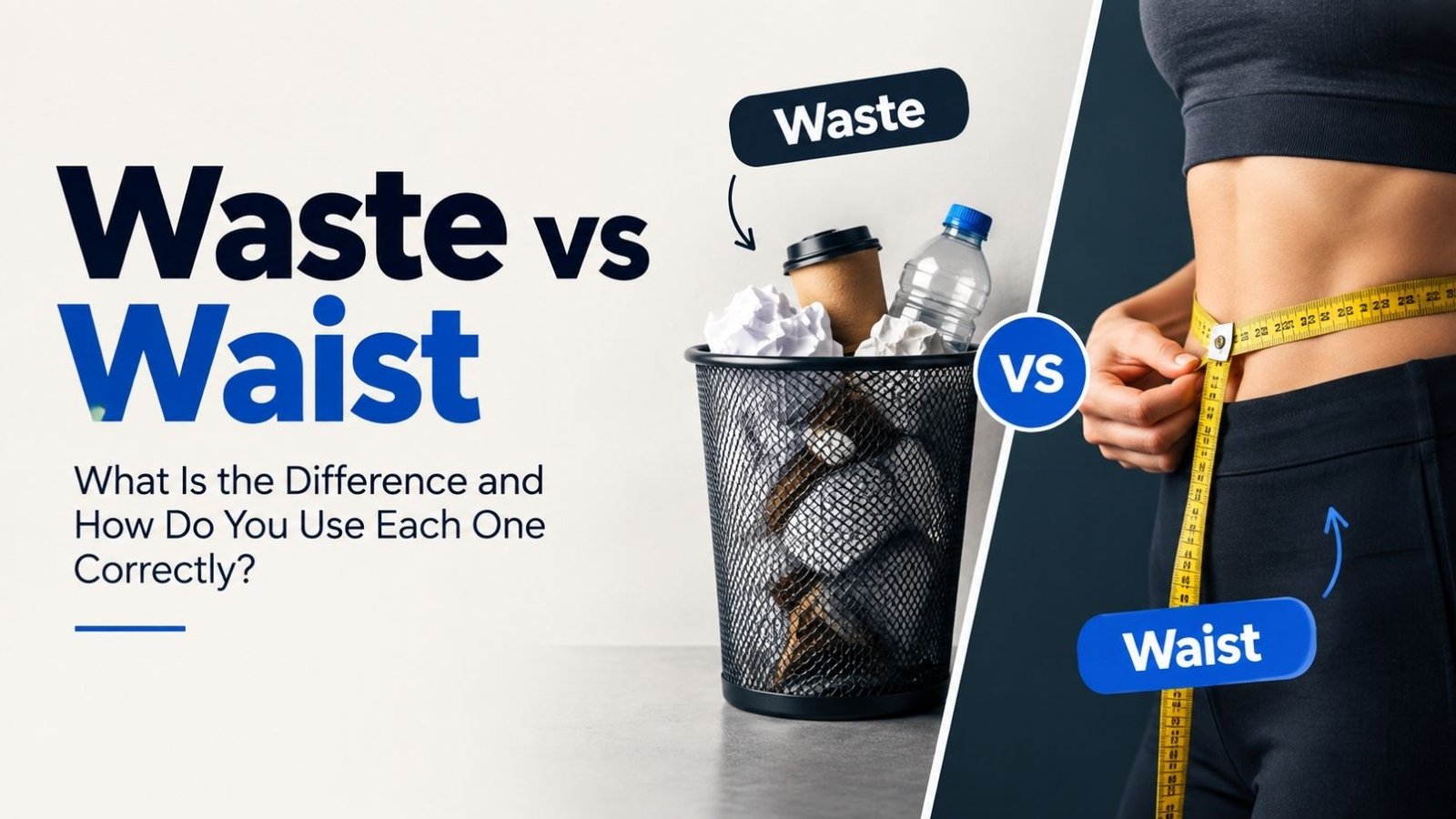
Waste and waist sound exactly the same, but they mean completely different things. Waste refers to something used carelessly, thrown away, or left over with no purpose. Waist refers to the narrow part of the human body between the ribs and the hips. These two words are homophones, which means they share a pronunciation but not a spelling, a meaning, or a grammatical role.
This confusion trips up even confident English speakers because the ear cannot tell the words apart. Only the spelling and the context reveal which word is correct. Understanding the difference matters for clear writing, accurate grammar, and everyday communication, whether you are describing wasted time, a wasteful habit, or the waist of a dress. Below, you will find simple definitions, real examples, pronunciation guidance, and the small memory tricks that make this mix-up disappear for good.
Waste vs Waist: The Simple Difference
The fastest way to remember the difference is this: waste is about loss, and waist is about the body.
| Word | Part of Speech | Core Meaning | Example |
| Waste | Noun and verb | To use carelessly, or unwanted material left over | She did not want to waste her time. |
| Waist | Noun only | The narrow middle section of the body | He wore a belt around his waist. |
Both words are pronounced the same way, roughly “wayst.” Nothing in the sound tells you which one is meant. Spelling and sentence context are the only reliable clues.
Read More: Onsite Vs On Site
What Does Waste Mean?
Waste has two everyday uses: as a verb describing an action, and as a noun describing a result or a substance.
As a verb: waste means to use something in a careless or unnecessary way, without getting real value from it.
- She wasted an hour scrolling through her phone.
- Please do not waste food.
- He wasted the opportunity to apologize.
As a noun: waste refers to material that is no longer needed, unwanted byproducts, or the act of using something poorly.
- The factory produces a large amount of waste every day.
- Buying that extra equipment was a waste of money.
- Recycling helps reduce household waste.
Waste can describe money, time, effort, food, energy, natural resources, or physical materials that are thrown away. The common thread across every use is loss: something valuable is lost, misused, or discarded.
Common Word Forms of Waste
Waste changes form depending on how it is used in a sentence.
- Waste (base verb): I do not want to waste this chance.
- Wasted (past tense): They wasted the whole afternoon.
- Wasting (present participle): He is wasting his talent.
- Wasteful (adjective): That was a wasteful decision.
- Wastefully (adverb): She spent the budget wastefully.
What Does Waist Mean?
Waist is a noun with one primary meaning: the narrow section of the human torso, located between the ribs and the hips. It is the part of the body where you would tie a belt or where the top and bottom of a two-piece outfit meet.
- She measured her waist before buying the dress.
- His shirt was tucked into his waist.
- The waist of these jeans fits perfectly.
Waist is also used in fashion and clothing to describe the part of a garment that sits at or near this area of the body.
- This dress has an empire waist.
- The skirt sits high on the waist.
- A drop waist dress has a lower seam than usual.
Unlike waste, waist does not function as a verb. It only works as a noun, and it typically appears alongside words like measure, size, belt, dress, or fit.
Waste vs Waist: Grammar and Part of Speech
Understanding part of speech is one of the clearest ways to avoid mixing these words up.
| Feature | Waste | Waist |
| Can be a verb | Yes | No |
| Can be a noun | Yes | Yes |
| Common collocations | waste time, waste money, food waste | waist size, waist measurement, high waist |
| Plural form | wastes (rare, used for types of waste) | waists |
| Adjective form | wasteful | no direct adjective form |
If the sentence needs an action, such as using something carelessly, the correct word is almost always waste. If the sentence is describing a body part or the section of a garment, the correct word is waist.
Read More: Forty Vs Fourty
How to Pronounce Waste and Waist
Waste and waist are pronounced identically in standard American and British English.
- Phonetic spelling: wayst
- IPA: /weɪst/
- One syllable, with a long “a” sound, similar to the word “waist” in “haste” or “taste.”
Because the pronunciation is identical, listening alone will never tell you which word is intended in speech. Written context is what carries the meaning.
Why Waste and Waist Sound the Same: A Quick Origin Note
Waste and waist are homophones because of how English absorbed and adapted words from different source languages over time.
Waste comes from Old North French “wast” and Latin “vastus,” meaning empty or desolate. It entered English with the general sense of something ruined, empty, or unused.
Waist likely developed from Middle English “wast,” possibly connected to the idea of growth or the middle part of the body, and its spelling later shifted to include the “i” to distinguish it in writing from waste. Despite the separate paths, both words settled into the same pronunciation over centuries of English sound change.
This shared sound with different spellings and meanings is exactly what defines a homophone pair.
Waste vs Waist in Context: Everyday Examples
Seeing both words used side by side in similar sentence patterns makes the difference easier to retain.
| Sentence with Waste | Sentence with Waist |
| Do not waste your energy arguing with him. | He put his hands on his waist and stretched. |
| The company reduced waste by recycling materials. | This belt fits comfortably around my waist. |
| It felt like a waste of a perfectly good afternoon. | The dress has a fitted waist and a flowing skirt. |
| Wasting water is a common household habit. | She wants a dress with an empire waist. |
Notice that waste often appears near words about time, money, food, or resources. Waist almost always appears near words about the body or clothing.
Common Mistakes with Waste and Waist
Because these words sound identical, mistakes usually happen in writing rather than speech.
❌ Incorrect: I don’t want to waist any more time.
✅ Correct: I don’t want to waste any more time.
Why: The sentence describes using time carelessly, which is the meaning of waste, not a body part.
❌ Incorrect: She wrapped a belt around her waste.
✅ Correct: She wrapped a belt around her waist.
Why: A belt goes around the body, so waist is the correct word here.
❌ Incorrect: That was a complete waist of money.
✅ Correct: That was a complete waste of money.
Why: Money lost with no value returned is a waste, not a waist.
A simple memory trick: waist contains the letter “i,” just like the word “figure,” which can help you connect waist to the body. Waste does not contain that letter, and it lines up with words like “spent” or “lost.”
Waist vs Hip: A Related Comparison
Readers researching waist often also want to understand how it compares to a related body term: the hip.
- Waist: the narrower section of the torso, typically located just above the belly button.
- Hip: the wider area below the waist, where the pelvis bones are located.
Waist-to-hip ratio is a measurement some people use to compare these two areas, usually for clothing fit or general body measurement purposes. This is a separate topic from the waste versus waist spelling issue, but the two are sometimes searched together because of the similar pronunciation between waist and hip-related terms.
How to Measure Your Waist
Since waist frequently comes up in clothing and fit-related searches, a short, practical explanation is useful here.
- Wrap a soft measuring tape around the narrowest part of your torso, usually just above your belly button.
- Keep the tape snug but not tight.
- Breathe normally and measure after exhaling.
- Record the number in inches or centimeters, depending on the sizing chart you are using.
This is a straightforward physical measurement and has no connection to the word waste.
Read More: Fair vs Fare
Synonyms and Related Words
Understanding related words can reinforce the correct meaning of each term.
| Word | Related To | Example Use |
| Squander | Waste | He squandered his savings on unnecessary items. |
| Discard | Waste | They discard packaging waste responsibly. |
| Midsection | Waist | The midsection of the dress is fitted. |
| Midriff | Waist | The top ends just above the midriff. |
These related words are not interchangeable in every sentence, but they help confirm which category a new word belongs to: action and loss for waste, or body and clothing for waist.
Frequently Asked Questions
What is the difference between waste and waist?
Waste means to use something carelessly or refers to unwanted material. Waist refers to the narrow middle part of the human body, located between the ribs and the hips.
Are waste and waist pronounced the same way?
Yes. Both words are pronounced “wayst,” with the same vowel sound and stress. The spelling is the only way to tell them apart in writing.
Is waist a verb?
No. Waist is only a noun. Waste can function as both a noun and a verb.
How do I remember which word to use?
Waist contains an “i,” which can help you associate it with the body. Waste relates to something lost, spent, or thrown away, with no connection to the body.
Can waste ever refer to a body part?
No. Waste never refers to anatomy. If the sentence involves the body, belt, or clothing fit, waist is the correct word.
What is an example of waste used correctly in a sentence?
“Turning off unused lights helps reduce energy waste” uses waste correctly, referring to unnecessary loss of a resource.
What is an example of waist used correctly in a sentence?
“The tailor adjusted the waist of the trousers” uses waist correctly, referring to the part of the garment near the body’s midsection.
Why do waste and waist sound identical if they mean different things?
They are homophones, a common feature in English where two words share pronunciation because of separate historical spelling developments, even though their meanings and origins differ.
Is there a British versus American difference in how these words are pronounced?
No significant difference exists. Both words are pronounced the same way, “wayst,” in both American and British English.
Which word is more commonly used in daily English?
Both words are common, but they appear in very different contexts. Waste shows up in discussions about time, money, food, and resources. Waist shows up in discussions about the body, health, and clothing.
Final Thoughts
Waste and waist will always sound identical when spoken aloud, which is exactly why so many people mix them up in writing. The reliable fix is to think about meaning first: if the sentence is about something being used carelessly, lost, or thrown away, the correct word is waste. If the sentence is about the body or the fit of clothing, the correct word is waist.
Once you connect waist to the body through its spelling and connect waste to the idea of loss, the confusion tends to disappear for good. A quick mental check before you write either word, especially in emails, resumes, or published content, is usually all it takes to get it right every time.

Danish Raza is the author of Grammavio, a trusted resource for simple and easy-to-understand English grammar guides. He creates helpful content covering grammar rules, word meanings, vocabulary, and common grammar mistakes to help readers improve their English skills.



2 Comments