
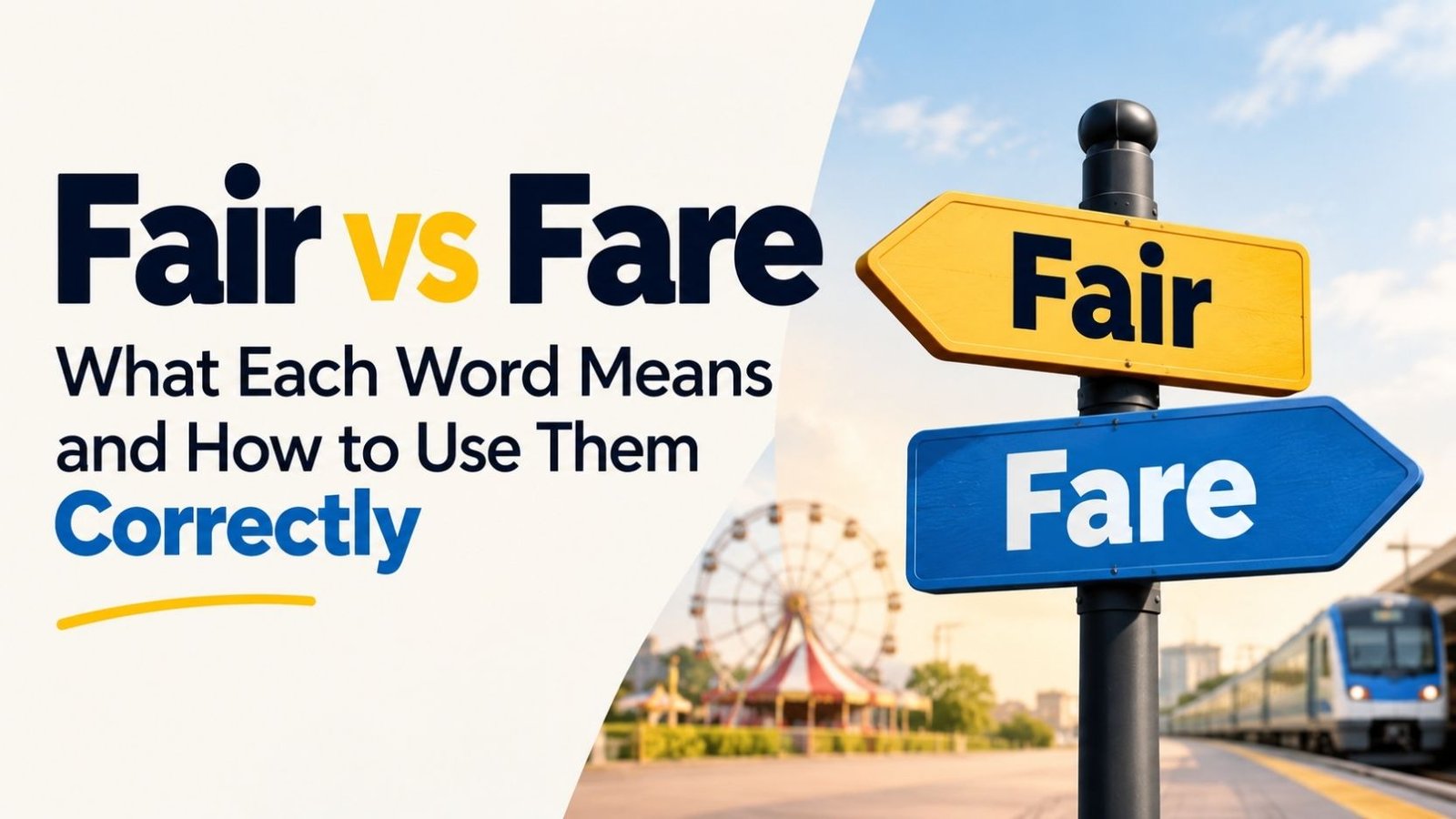
Fair and fare sound exactly the same, but they mean completely different things. Fair is usually an adjective that means just, reasonable, or light in color. Fare is usually a noun or verb connected to money, travel, or how someone is doing. Confusing the two is one of the most common English homophone mistakes, especially in phrases like “how did you fare” and “that’s not fair.”
This mix-up happens because fair and fare are homophones, words that sound alike but carry different meanings and spellings. Getting them right matters in writing, since spell check will not catch the error if you use the wrong one in a grammatically correct sentence. Understanding the difference helps you write clearly, avoid embarrassing mistakes, and sound more polished in everyday communication.
Fair vs Fare: Quick Definition
Fair is most often an adjective meaning right, just, or acceptable. It can also mean light colored, as in fair skin, or refer to an event, like a county fair. Fare is most often a noun meaning the money paid for a trip, like a taxi fare. It is also a verb meaning to get along or perform in a situation, as in “How did you fare on the exam?”
| Word | Main Part of Speech | Core Meaning | Example |
| Fair | Adjective, noun | Just, reasonable, light colored, or an event | That decision was fair. |
| Fare | Noun, verb | Cost of travel, or to get along | The bus fare went up. |
Read More: Vinal Vs Vinyl
Fair Meaning
Fair carries several distinct meanings depending on context. Keeping them separate helps you choose the right sense quickly.
Meaning 1: Just or reasonable: This is the most common use. It describes something treated equally or decided without bias.
Example: The referee made a fair call.
Meaning 2: Light in color: Fair describes pale skin or light colored hair.
Example: She has fair skin that burns easily in the sun.
Meaning 3: An event or exhibition: Fair can be a noun for a gathering, such as a county fair, job fair, or book fair.
Example: We visited the county fair last weekend.
Meaning 4: Average or acceptable: Fair can describe something that is decent but not excellent.
Example: His performance was fair, not outstanding.
Meaning 5: Fair as a verb (rare): In sailing and shipbuilding, “to fair” means to smooth or align a surface. This use is specialized and uncommon in everyday English.
Fare Meaning
Fare has fewer meanings than fair, but they are just as important to keep straight.
Meaning 1: The cost of travel: Fare is the price paid to ride a bus, train, taxi, or plane. Example: The train fare increased this year.
Meaning 2: A paying passenger: In taxi driving, a fare can also refer to the passenger.
Example: The driver picked up a fare downtown.
Meaning 3: To get along or perform (verb): Fare as a verb describes how someone or something is doing in a situation.
Example: How did you fare during the storm?
Meaning 4: Food, in older or literary use: Fare can describe food or a meal, especially in phrases like simple fare.
Example: The restaurant serves traditional English fare.
Fair vs Fare: Grammar and Part of Speech
Fair functions mainly as an adjective, though it also works as a noun and, rarely, a verb. Fare functions mainly as a noun and a verb, but it does not function as an adjective.
| Word | Adjective | Noun | Verb |
| Fair | Yes, common | Yes, event | Rare, technical |
| Fare | No | Yes, common | Yes, common |
This distinction explains why “how did you fair” is incorrect. Fair cannot function as a verb in that sentence structure. The correct form is “how did you fare,” using fare as a verb meaning to get along or perform.
How Did You Fare vs Fair
This is one of the most searched confusions between these two words, so it deserves its own explanation.
“How did you fare” is correct. Fare here works as a verb meaning how someone performed or managed in a situation.
Example: How did you fare on your driving test?
“How did you fair” is incorrect. Fair is not a verb with this meaning, so it cannot replace fare in this sentence.
💡 Tip: If you can replace the word with “get along,” “perform,” or “manage,” use fare, not fair.
Fair vs Fare vs Faire vs Fayre
Two additional spellings sometimes appear alongside fair and fare, and both cause confusion.
Faire: is the French word for “to make” or “to do.” It is not an English word, though it appears in English through French loanwords like “laissez faire,” a term used in economics to describe minimal government intervention. Faire should never be used as a substitute for fair or fare in standard English sentences.
Fayre: is an older, chiefly British spelling of fair, used specifically for the event meaning. You may see it on signage for a “Christmas Fayre” or “Food Fayre” in the United Kingdom. It is a stylistic variation, not a separate word, and it is rarely used in American English.
| Word | Meaning | Usage |
| Fair | Just, light colored, or an event | Standard English |
| Fare | Travel cost or to get along | Standard English |
| Faire | To make or do | French, seen in loanwords |
| Fayre | An event, old spelling of fair | British, decorative signage |
Read More: Ensure or Insure
Fair vs Fare Pronunciation
Fair and fare are pronounced identically in American English: /fɛr/. Both words rhyme with “hair,” “bear,” and “chair.” There is no pronunciation clue that tells a listener which word is meant. Context alone determines the correct meaning, which is exactly why spelling matters so much in writing.
Origin of Fair and Fare
Fair comes from the Old English word “fæger,” meaning beautiful or pleasant. Over time, its meaning shifted toward justice and evenhandedness, while still keeping the sense of light or pleasing appearance in phrases like fair skin. The “event” meaning of fair developed separately, from the Latin “feria,” meaning holiday or market day, through Old French “feire.”
Fare comes from the Old English word “faran,” meaning to travel or to get along. This origin explains both major modern meanings: the cost of travel and the sense of managing or performing in a situation. Both senses grew from the same root idea of a journey, literal or figurative.
Fair vs Fare: Examples in Sentences
Seeing both words in full sentences makes the difference easier to remember.
- The judge’s decision was fair to both sides.
- The taxi fare from the airport cost forty dollars.
- She has fair hair and blue eyes.
- How did the new employee fare during training?
- We are going to the state fair this weekend.
- The restaurant offers simple, affordable fare.
- It would not be fair to change the rules now.
- Bus fare increases start next month.
Common Mistakes With Fair and Fare
❌ Incorrect: How did you fair on the test?
✅ Correct: How did you fare on the test.
Fare is the verb form here, meaning to perform or manage.
❌ Incorrect: The bus fair went up again.
✅ Correct: The bus fare went up again.
Fare refers to the cost of travel, not fairness.
❌ Incorrect: That’s not fare, you went first last time.
✅ Correct: That’s not fair, you went first last time.
Fair means just or reasonable in this context.
❌ Incorrect: We visited the county fare.
✅ Correct: We visited the county fair.
Fair is the correct word for the event, not fare.
Fair vs Fare: Synonyms and Related Words
| Word | Meaning | Difference From Fair or Fare |
| Just | Reasonable, unbiased | Closer synonym for fair in the justice sense |
| Impartial | Not favoring one side | Formal synonym for fair |
| Cost | Price of something | Broader than fare, not limited to travel |
| Toll | A fee paid to use a road | Related to fare, but specific to roads |
| Cope | To manage a difficult situation | Close synonym for fare as a verb |
Read More: Afterward vs Afterwards
Fair Warning, Fair Share, Fair Weather, and Similar Phrases
Several common expressions use fair rather than fare, since they rely on the “just” or “reasonable” meaning.
- Fair warning: means a clear, honest heads-up before something happens.
- Fair share: means the portion someone is entitled to.
- Fair weather: describes calm, pleasant conditions, and a “fair weather friend” is someone loyal only when things are easy.
- Fair game: describes something considered acceptable to criticize, pursue, or use.
- Fair amount: describes a reasonably large quantity.
None of these expressions use fare, since none of them involve travel cost or the sense of getting along.
Frequently Asked Questions
What does fair vs fare mean?
Fair usually means just, reasonable, or light colored, or refers to an event. Fare usually means the cost of travel or how someone performed in a situation.
How did you fair or fare, which is correct?
Fare is correct. “How did you fare” uses fare as a verb meaning to get along or perform.
Is fair vs fare the same in pronunciation?
Yes, fair and fare are pronounced exactly the same in American English, as /fɛr/.
What is the difference between fair and fayre?
Fayre is an older British spelling of fair, used specifically for events like fairs and festivals. It is not used in standard American English.
Is faire the same as fair or fare?
No, faire is a French word meaning to make or to do. It appears in English loanwords like laissez-faire, but it is not interchangeable with fair or fare.
What part of speech is fare?
Fare is mainly a noun, meaning the cost of travel, and a verb, meaning to get along or perform. It is not an adjective.
What part of speech is fair?
Fair is mainly an adjective, meaning just or light colored. It is also a noun for an event, and rarely a technical verb in shipbuilding.
Can fair mean food?
No, fair does not mean food. Fare, not fair, carries that meaning, as in “simple fare” describing a basic meal.
Is it fair share or fare share?
It is fair share, meaning a just or reasonable portion of something.
Is it fair amount or fare amount?
It is fair amount, meaning a reasonably large quantity of something.
Final Thoughts on Fair vs Fare
Fair and fare sound identical but belong to different word families entirely. Fair connects to justice, fairness, appearance, and events, while fare connects to travel, cost, and how someone manages a situation. The phrase “how did you fare” is the one people search for most often, and remembering that fare works as a verb here solves that confusion permanently.
The easiest way to keep these words straight is to think about meaning rather than sound, since sound will never help you choose correctly. If the sentence is about justice, light color, or an event, use fair. If the sentence is about travel cost, a passenger, or how someone performed, use fare. With that simple test, mixing up fair vs fare becomes far less likely.

Danish Raza is the author of Grammavio, a trusted resource for simple and easy-to-understand English grammar guides. He creates helpful content covering grammar rules, word meanings, vocabulary, and common grammar mistakes to help readers improve their English skills.



One Comment