
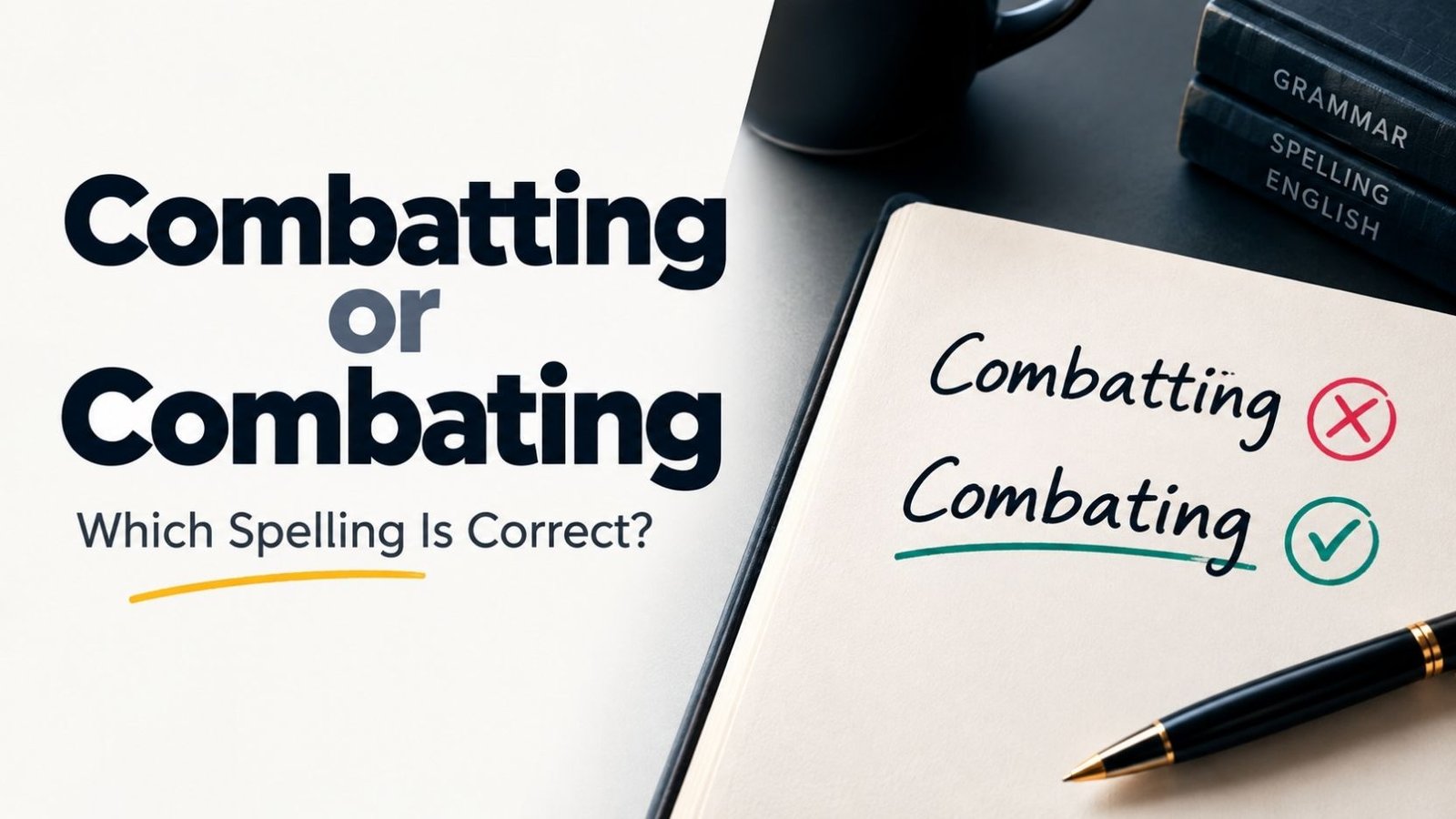
Both spellings are correct. Combating (one T) is the more common and more widely preferred form, especially in American English. Combatting (two Ts) is an accepted variant that major dictionaries also list.
The difference comes from how English doubles consonants when adding endings like ing. The verb combat can be stressed on either syllable, so both spellings developed. If you want one safe choice for US writing, use combating, and stay consistent throughout your document.
Quick Answer: Combatting or Combating?
| Spelling | Status | Best for |
| Combating | Preferred, more common | US writing, news, business, academic work |
| Combatting | Accepted variant | Writers who follow a style guide or publication that uses it |
💡 Tip: Pick one spelling and use it everywhere in the same piece. Mixing them looks like an error.
The same logic applies to the past tense. Combated and combatted are both accepted, and combated is generally the preferred form.
Read More: Lens or Lense
Why Are There Two Spellings?
The two spellings come from a common English spelling rule. When a verb ends in a single consonant after a single vowel, you often double the consonant before adding ing. But this only happens when the last syllable is stressed.
Here is how the rule works with common verbs:
- Begin: is stressed on the second syllable, so it becomes beginning.
- Target: is stressed on the first syllable, so it becomes targeting.
- Format: is stressed on the second syllable, so it becomes formatting.
- Benefit: is stressed on the first syllable, so it becomes benefiting.
Combat sits in the middle. The noun is usually stressed on the first syllable. The verb can be stressed on either the first or the second. If you stress the second syllable, the T doubles and you get combatting. If you stress the first, the T stays single and you get combating.
Other words behave the same way. Focusing and focussing are both seen, for example, and so are benefiting and benefitting.
Combating Meaning and Definition
Combating means actively fighting against something harmful or unwanted. The “something” is usually a problem, not a person. In everyday writing, it often means working to reduce, stop, or prevent something bad.
Here is a simple breakdown:
- Meaning: Fighting, resisting, or working against a problem
- Part of speech: Verb, in its present participle form (the -ing form)
- Base verb: Combat
- Common partners: Disease, crime, poverty, inflation, climate change, burnout, loneliness
The word can also describe real fighting, as in a battle. But in modern writing it most often describes efforts against a problem.
How to Use Combating in a Sentence
Combating works like any other -ing verb. It can follow a helping verb, or it can act as a noun phrase (a gerund) at the start of a sentence.
- The city is combating rising housing costs.
- Combating misinformation requires clear and honest reporting.
- She started a daily walking habit to combat burnout.
Notice that the word is usually followed by a problem. You combat something. You do not simply “combat.”
Verb Forms of Combat
Here are all the forms in one place.
| Form | Preferred spelling | Accepted variant |
| Base form | combat | none |
| Third person singular | combats | none |
| Present participle | combating | combatting |
| Past tense and past participle | combated | combatted |
⚠️ Common mistake: Writing “combatted” in one paragraph and “combating” in the next. If you choose the doubled form, use it for both the past tense and the ing form. If you choose the single form, do the same.
Combatting or Combating in American English
In American English, combating is the stronger choice. Major American dictionaries, such as Merriam Webster, list combating first and treat combatting as a variant. Newspapers, government websites, and university publications also tend to use the single T form.
Many US style guides defer to a standard dictionary. If you write for a publication with its own style guide, check it. AP style, for instance, follows its own reference dictionary, so look at the current AP Stylebook entry if you need to confirm it for professional work.
Read More: In Process or In Progress
Combatting or Combating in UK, Canada, and Australia
You may have heard that one spelling is British and the other is American. That is not quite true. Both spellings appear in all of these regions.
- UK: Combating is common. Combatting also appears, and dictionaries accept it.
- Canada: Canadian writing follows a mix of British and American habits. Both forms are acceptable, and combating is the safer pick.
- Australia: Both forms are accepted. Combating is more common in published writing.
The practical advice is the same everywhere. Use combating unless your style guide says otherwise.
💡 Note: Official names of laws, programs, and organizations keep their original spelling. If a title uses combatting, copy it exactly as written, even if your own text uses combating.
How to Pronounce Combating
Combating has three syllables. Most Americans say it with the stress on the second syllable.
- Simple pronunciation: kum BAT ing
- IPA (common US form): /kəmˈbætɪŋ/
- Alternate stress: KOM buh ting, with the stress on the first syllable
The alternate stress pattern is exactly why both spellings exist. A speaker who stresses the second syllable would naturally double the T in writing. A speaker who stresses the first syllable would not.
Where Does the Word Combat Come From?
Combat entered English through French. It comes from the French verb combattre, which goes back to Late Latin. The Latin parts are generally explained as a prefix meaning “with” or “together,” plus a verb meaning “to beat.” So the word originally pictured two sides beating against each other.
Over time, the sense widened. It moved from physical fighting to any struggle against an opponent, and later to struggles against problems like disease or crime.
Similar Words and Synonyms
Combating has many everyday synonyms. They are not identical, so choose based on tone.
| Word | Meaning | How it differs |
| Fighting | Struggling against something | Plain and common, works in almost any context |
| Battling | Fighting hard over time | Suggests a long, tough effort |
| Tackling | Dealing with a problem directly | More practical and less dramatic |
| Countering | Acting against something | Suggests a direct response to a threat |
| Resisting | Standing against something | Focuses on not giving in |
| Addressing | Dealing with an issue | Milder, often used in formal writing |
Combating sounds a little more formal than fighting. It is common in news, policy, and health writing.
Common Phrases With Combating
Writers often pair combating with large public topics and personal wellbeing topics. Some typical examples:
- Combating climate change
- Combating inflation
- Combating loneliness
- Combating burnout
- Combating misinformation
- Combating jet lag
The spelling rule is the same for each phrase. You can use either form, though the single T form is the standard choice.
Read More: Ambiance vs Ambience
Common Mistakes to Avoid
Mixing spellings in one document
❌ Incorrect: The group has combatted poverty and is now combating hunger.
✅ Correct: The group has combated poverty and is now combating hunger.
Writing three Ts
❌ Incorrect: Combattting
✅ Correct: Combatting or combating
Using “combat” as if it were the ing form
❌ Incorrect: The team is combat the problem.
✅ Correct: The team is combating the problem.
Treating it as a spelling error
Some people mark combatting as wrong. It is not wrong. It is a recognized variant, even if combating is more common.
Frequently Asked Questions
Is it combatting or combating?
Both are correct. Combating is more common and generally preferred, while combatting is an accepted variant.
Is combating a word?
Yes. It is the present participle of the verb combat.
Which spelling does American English prefer?
American English generally prefers combating, with combatting listed as a variant.
Is combatting British spelling?
Not exactly. Both spellings appear in British and American writing. The choice is not strictly tied to a country.
What is the past tense of combat?
The past tense is combated or combatted. Combated is generally preferred.
Is combating a noun or a verb?
It is a verb form. It can also act like a noun in a sentence when it is used as a gerund, such as “Combating fraud is difficult.”
How do you pronounce combating?
Most Americans say kum BAT ing, with the stress on the second syllable.
What does combating mean in simple terms?
It means fighting against a problem or harmful thing to reduce it or stop it.
What is a good synonym for combating?
Fighting, tackling, battling, and countering are all common synonyms.
Conclusion
Combating and combatting are both correct spellings of the ing form of the verb combat. The difference comes from stress. If the last syllable is stressed, the T can double. If the first syllable is stressed, it stays single. Dictionaries list combating as the more common form and combatting as an accepted variant.
For most readers, the simple answer is best. Use combating, keep your spelling consistent, and follow your publication’s style guide if it says otherwise. When you quote an official title or name, copy its spelling exactly as written.

Danish Raza is the author of Grammavio, a trusted resource for simple and easy-to-understand English grammar guides. He creates helpful content covering grammar rules, word meanings, vocabulary, and common grammar mistakes to help readers improve their English skills.



One Comment