
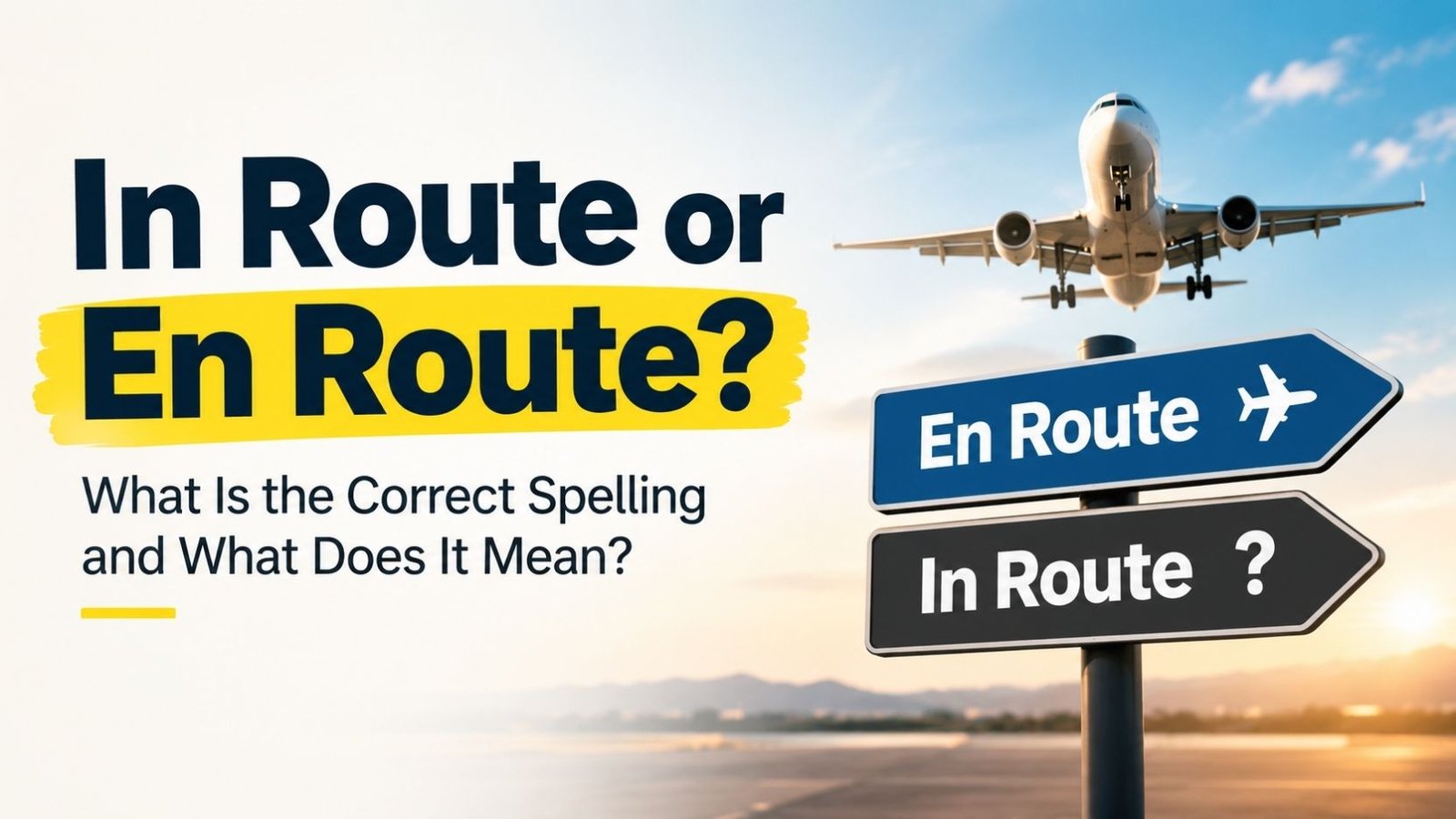
The correct spelling is en route, not “in route.” En route is a French loanword that English speakers use as an adverb or adjective meaning “on the way” or “while traveling toward a destination.” You will see it in travel updates, shipping notifications, sports commentary, and everyday conversation. “In route” is a common misspelling that shows up often in casual writing and search queries, but it is not a standard English phrase with its own separate meaning in most contexts.
Understanding this difference matters because “en route” appears constantly in real life, from flight status boards to delivery tracking pages. Getting it right makes your writing look polished and avoids a small but noticeable error. There is one important exception worth knowing about too: American football actually does use “in route” as genuine terminology, and we will explain exactly where that fits in below.
Quick Answer
If you are asking, “Is it in route or en route?” the short answer is this:
- En route: is correct for describing travel, movement, or something happening on the way to a destination.
- In route: is generally considered a misspelling of “en route,” except in one specific context: American football, where “in route” refers to a type of pass route.
💡 Tip: When in doubt, picture the French phrase. “En route” literally breaks down to “en” (in or on) plus “route” (road or way). Keeping the two words together, with “en” first, is the version every major dictionary recognizes.
Read More: Vinal Vs Vinyl
What Does En Route Mean?
En route means on the way, along the way, or while traveling from one place to another. It works as an adverb, describing how or when something happens, and it can also function as an adjective. Merriam-Webster defines it simply as “on or along the way.”
Here is what that looks like in practice:
- As an adverb: “She read a book en route.” (This tells you when or how the reading happened, during the journey.)
- As an adjective: “The plane experienced turbulence en route to Chicago.” (This describes the plane’s state, being in transit.)
The phrase always signals movement toward something. It does not describe arrival, and it does not describe the starting point. It sits specifically in the middle of a journey.
Is It In Route or En Route? A Direct Explanation
“In route” is not the accepted spelling for describing travel or transit. English borrowed the phrase directly from French, and the French version keeps “en” as the first word, not “in.” Because “en” and “in” sound similar and even carry related meanings across languages, many English speakers naturally slip and write “in route” instead.
This is an example of what linguists sometimes call an eggcorn: a phrase that gets misheard or misspelled because the incorrect version still sounds plausible and almost makes sense. “In route” seems logical in English, since “in” often pairs with location words. But the phrase was never built that way. It came into English as a fixed French borrowing, and dictionaries have preserved that original spelling ever since.
So if your sentence describes a person, vehicle, package, or plan that is currently traveling toward a destination, “en route” is the spelling to use.
Grammar: Part of Speech and Sentence Structure
En route functions primarily as an adverb, though it can also work as an adjective depending on where it sits in a sentence.
As an adverb: it modifies a verb and tells you when or how something happens:
- “We stopped for gas en route.”
- “He called his manager en route to the airport.”
As an adjective: it describes a noun directly:
- “The en route delays pushed back our arrival.”
- “Crews handled the en route repairs quickly.”
One grammar detail worth noting: en route does not change form. It has no plural version, no past tense, and no comparative form. It stays exactly the same whether you are talking about one traveler or a hundred, one trip or many.
| Feature | Detail |
| Part of speech | Adverb or adjective |
| Plural form | None, stays the same |
| Verb forms | None, it is not a verb |
| Typical position | After the subject and verb, or before a destination phrase |
| Common pairing | “en route to” plus a destination |
How to Pronounce En Route
Because en route comes from French, its pronunciation in English blends the original French sound with a more anglicized version that most American speakers use comfortably.
American English pronunciation: ahn-ROOT or en-ROOT
French-influenced pronunciation: ahn-ROOT, with a nasal “ahn” sound
Dictionary.com lists both the fully anglicized pronunciation and the closer-to-French version, rendering it as “ahn root, en, ahn root” depending on how closely a speaker wants to follow the original French. In everyday American speech, most people simply say “ahn ROOT” or “en ROOT,” placing stress on the second syllable.
You do not need to master French pronunciation to use this phrase correctly. Either common American version will be understood clearly in conversation.
Origin and Etymology of En Route
En route comes directly from French, where it literally means “on the road” or “on the way.” The word “route” traces back to the Old French word “rute,” meaning road.
According to Merriam-Webster, the etymology of en route is French, and its first known use in English dates back to 1779. English speakers adopted the phrase during a period when French vocabulary heavily influenced English travel, military, and diplomatic language. Many similar French borrowings entered English around the same era, including phrases like “en masse” and “en route” itself, which kept their French structure intact rather than being fully translated.
This origin explains why the spelling has stayed fixed for more than two centuries. Dictionaries treat borrowed phrases like this one as fixed units, meaning the original word order and spelling get preserved even as pronunciation slowly adapts to English speech patterns.
En Route vs In Route: A Side-by-Side Comparison
| Version | Standard Usage | Meaning |
| En route | Correct in nearly all everyday, travel, and written contexts | On the way, while traveling toward a destination |
| In route | Considered a common misspelling in general usage | Not a standard phrase, except in American football terminology |
| On route | Used occasionally in British English as an informal variant | Similar meaning to “en route,” but less standard |
| Enroute | Sometimes seen as one word, especially in casual or business writing | Same meaning as “en route,” though dictionaries generally list the two-word form as standard |
Read More: Dreamed or Dreamt
When “In Route” Is Actually Correct: American Football
There is one clear exception to everything above, and it explains why “in route football” shows up so often in searches.
In American football, an “in route” is a specific type of pass route. The receiver runs downfield and then cuts sharply toward the middle of the field at a defined depth, often around ten to twelve yards. This route is also called a dig route, and it is a real, commonly used term among coaches, players, and sports commentators.
In this context, “in route” is two separate words used as football terminology, not a misspelling of “en route.” The “in” refers to the direction of the cut, toward the inside of the field, and “route” refers to the receiver’s running pattern.
✅ Correct football usage: “The receiver ran a perfect in route to beat the linebacker.”
❌ Incorrect travel usage: “We stopped for gas in route to the game.” (This should be “en route.”)
So context decides everything here. If you are talking about football strategy, “in route” is legitimate. If you are talking about travel, shipping, or being on the way somewhere, “en route” is the spelling you want.
En Route in a Sentence
A few natural examples show how flexible the phrase is across different situations:
- “The ambulance radioed ahead while en route to the hospital.”
- “Our flight had a short layover en route to Tokyo.”
- “The package is currently en route and should arrive by Friday.”
- “He practiced his presentation en route to the meeting.”
Notice how the phrase almost always pairs with a preposition like “to,” pointing toward a specific destination, or it stands alone right after a verb to describe ongoing travel.
En Route in Shipping and Delivery Tracking
Search interest around phrases like “weather in route” and “en route to DHL ecommerce or awaiting processing” points to a very practical, everyday use of this phrase: package tracking.
When a shipping status reads “en route,” it means the package has left its origin point and is currently moving toward the next stop or the final delivery address. It has not arrived yet, but it is actively in transit rather than sitting in a warehouse waiting to be processed. A status like “awaiting processing,” by contrast, means the package has not yet started its journey. Understanding this distinction helps when you are tracking a delivery and trying to estimate arrival time.
Common Mistakes with En Route
Here are the mix-ups people run into most often, along with the correct versions.
❌ Incorrect: “I’ll call you when I’m in route.”
✅ Correct: “I’ll call you when I’m en route.”
❌ Incorrect: “The team is inroute to the airport.”
✅ Correct: “The team is en route to the airport.”
❌ Incorrect: “We hit traffic on route to the concert.” (acceptable informally in British English, but not standard in American English)
✅ Correct (American English): “We hit traffic en route to the concert.”
⚠️ Common mistake: Writing “en route” as one solid word, “enroute,” in formal writing. While this variant does appear in some casual and business contexts, most major dictionaries list the two-word spelling as the standard form.
Is “Enroute” a Word?
Yes, “enroute” appears as a one-word variant in everyday and business writing, and some dictionaries acknowledge it. However, the two-word form “en route” remains the standard, dictionary-preferred spelling across major English references. If you are writing something formal, academic, or professional, “en route” with a space is the safer and more widely recognized choice.
En Route vs On Route: British English Usage
In British English, some speakers use “on route” as a casual alternative to “en route,” particularly in spoken conversation. It is not considered fully standard, but it appears often enough that it is worth mentioning if you are writing for a British audience or researching this phrase’s regional variations. American English does not typically use “on route” at all; “en route” remains the expected form on both sides of the Atlantic when writing formally.
Synonyms and Related Words
Several phrases overlap closely with “en route,” though each carries a slightly different shade of meaning.
| Word or Phrase | Meaning | Difference from En Route |
| In transit | Currently moving between two points | Slightly more formal, common in shipping and logistics |
| On the way | Informal, everyday equivalent | Less formal, used in casual speech far more often |
| Traveling | General movement from place to place | Broader term, not tied to a specific destination |
| Underway | In progress, moving forward | Often used for journeys, projects, or processes more broadly |
“En route” tends to sound slightly more formal or precise than “on the way,” which is why it shows up often in official travel updates, news reports, and shipping notifications rather than in relaxed daily conversation.
Read More: Lie Down or Lay Down
En Route as a Brand or Product Name
You may also encounter “en route” used as a name for products that have nothing to do with grammar, including jewelry lines, wine labels, and clothing collections. In these cases, brands are borrowing the phrase’s meaning, the idea of movement, travel, or being on a journey, as a marketing choice rather than as a grammar term. If you are searching for a specific product, store policy, discount code, or review of a particular brand, that information depends on the individual company and is worth checking directly on that brand’s official website rather than through general dictionary or grammar resources.
Frequently Asked Questions
Is it “in route” or “en route”?
“En route” is the correct spelling for describing travel or being on the way to a destination. “In route” is a common misspelling, except in American football, where it refers to a specific pass route.
What does “en route” mean?
It means on the way, or while traveling toward a destination. It describes something happening during a journey, not before it starts or after it ends.
How do you pronounce “en route”?
Most American speakers say “ahn ROOT” or “en ROOT,” with stress on the second syllable. The pronunciation reflects its French origin.
Is “en route” a noun, verb, or adjective?
It functions as an adverb or adjective. It is never used as a noun or a verb.
Where does “en route” come from?
It comes from French, first recorded in English use in 1779. The French phrase literally means “on the road.”
Is “enroute,” written as one word, correct?
It appears in some casual and business writing, but major dictionaries treat the two-word spelling, “en route,” as the standard form.
What is an “in route” in football?
It is a receiver’s pass route that cuts toward the middle of the field, also known as a dig route. This is a legitimate football term, separate from the travel phrase “en route.”
Is “on route” correct?
“On route” appears in informal British English but is not considered standard, especially in American English. “En route” is the safer choice in formal writing.
What does “en route” mean on a shipping tracker?
It means the package has left its origin and is currently moving toward its next stop or final destination, rather than still waiting to be processed.
Can “en route” be used at the start of a sentence?
Yes. For example: “En route to the office, she stopped for coffee.” This placement is grammatically correct and common in both spoken and written English.
Conclusion
“En route” is the correct, dictionary-recognized spelling for describing travel or movement toward a destination, borrowed directly from French and used in English since the late eighteenth century. “In route” is generally a misspelling of this phrase, with one clear exception: American football, where “in route” names a specific type of pass route and has its own legitimate meaning entirely separate from travel.
Whether you are tracking a package, describing a flight delay, writing about a football play, or simply trying to spell a common phrase correctly, knowing this distinction helps your writing read as accurate and polished. When you mean “on the way somewhere,” reach for “en route.” When you are talking about a receiver cutting toward the middle of the field, “in route” is exactly right.

Danish Raza is the author of Grammavio, a trusted resource for simple and easy-to-understand English grammar guides. He creates helpful content covering grammar rules, word meanings, vocabulary, and common grammar mistakes to help readers improve their English skills.


