
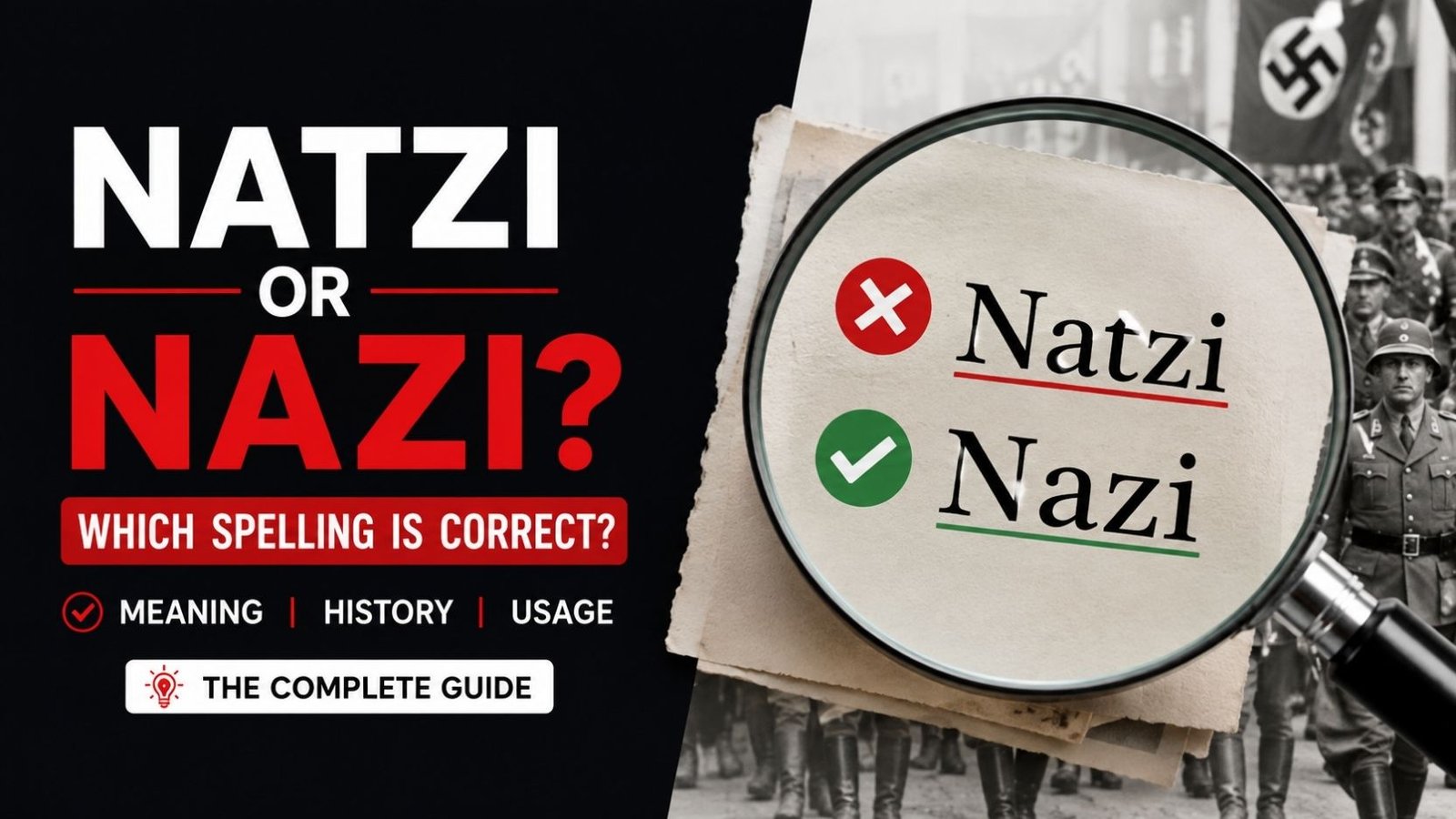
The correct spelling is Nazi. Natzi is a common misspelling that happens because of how the word sounds when spoken aloud. Many people type it the way they hear it, which naturally leads to the wrong letters. If you have ever paused mid-sentence wondering which version to use, you are not alone.
Understanding this spelling matters for more than grammar alone. Nazi refers to a specific historical political party and ideology from twentieth-century Germany. Getting the spelling right helps you write clearly, search for accurate information, and avoid confusion in academic, journalistic, or everyday writing.
What Does Nazi Mean?
Nazi is a shortened form of the German word Nationalsozialist, which translates to National Socialist. It refers to a member of the National Socialist German Workers’ Party, the political party led by Adolf Hitler that ruled Germany from 1933 to 1945.
The term is used in three main ways today:
- As a noun describing a member or supporter of the Nazi Party
- As an adjective describing anything connected to that party or its ideology, such as Nazi Germany or Nazi propaganda
- As an informal, often critical label for someone seen as extremely rigid, controlling, or authoritarian in an unrelated context, such as the phrase soup Nazi from popular culture
The first two meanings are historical and political. The third is informal and should be used carefully, since it references a real and deeply harmful historical movement.
See More: Thats Vs That’s
Natzi Or Nazi: Why The Confusion Happens
The spelling mix-up comes down to pronunciation. When English speakers hear the word Nazi spoken quickly, the “ts” sound in the middle can feel like it belongs after an added letter, leading some writers to insert a “t” that does not exist in the correct spelling.
Here is a simple way to remember it:
| Spelling | Status | Why |
| Nazi | Correct | Matches the original German shortening of Nationalsozialist |
| Natzi | Incorrect | A phonetic misspelling based on how the word sounds |
There is no dictionary, encyclopedia, or academic source that lists Natzi as an accepted alternate spelling. It is simply an error.
Nazi: Grammar And Part Of Speech
Nazi functions as both a noun and an adjective in English.
As a noun, it refers to a person:
- “He was a Nazi during the war.”
- “Historians study how ordinary citizens became Nazis.”
As an adjective, it describes something related to the party or era:
- “Nazi Germany invaded Poland in 1939.”
- “The museum displays Nazi propaganda from the 1930s.”
Because Nazi refers to a specific historical and political identity, it is capitalized in standard English writing, just like other proper nouns and their adjective forms, such as American or Soviet.
Nazi Plural Form
The plural of Nazi is Nazis. No apostrophe is needed to form the plural, since Nazi is a regular noun.
- Incorrect: Nazi’s ruled Germany.
- Correct: Nazis ruled Germany.
The apostrophe version, Nazi’s, is only correct when showing possession, such as “the Nazi’s uniform” referring to something belonging to one Nazi.
How To Pronounce Nazi
Nazi is pronounced NAHT see in English, with the stress on the first syllable. In the International Phonetic Alphabet, it is written as /ˈnɑːtsi/.
A few pronunciation notes:
- The first syllable rhymes with “hot,” not with “hat” or “day”
- The “z” is pronounced like “ts,” similar to the end of the word “cats”
- American and British English pronounce the word the same way, since it comes directly from German rather than evolving separately in each dialect
This pronunciation is also part of why the misspelling Natzi appears so often. The “ts” sound naturally suggests a “t” to many English speakers, even though the correct spelling only uses a “z.”
Origin Of The Word Nazi
The word Nazi comes from German. It is a shortened, informal version of Nationalsozialist, meaning National Socialist. German speakers commonly created short forms by combining the first syllables of longer compound words, and Nazi followed that same pattern.
The National Socialist German Workers’ Party used the full name Nationalsozialistische Deutsche Arbeiterpartei. The abbreviated term Nazi became widely used both inside and outside Germany during the 1930s and 1940s to refer to the party, its members, and its ideology.
Interestingly, the term was originally used somewhat dismissively before it became the standard historical label. Over time, it lost that informal edge and became the accepted term used in history books, journalism, and everyday speech.
See More: Brite Vs Bright
Nazi Germany: What The Term Refers To
Nazi Germany refers to the period between 1933 and 1945 when the Nazi Party controlled the German government under Adolf Hitler. During this time, the regime:
- Established a totalitarian dictatorship
- Enforced racist and antisemitic laws
- Carried out the Holocaust, the systematic murder of six million Jewish people and millions of others
- Initiated World War II in Europe through the invasion of Poland in 1939
The regime ended in 1945 with Germany’s surrender and Hitler’s death. This historical context is important whenever the word Nazi or Nazi Germany appears in writing, since the term carries significant historical weight.
Nazi Symbols And Nazi Flag
The Nazi Party used specific visual symbols that remain historically documented today.
- Nazi flag: A red flag featuring a white circle with a black swastika in the center. This flag became the official state flag of Germany during the Nazi era.
- Nazi symbol: The swastika, an ancient symbol from multiple cultures, was adopted and repurposed by the Nazi Party as its primary emblem.
- Nazi eagle: An eagle holding a wreath containing a swastika, used as an official state emblem alongside the flag.
- Nazi SS: The Schutzstaffel, commonly abbreviated SS, was a major paramilitary organization within the Nazi Party responsible for enforcing the regime’s policies, including the operation of concentration camps.
These symbols are documented in historical and educational contexts. In many countries, including Germany, public display of these symbols is restricted or illegal outside of educational, artistic, or historical settings.
Nazi Salute
The Nazi salute, sometimes called the Hitler salute, involved raising a straight right arm at an angle, often accompanied by the phrase “Heil Hitler.” It was adopted as a mandatory greeting within Nazi Germany and remains one of the most recognized symbols of the regime.
Neo-Nazi: A Related But Different Term
Neo-Nazi refers to individuals or groups in the present day who follow or promote Nazi ideology, despite the original party no longer existing. The prefix “neo” means new, so the term literally means “new Nazi.”
- Nazi refers to the historical party and its members between 1920 and 1945
- Neo-Nazi refers to modern individuals or groups who adopt similar beliefs today
Both spellings follow the same rule as the base word: Nazi with a “z,” never Natzi with a “t.”
Common Mistakes With Nazi Spelling And Usage
❌ Incorrect: Natzi, natzism, neo natzi
✅ Correct: Nazi, Nazism, neo-Nazi
❌ Incorrect: nazi Germany (lowercase)
✅ Correct: Nazi Germany (capitalized, since it is a proper adjective)
❌ Incorrect: The Nazi’s invaded Poland.
✅ Correct: The Nazis invaded Poland.
A quick memory tip: Nazi has no “t” in it at all. If you find yourself typing Natzi, pause and remove the extra letter before continuing.
Nazi vs Natzi: Quick Comparison Table
| Feature | Nazi | Natzi |
| Correct spelling | Yes | No |
| Found in dictionaries | Yes | No |
| Origin | Shortened from German Nationalsozialist | Phonetic misspelling |
| Recommended use | Always | Never |
Similar And Related Words
- Nazism: The noun form referring to the ideology and political system itself, rather than an individual member.
- Fascism: A broader political ideology involving dictatorial power and extreme nationalism. Nazism is often considered a specific form of fascism, though the two terms are not identical.
- Third Reich: Another historical term referring to Nazi Germany, meaning “Third Empire” in German.
Understanding these related terms helps clarify how Nazi fits into broader historical and political vocabulary.
See More: Input Or Imput
Frequently Asked Questions
Is it spelled Natzi or Nazi?
Nazi is the only correct spelling. Natzi is a common misspelling based on pronunciation.
Why do people write Natzi instead of Nazi?
Because the word is pronounced with a “ts” sound in the middle, some writers mistakenly add a “t” that does not appear in the correct spelling.
What does Nazi mean?
Nazi refers to a member of the National Socialist German Workers’ Party that ruled Germany from 1933 to 1945, or to anything connected to that party and its ideology.
Is Nazi a noun or an adjective?
Nazi can function as both. As a noun, it refers to a person or party member. As an adjective, it describes something related to the party, such as Nazi Germany.
What is the plural of Nazi?
The plural is Nazis, formed by simply adding an “s,” without an apostrophe.
How do you pronounce Nazi?
Nazi is pronounced NAHT see, with stress on the first syllable, written as /ˈnɑːtsi/ in the International Phonetic Alphabet.
What is the difference between Nazi and neo-Nazi?
Nazi refers to the historical party active between 1920 and 1945. Neo-Nazi refers to modern individuals or groups who follow a similar ideology today.
Where does the word Nazi come from?
It comes from German, as a shortened form of Nationalsozialist, meaning National Socialist.
Is Nazi capitalized?
Yes. Since it refers to a specific historical party and its members, Nazi is capitalized as a proper noun and proper adjective in standard English.
What is the Nazi symbol called?
The primary symbol associated with the Nazi Party is the swastika, which appeared on the Nazi flag and various party emblems.
Final Thoughts
Nazi is the correct spelling, and Natzi is simply a misspelling that comes from how the word sounds rather than how it is actually written. Remembering that the word contains a “z” and not a “t” will help you avoid the mistake in the future, whether you are writing a historical essay, a news article, or a casual message.
Beyond spelling, understanding what the term Nazi actually refers to gives your writing accuracy and context. It connects to a specific and well documented period of history, and using the word correctly, both in spelling and in meaning, shows respect for that historical weight while keeping your writing clear and grammatically correct.

Danish Raza is the author of Grammavio, a trusted resource for simple and easy-to-understand English grammar guides. He creates helpful content covering grammar rules, word meanings, vocabulary, and common grammar mistakes to help readers improve their English skills.



One Comment