
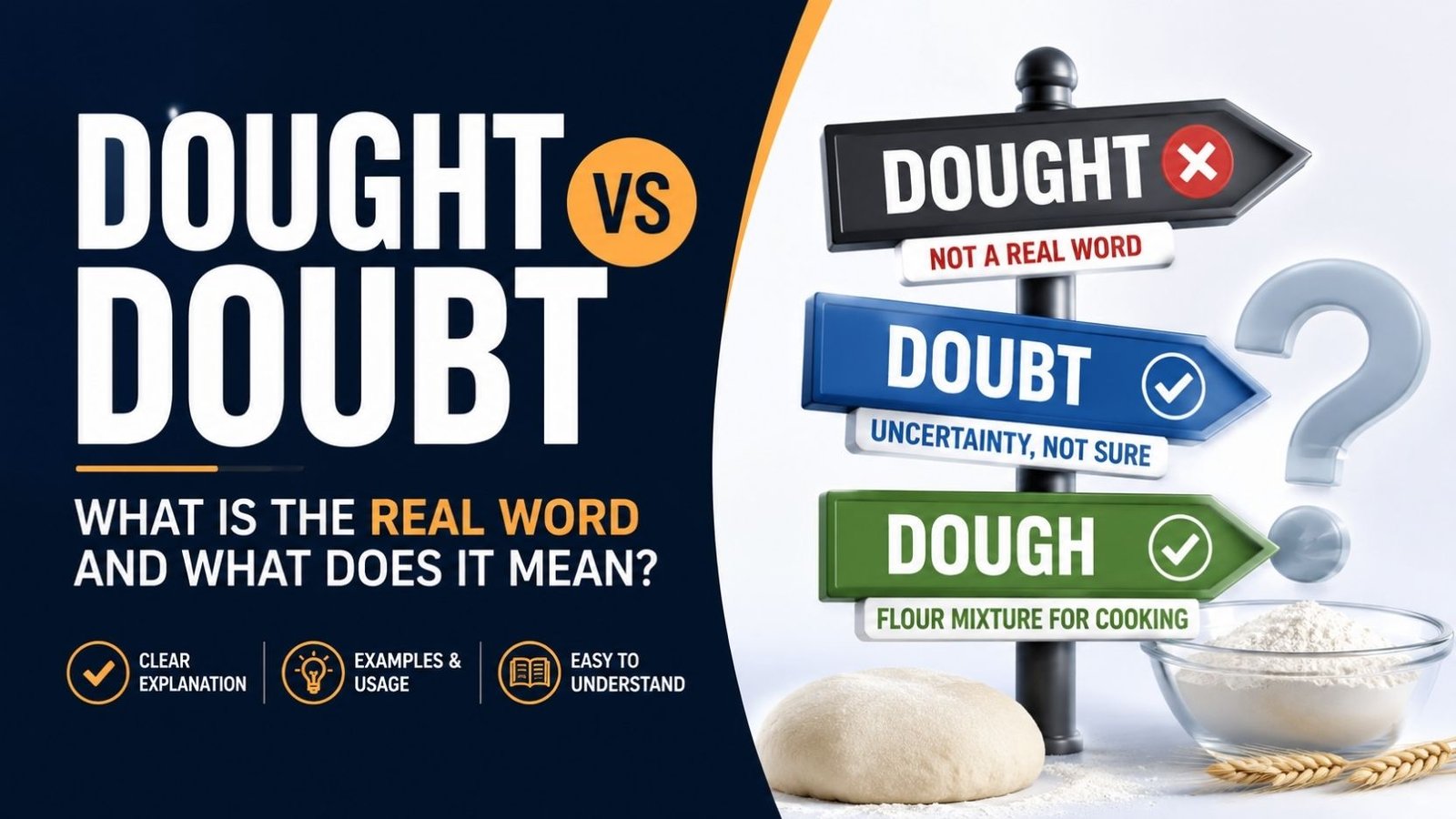
If you have typed “dought” into a search bar, you are not alone. It looks like it could be a word, but it is not one. Most people who type it actually mean one of two very different words: doubt or dough. This guide clears up the confusion and explains exactly which word you need.
Understanding this difference matters more than it seems. Doubt is a common word used in everyday conversation, law, and even a well-known TV series and band name. Dough is the word behind cookie dough, pizza dough, and sourdough bread. Mixing them up in writing can change your meaning completely or simply look like a spelling mistake.
Is Dought A Real Word?
No. Dought is not a standard English word. It does not appear in major dictionaries such as Merriam-Webster, Oxford, or Cambridge. It is a misspelling that shows up in two separate situations, depending on what the writer actually meant.
Situation 1: Dought instead of Doubt
Some people write “dought” when they mean doubt, as in “I have no dought about it.” This usually happens because doubt has a silent letter that trips people up, and the writer’s brain fills in a more phonetic-looking spelling instead.
Situation 2: Dought instead of Dough
Other people write “dought” when they mean dough, as in “cookie dought recipe” or “pizza dought.” This happens because dough also has an unusual spelling pattern, and dought feels like a natural but incorrect shortcut.
💡 Tip: If you are ever unsure which one you meant, ask yourself whether you are talking about uncertainty (doubt) or a food mixture of flour and liquid (dough). That question almost always settles it.
See More: Excited Or Exited
Dought Vs Doubt: Quick Comparison
| Word | Correct Spelling | Meaning | Example |
| Dought | Not a real word | Misspelling, usually meant as “doubt” or “dough” | Incorrect in any formal writing |
| Doubt | doubt | A feeling of uncertainty or lack of confidence | She had doubt about the plan. |
What Does Doubt Mean?
Doubt is a noun and a verb that describes a feeling of being unsure about something.
As a noun, doubt means uncertainty, hesitation, or a lack of full confidence in a fact, decision, or person.
- “There is some doubt about who left first.”
As a verb, to doubt means to feel unsure about something or to question whether it is true.
- “I doubt that the meeting will start on time.”
Both forms describe the same core idea: something is not fully settled in the speaker’s mind.
Doubt: Grammar and Part of Speech
Doubt can function as either a noun or a verb, and the sentence structure around it usually makes the part of speech clear.
| Form | Example | Function |
| Noun | “He expressed doubt about the results.” | Names the feeling of uncertainty |
| Verb | “I doubt she will call back.” | Describes the action of questioning something |
| Adjective (doubtful) | “The outcome looks doubtful.” | Describes something uncertain |
| Adverb (doubtfully) | “She answered doubtfully.” | Describes how an action was done |
As a verb, doubt is regular. Its forms are doubt, doubts, doubted, and doubting.
- Present: “I doubt it.”
- Past: “I doubted it.”
- Continuous: “I am doubting my choice.”
How to Pronounce Doubt
Doubt is pronounced daut, rhyming with “out” and “shout.”
The letter b in doubt is completely silent. This silent b is actually the main reason the dought misspelling happens so often, since the word sounds like it should be spelled without a b at all.
In IPA, doubt is written as /daʊt/. This pronunciation is the same in both American and British English.
See More: Seem Vs Seems
Where Does The Word Doubt Come From?
Doubt entered English from Old French doute, which came from Latin dubitare, meaning “to waver” or “to be uncertain.”
Interestingly, the silent b was not originally part of the English spelling. Scholars later added it back in during the 1500s to match the Latin root dubitare, even though English speakers had stopped pronouncing that sound centuries earlier. This is why doubt looks like it should rhyme with “about” phonetically, but the b stays silent.
Common Phrases That Use Doubt
Doubt appears in several everyday expressions. Each one has a slightly different shade of meaning.
No doubt
This phrase means “certainly” or “without question.”
- “No doubt, she worked hard for this.”
Benefit of the doubt
This means choosing to trust or believe someone, even without full proof.
- “I’ll give him the benefit of the doubt this time.”
Reasonable doubt
This is a legal standard used in criminal trials. A jury must be convinced “beyond a reasonable doubt” before finding someone guilty, meaning there is no realistic, sensible reason to doubt the person’s guilt. This same phrase is also the title of a popular legal drama television series that follows a criminal defense attorney.
Self doubt
This describes a lack of confidence in one’s own abilities or decisions.
- “Self doubt kept her from applying for the job.”
When in doubt
This phrase introduces advice for uncertain situations, often followed by a suggested action, such as “when in doubt, ask.”
Doubt In Popular Culture
The word doubt also shows up outside of everyday grammar.
No Doubt is the name of a well known American rock band, formed in the 1980s and fronted by singer Gwen Stefani. “Press X to Doubt” is a popular internet meme based on a button prompt from a video game, used humorously to express skepticism about a claim online. These uses do not change the core meaning of doubt; they simply borrow the word for a band name or a joke format.
What Does Dough Mean?
Since many people who search for “dought” are actually thinking of dough, it helps to define this word too.
Dough is a noun that refers to a soft, thick mixture of flour and liquid, usually combined with other ingredients like sugar, fat, or yeast, used to make bread, cookies, pizza, and other baked goods.
- “She kneaded the dough until it was smooth.”
- “The pizza dough needs to rest for an hour.”
Dough is pronounced doe, rhyming with “go” and “so.” The letters ough here make a long o sound, which is different from the “ow” sound in words like “cow” or “how.”
Dough Vs Doubt: Side By Side
| Word | Meaning | Pronunciation | Word Type |
| Dough | Flour and liquid mixture used in baking | doe (rhymes with “go”) | Noun |
| Doubt | Uncertainty or lack of confidence | daut (rhymes with “out”) | Noun or verb |
Both words share the tricky “ough” letter pattern, which is one more reason dought feels like a believable spelling for either one.
Common Mistakes With Dought
❌ Incorrect: “I have no dought about this decision.”
✅ Correct: “I have no doubt about this decision.”
❌ Incorrect: “Mix the flour and water to make the dought.”
✅ Correct: “Mix the flour and water to make the dough.”
❌ Incorrect: “She felt self dought before the interview.”
✅ Correct: “She felt self-doubt before the interview.”
❌ Incorrect: “This sour dought starter needs more time.”
✅ Correct: “This sourdough starter needs more time.”
⚠️ Common mistake: Autocorrect will sometimes accept “dought” without flagging it, especially in casual typing apps that don’t check every word against a dictionary. Always double-check spelling in formal writing, emails, and published content.
Synonyms For Doubt
| Word | Meaning | Difference From Doubt |
| Uncertainty | A general lack of sureness | Broader and less personal than doubt |
| Skepticism | A habit of questioning claims | Suggests a mindset, not just a single feeling |
| Suspicion | A feeling that something is wrong or untrue | Often implies distrust of a person |
| Hesitation | Pausing before deciding | Focuses on delay rather than belief |
| Disbelief | Refusing to accept something as true | Stronger and more final than doubt |
See More: Refer Or Reffer
Synonyms for Dough
| Word | Meaning | Difference From Dough |
| Batter | A thinner mixture used for cakes or pancakes | Looser consistency than dough |
| Paste | A thick, smooth mixture | Not always edible or food related |
| Mixture | A general combination of ingredients | Less specific than dough |
Frequently Asked Questions
Is dought a real word?
No. Dought is not found in standard dictionaries. It is a common misspelling of either doubt or dough.
How do you spell dought correctly?
There is no correct spelling of dought because it is not a real word. Depending on your meaning, the correct spelling is either doubt or dough.
What does dought mean in a sentence?
When people write dought, they usually mean either doubt, as in uncertainty, or dough, as in a bread or cookie mixture.
Is dought and doubt the same?
No. Doubt is the correct spelling of the real word. Dought is simply a misspelling.
How do you pronounce doubt?
Doubt is pronounced daut, rhyming with “out.” The letter b is silent.
Why is there a silent b in doubt?
The silent b was added to the English spelling in the 1500s to match the word’s Latin root, dubitare, even though English speakers no longer pronounced that sound.
Is doubt a noun or a verb?
Doubt can be both. As a noun, it means uncertainty. As a verb, it means to question whether something is true.
What is the difference between doubt and dough?
Doubt refers to uncertainty or questioning something. Dough refers to a mixture of flour and liquid used in baking. They are unrelated in meaning but share a similar “ough” spelling pattern.
What does reasonable doubt mean?
Reasonable doubt is a legal standard in criminal trials. It means there is no sensible, logical reason to doubt that the accused committed the crime, and a jury must reach this level of certainty to convict.
What is a synonym for doubt?
Common synonyms include uncertainty, skepticism, suspicion, and hesitation, though each carries a slightly different shade of meaning.
Final Thoughts
Dought is not a word you will find in any dictionary, but it is an easy mistake to make. The confusion almost always comes down to two real words: doubt, which describes uncertainty, and dough, which describes the mixture used in baking. Both words share tricky spelling patterns that make dought feel like a natural shortcut, even though it is incorrect.
The simplest way to avoid the mistake is to pause and ask what you actually mean. If you are describing a feeling of uncertainty, the word you want is doubt. If you are talking about bread, cookies, or pizza, the word you want is dough. Keeping this distinction in mind will help your writing stay clear, correct, and easy for readers to trust.

Danish Raza is the author of Grammavio, a trusted resource for simple and easy-to-understand English grammar guides. He creates helpful content covering grammar rules, word meanings, vocabulary, and common grammar mistakes to help readers improve their English skills.



2 Comments