
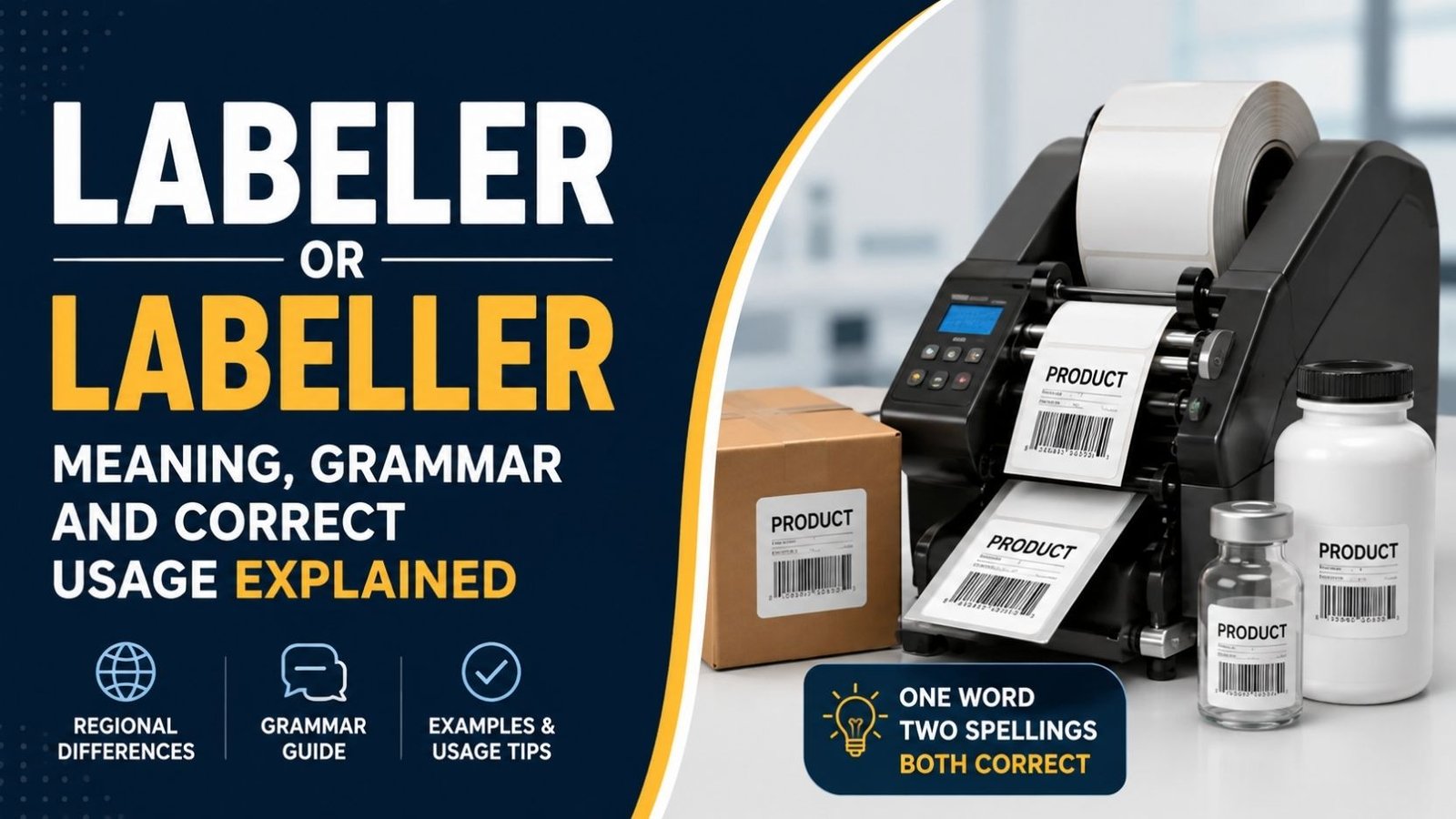
Both labeler and labeller are correct. They mean the same thing. The only real difference is spelling, and that difference depends on which form of English you use. American English uses labeler, while British English (along with Australian and Canadian English) uses labeller.
This small spelling difference often confuses people because both words sound identical and appear constantly online, especially in product listings for labeling machines. Understanding which one to use, and why the difference exists, helps you write with more confidence, whether you are describing a job title, a piece of equipment, or a simple everyday task like putting price tags on items.
What Does Labeler or Labeller Mean?
At its core, the word describes two related things.
Meaning 1: A person who labels something. This is someone who attaches, writes, or applies labels to items. For example, a warehouse worker who tags boxes with shipping information could be called a labeler.
Meaning 2: A machine or tool that applies labels. This is the far more common meaning in everyday use. A labeler (or labeller) is a device that prints, cuts, or wraps labels around products such as bottles, boxes, cables, and packages.
Both meanings come from the same root word: label, plus the suffix -er (or -ler in British spelling), which turns a noun or verb into “a person or thing that does this action.”
See More: Weiner Or Wiener
Labeler or Labeller: The Spelling Difference Explained
The confusion between these two spellings is not random. It follows a well-known pattern in English spelling.
| Form | Used In | Example |
| Labeler | American English (United States) | “I bought a new labeler for the warehouse.” |
| Labeller | British, Australian, and Canadian English | “The labeller printed the wrong barcode.” |
This pattern is not unique to this word. Many English words that end in a single -l follow the same rule.
| American Spelling | British Spelling |
| Labeler | Labeller |
| Traveler | Traveller |
| Modeling | Modelling |
| Canceled | Cancelled |
In American English, when a word ends in a single vowel plus -l, the final -l usually stays single before adding -er. In British English, that final -l is usually doubled. This is why “label” becomes “labeler” in the United States but “labeller” in the United Kingdom.
💡 Tip: If you are writing for a U.S. audience, use labeler. If you are writing for a U.K., Australian, or Canadian audience, use labeller. Neither spelling is “wrong.” They are simply regional preferences.
Labeler or Labeller: Grammar and Part of Speech
Both labeler and labeller are nouns. They are not verbs, adjectives, or adverbs.
- Singular form: labeler/labeller
- Plural form: labelers/labellers
The word comes from the verb to label, which means to attach a tag or mark of identification to something. Adding -er or -ler changes the verb into a noun that names the person or thing performing that action.
Example sentence structures:
- “The labeler prints barcodes automatically.” (subject + verb + object)
- “She works as a labeler at the packaging plant.” (job title usage)
- “This labeller applies labels to curved bottles.” (machine usage)
How to Pronounce Labeler or Labeller
Despite the spelling difference, both words are pronounced the same way.
Pronunciation: LAY-buh-ler
- Stress falls on the first syllable: LAY
- The middle sounds soft, almost like “buh”
- The ending sounds like “ler,” similar to the word “smaller”
There is no difference in pronunciation between American and British speakers on this particular word, even though the spelling changes.
See More: Dought Vs Doubt
Origin of the Word Labeler or Labeller
The root word label entered English from Old French in the late Middle Ages, originally referring to a narrow strip or band, often used to describe a strip of cloth or paper attached to a document as a mark of identification. Over time, the meaning expanded to describe any tag or marker attached to an object to identify it.
The agent suffix -er, added to describe “one who does something,” has been part of English word formation for centuries. When applied to “label,” it created a simple, logical noun: someone (or something) that labels.
The British doubling of the final consonant (labeller) follows a broader 18th and 19th century British spelling convention, formalized in dictionaries such as those associated with British lexicography. American spelling reform, closely tied to Noah Webster’s 19th century efforts to simplify English spelling, favored the single-consonant form, which is why “labeler” became standard in the United States.
Labeler or Labeller in Different Contexts
As a Job Title
In warehouses, factories, and shipping centers, a labeler (or labeller) may refer to a worker responsible for tagging products, boxes, or shipments with correct information before they are sent out.
As a Machine or Device
This is the most searched meaning today. A huge range of labeling machines exist for different industries, and people often search for these machines using both spellings depending on their location.
Common types of labeling machines include:
- Cable labeler / wire labeler: Prints small labels for organizing wires and cables, often used in networking and electrical work.
- Ethernet cable labeler: A specialized wire labeler designed for tagging network cables clearly.
- Bottle labeler machine: Applies labels to bottles in food, beverage, or cosmetic production.
- Vial labeler: Used in pharmaceutical and laboratory settings to label small vials accurately.
- Pipe labeler: Applies durable labels to pipes, often for safety or identification purposes.
- Container labeler / box labeler: Applies labels to larger containers or shipping boxes.
- Heat shrink labeler: Applies labels using heat-shrink material that tightens around a product for a snug fit.
- Shrink sleeve labeler: Similar to a heat shrink labeler, often used for full-body product labels.
- Pressure sensitive labeler: Uses adhesive-backed labels that stick on contact, without heat or extra equipment.
- Print and apply labeler: Combines printing and label application in a single automated step, common in industrial settings.
- Automatic tube labeler / auto labeller: Applies labels to tube-shaped products automatically, reducing manual work.
- Wrap around labeller: Wraps a label completely around a cylindrical object, such as a can or bottle.
- Top labeller: Applies a label to the top surface of a product rather than the side.
- Portable labeler / portable Bluetooth labeler: A small, handheld device, often used for retail pricing or home organization.
- Industrial labeller: A heavy duty machine designed for high volume production lines.
- Brady labeler / Dymo labeler: Popular brand names known for producing handheld and industrial labeling machines.
As a Term in Technology
Data labeler refers to someone (or increasingly, software) that tags or categorizes data, often used to train machine learning models. This meaning has grown rapidly with the rise of artificial intelligence, where accurate data labeling is essential for building reliable systems.
How to Put a Price on Something With a Labeler
Many people search for how to put the price labeller correctly, especially when using a handheld pricing gun. The general process is simple:
- Load the correct label roll into the machine.
- Set the correct price using the machine’s dial or digital input.
- Test on a scrap label to confirm accuracy.
- Apply the label firmly to the product.
Common Mistakes With Labeler or Labeller
❌ Incorrect: Using “labeller” in formal American business writing without consistency.
✅ Correct: Stick to one spelling throughout a single document. Choose labeler for American audiences and labeller for British audiences.
❌ Incorrect: “Labler” or “labelor.”
✅ Correct: Labeler (American) or labeller (British). There is no version spelled “labler.”
❌ Incorrect: Mixing spellings in the same sentence, such as “The labeler and labeller both work the same way.”
✅ Correct: Pick one spelling and use it consistently across your writing.
Synonyms And Related Words
| Word | Meaning | Difference From Labeler |
| Tagger | Someone or something that attaches tags | Often used for physical tags rather than printed labels |
| Marker | A tool or person that marks items | Broader term, not always related to labels specifically |
| Printer | A device that prints text or images | Labelers often include printing, but not all printers apply labels |
| Applicator | A device that applies a substance or material | Sometimes used as part of a labeling machine’s function |
These words overlap with “labeler” in certain contexts, but none of them mean exactly the same thing. A labeler specifically applies identification tags, while these related words serve broader or slightly different purposes.
See More: Drier Or Dryer
Labeler or Labeller: Quick Comparison Table
| Feature | Labeler | Labeller |
| Region | American English | British, Australian, Canadian English |
| Pronunciation | LAY buh ler | LAY buh ler |
| Part of speech | Noun | Noun |
| Plural | Labelers | Labellers |
| Meaning | Person or machine that applies labels | Same meaning |
Frequently Asked Questions
What does labeler or labeller mean?
Both words mean the same thing: a person or machine that applies labels to objects, such as bottles, boxes, cables, or packages.
Is labeler or labeller the correct spelling?
Both are correct. Labeler is standard in American English, while labeller is standard in British, Australian, and Canadian English.
How do you pronounce labeler or labeller?
Both spellings are pronounced the same way: LAY buh ler.
Is labeler a noun or a verb?
Labeler is a noun. The related verb is “to label.”
What is a labeler machine used for?
A labeler machine applies labels to products automatically or manually, commonly used for bottles, boxes, cables, pipes, and vials.
What is the plural of labeler?
The plural is labelers in American English and labellers in British English.
Is a data labeler a real job?
Yes. A data labeler tags or categorizes information, often to help train artificial intelligence and machine learning systems.
What is the difference between a cable labeler and a wire labeler?
These terms are often used interchangeably. Both describe machines or tools designed to print small, durable labels for organizing wires and cables.
Why do Americans spell it labeler while the British spell it labeller?
The difference follows a broader spelling pattern where American English keeps a single final consonant before adding “-er,” while British English often doubles it.
Can labeler also refer to a person’s job title?
Yes. In warehouses and manufacturing settings, a labeler can refer to a worker responsible for applying labels to products or shipments.
Conclusion
Labeler and labeller are two correct spellings of the same word, separated only by regional English preferences. Labeler is the standard choice in the United States, while labeller is standard across British, Australian, and Canadian English. Both refer to a person or, more commonly today, a machine that applies labels to items ranging from small vials and cables to large industrial boxes and containers.
Choosing the right spelling simply depends on your audience. If you are writing for American readers, use labeler. If you are writing for British or Commonwealth readers, use labeller. Whichever spelling you choose, staying consistent throughout your writing is what matters most for clarity and professionalism.

Danish Raza is the author of Grammavio, a trusted resource for simple and easy-to-understand English grammar guides. He creates helpful content covering grammar rules, word meanings, vocabulary, and common grammar mistakes to help readers improve their English skills.



One Comment