
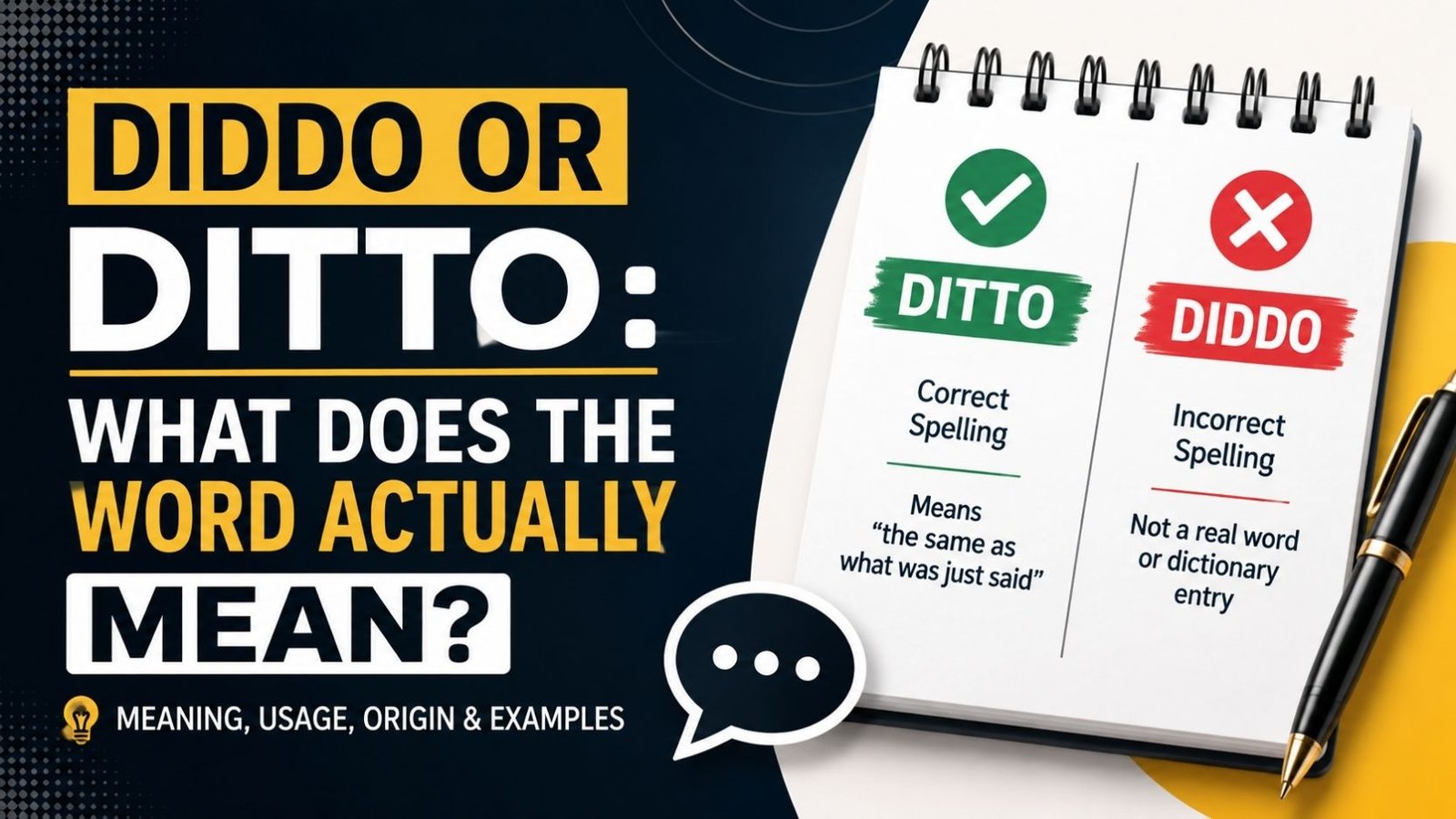
If you have ever paused mid-sentence wondering whether to type “diddo” or “ditto,” you are not alone. Ditto is the correct spelling. It means “the same as what was just said,” and people use it to agree with someone or to avoid repeating information they have already stated.
Diddo shows up constantly in texts, comments, and casual writing because it sounds exactly like ditto when spoken aloud. But spelling and sound are two different things in English, and this is one case where the ear can trick the hand. Understanding why ditto is correct, and why diddo is not, makes the word much easier to use with confidence.
Diddo or Ditto: Which Spelling Is Correct?
Ditto is the only spelling recognized in standard English dictionaries. Diddo is not listed as a word in Merriam-Webster, Dictionary.com, or any major reference source. It is simply a misheard or mistyped version of ditto.
This confusion happens for a simple reason. When Americans say “ditto” out loud, the double “t” in the middle often softens into a sound closer to a “d.” That flap sound is common in American English, and it is the same reason words like “butter” or “little” can sound like “budder” or “liddle” in casual speech. The spelling never changes, even though the sound shifts.
So if you are choosing between diddo or ditto for an email, a text, a school assignment, or any piece of writing, always choose ditto. It is the version every dictionary confirms, and it is the version native speakers expect to see in print.
Quick Answer Box
| Question | Answer |
| Is it diddo or ditto? | Ditto is correct. Diddo is a misspelling. |
| Is diddo a real word? | No. Diddo has no dictionary entry or accepted definition. |
| Why do people write diddo? | Because “ditto” sounds like “diddo” in fast, casual American speech. |
See More: Labeler Or Labeller
What Does Ditto Mean?
At its core, ditto means “the same as before.” It is a word people reach for instead of repeating a statement, an item, or an opinion that has already been shared.
Meaning 1: Agreement or repetition of a statement When someone says something you fully agree with, replying “ditto” is a quick way to say “I feel the same way” without restating their exact words.
Meaning 2: A mark used in lists to avoid repeating text In written lists, receipts, or ledgers, ditto (or the ditto mark, ″) shows that an item on the line above repeats on the line below, so the writer does not have to write it twice.
Meaning 3: A duplicate or copy (informal use) Ditto can describe something that is essentially a copy of something else, as in “her design is a ditto of the original.”
These meanings are closely related. All three point back to the same core idea: something already said, written, or shown applies again without needing to be repeated.
Ditto: Grammar And Part Of Speech
Ditto is flexible in how it works inside a sentence, which is part of why it is so widely used.
- As a noun: “Please mark that item with a ditto.” A noun ditto refers to the mark or the repeated item itself.
- As an adverb: “The morning was slow, and ditto the afternoon.” Here, ditto stands in for a repeated idea without restating it.
- As an interjection: “I loved that movie.” “Ditto!” This is the most common everyday use, functioning almost like “same” or “me too.”
- As a verb (informal): “He dittoed everything his boss said in the meeting.” This use means to repeat or copy someone’s statement, and it is far less common than the other forms.
💡 Tip: In casual conversation, ditto almost always works as an interjection meaning “same here.” In formal or written lists, it usually works as a noun or symbol showing repetition.
How to Pronounce Ditto
Ditto is pronounced DIT-oh, with the stress on the first syllable. In IPA, it is written as /ˈdɪt.oʊ/.
- American English: The double “t” often softens into a quick “d” sound, which is exactly why some people mishear it and write “diddo.”
- British English: The “t” sound tends to stay crisper, so “ditto” sounds closer to its spelling in British speech.
Either way, the spelling stays the same: d-i-t-t-o, two syllables, stress on the first one.
Origin And Etymology Of Ditto
Ditto has roots in Italian, not English. It comes from the Tuscan dialect form of detto, which is the past participle of the Italian verb dire, meaning “to say.” That Italian word ultimately traces back to the Latin dictus, also meaning “said,” from the verb dicere.
The word entered English in the early 1600s, originally used in legal and business documents to avoid repeating the same month or item multiple times in a list. Over time, it moved out of formal recordkeeping and into everyday conversation, eventually becoming the casual, agreeable word people use today.
This history also explains why diddo has no real etymology of its own. It never came from Italian, Latin, or any documented source. It is purely a product of how ditto sounds when spoken quickly.
Ditto In A Sentence
Seeing the word in context makes its meaning click much faster than a definition alone.
- “I think we should order pizza.” “Ditto, I’m starving.”
- The receipt listed one shirt at ten dollars, and a ditto mark under the price to show the second shirt cost the same.
- She agreed with her sister’s plan and simply said, “Ditto.”
Notice how in each example, ditto replaces a full repeated statement. That is the entire purpose of the word: efficiency without losing meaning.
Ditto In Different Contexts
The meaning of ditto barely changes across situations, but the tone and format shift depending on where it appears.
In conversation: Ditto works as a quick, informal way to agree, similar to saying “same” or “me too.”
In lists and records: A ditto mark (″) placed under a repeated word or number shows that the same entry applies again, which saves space and avoids repetitive writing.
In business and formal writing: Ditto appears far less often here, since formal writing usually favors clearer phrasing like “the same applies” instead of the more casual “ditto.”
In pop culture: The word has been borrowed for brand names, song titles, and even a well-known Pokémon, all leaning on the core idea of duplication or sameness.
See More: Drier Or Dryer
Common Mistakes: Diddo vs Ditto
⚠️ Common Mistake: Writing “diddo” because it matches how the word sounds when spoken casually.
❌ Incorrect: “Diddo, I completely agree with you.”
✅ Correct: “Ditto, I completely agree with you.”
❌ Incorrect: “That shirt is a diddo of the one I bought last week.”
✅ Correct: “That shirt is a ditto of the one I bought last week.”
The correct spelling always uses two t’s, never a d in the middle. If you remember the Italian root, detto, it becomes easier to recall why ditto keeps that double consonant.
Ditto Vs Similar Words
| Word | Meaning | How It Differs From Ditto |
| Ditto | The same as stated before | Standard word, used in speech and formal lists |
| Dido | An elaborate or foolish act, or a reference to a mythological queen | Unrelated meaning; often confused with ditto only because of similar spelling |
| Likewise | In the same way, similarly | More formal than ditto, common in polite written responses |
| Same here | Informal agreement phrase | Functionally similar to ditto but used only in casual speech |
Dido deserves special mention because it is a real, separate English word, unlike diddo. “Raising a dido” is an old informal expression meaning to cause a fuss or commotion, and Dido is also the name of a queen in classical mythology. Neither meaning has anything to do with agreement or repetition, so it should not be confused with ditto.
Diddo Or Ditto Pokémon: What Is The Connection?
Many people searching for “diddo or ditto pokemon” are actually looking for information about Ditto, the Pokémon, not a spelling rule. Ditto is a Normal type Pokémon introduced in the very first generation of the games. Its name generally refers to the concept of a copy, which ties directly into its main ability of transforming into other Pokémon.
In battle, Ditto knows only one move, Transform, which lets it copy the appearance and abilities of the Pokémon it is facing. Its Japanese name, Metamon, is thought to combine the idea of metamorphosis with a reference to a monster, reinforcing its shape-shifting identity.
Ditto also appears across spin-off games and media. In Pokémon Pokopia, players can actually control a Ditto, using its transformation ability to explore the game world in different forms. Fans also chase rare shiny Ditto, collect the character on Ditto Pokémon cards, and encounter it while playing Pokémon GO, where it famously disguises itself as other Pokémon until caught.
So while “diddo” is never correct in English spelling, “Ditto” is very much the correct and official name of this specific Pokémon character. The overlap in sound is simply a coincidence of language, not a grammar exception.
Other Places You Might See the Word “Ditto”
Because ditto is such a recognizable word, it has been borrowed for several unrelated products and names. A few examples people commonly search for include:
- Ditto Music: A music distribution and rights management company that helps independent artists release songs on streaming platforms.
- Ditto machine: An older type of spirit duplicator once common in schools and offices before photocopiers became standard, used to produce copies of printed pages.
- Ditto memory foam futon mattress: A mattress product line named after the idea of consistent, repeatable comfort.
- Beth Ditto: A musician and former lead singer of the band Gossip, known for her distinctive voice and public persona.
These uses do not change the core meaning of the word. They simply borrow the idea of sameness, copying, or consistency that “ditto” has carried since its earliest use in English.
Why This Confusion Happens So Often
English spelling does not always match pronunciation, and ditto is a textbook example. The double “t” is technically pronounced with a hard stop, but in fast American speech, it frequently softens into a light “d” sound. This is called a flap or tap sound, and it happens automatically in casual speech without speakers even noticing.
Add autocorrect, texting habits, and the fact that many people learn spoken words before written ones, and it becomes easy to see why diddo keeps appearing online. The mistake is understandable. It is just not correct.
See More: Weiner Or Wiener
Frequently Asked Questions
Is it diddo or ditto?
It is ditto. Diddo is not a recognized word in any standard English dictionary.
What does ditto mean?
Ditto means “the same as what was just said or written.” It is used to show agreement or to avoid repeating information.
Is ditto a noun or a verb?
Ditto can function as a noun, an adverb, an interjection, and occasionally an informal verb, depending on how it is used in a sentence.
How do you pronounce ditto?
Ditto is pronounced DIT-oh, with the stress on the first syllable.
Where does the word ditto come from?
Ditto comes from an old Italian dialect word, detto, meaning “said,” which itself comes from the Latin word dictus.
Is diddo used anywhere correctly?
No. Diddo has no accepted dictionary definition. It is always a misspelling of ditto.
What is a ditto mark?
A ditto mark, written as ″, is a symbol placed under a word or number in a list to show that it repeats the entry above it.
Is Ditto the Pokémon spelled the same as the word ditto?
Yes. Ditto the Pokémon uses the standard English spelling, ditto, with two t’s.
Can ditto be used in formal writing?
Ditto is mostly informal. In formal writing, words like “likewise” or “the same applies” are usually a better fit.
Is ditto still commonly used today?
Yes. People still use ditto in speech, texting, and casual writing to express quick agreement or repetition.
Final Thoughts
Between diddo or ditto, only one spelling has ever been correct. Ditto comes from a genuine Italian and Latin root meaning “said,” and it has carried the idea of repetition and agreement into English for centuries. Diddo, on the other hand, is simply what ditto sounds like when spoken quickly, especially in American English, and it has no dictionary standing of its own.
The next time you want to agree with someone without repeating their entire sentence, or you are labeling a list where an item repeats, reach for ditto with confidence. It is short, useful, and grammatically correct in a way that diddo will never be, no matter how often it shows up in texts and comments online.

Danish Raza is the author of Grammavio, a trusted resource for simple and easy-to-understand English grammar guides. He creates helpful content covering grammar rules, word meanings, vocabulary, and common grammar mistakes to help readers improve their English skills.



One Comment