
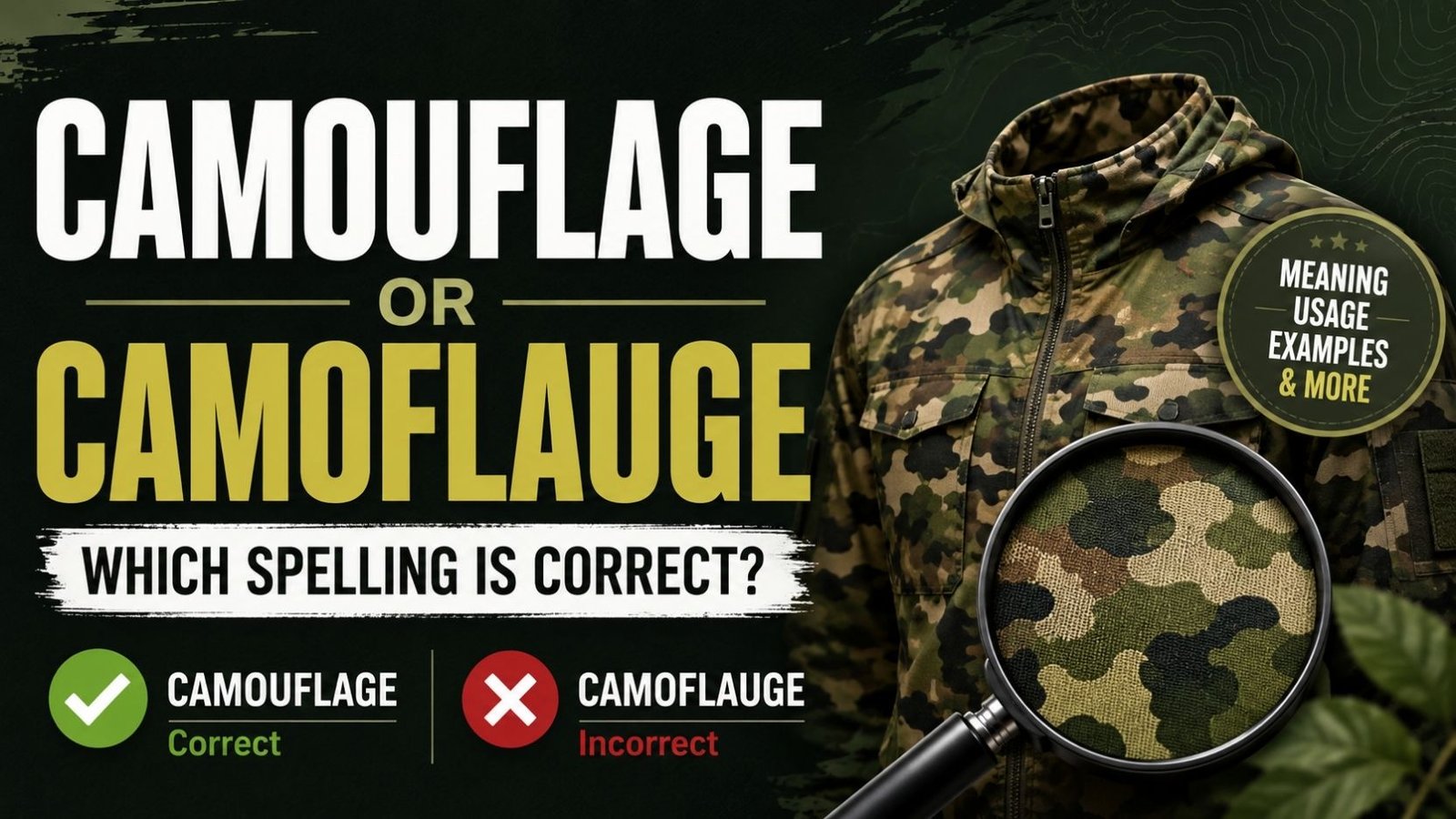
The correct spelling is camouflage, not camoflauge. Camoflauge is one of the most common misspellings in English, but it has no place in a dictionary. If you have typed camoflauge into a search bar and wondered which version is right, camouflage is the one you want, every single time.
This mix-up happens because the word sounds tricky to spell out loud. The letters get jumbled in people’s minds, especially the order of the “l” and the “a” near the end. Once you understand why camouflage looks the way it does, the spelling becomes much easier to remember for good.
Camouflage Or Camoflauge: A Quick Answer
Camouflage is the only correct spelling recognized by every major English dictionary, including Merriam-Webster, Oxford, and Cambridge. Camoflauge, along with other variants like camoflague or camoflage, is simply a spelling mistake.
It is not an alternate British or American form. It is not slang. It is not a stylistic choice. It is an error that shows up often because the word has an unusual letter pattern borrowed from French.
| Spelling | Status |
| Camouflage | Correct in all English dictionaries |
| Camoflauge | Incorrect, common misspelling |
| Camoflague | Incorrect, common misspelling |
| Camoflage | Incorrect, common misspelling |
💡 Tip: If you always struggle with this word, try breaking it into three small chunks: camo, u, flage. Saying it in parts makes the correct order easier to remember.
What Does Camouflage Mean?
At its core, camouflage means the act of hiding or disguising something so it blends into its surroundings. It can refer to an appearance, a pattern, a behavior, or a technique that makes a person, animal, or object harder to notice.
Meaning 1: Natural Disguise
In nature, camouflage describes the colors, patterns, or shapes that help an animal blend into its environment. A moth that looks like tree bark or a frog that matches the color of leaves is using camouflage to stay hidden from predators or prey.
Meaning 2: Military and Clothing Pattern
Camouflage also refers to the mottled green, brown, and tan patterns used on military uniforms and gear. This pattern helps soldiers blend into forests, deserts, or other terrain. Over time, this pattern became a popular fashion print, seen on jackets, pants, hats, and accessories.
Meaning 3: To Conceal or Disguise (Verb)
As a verb, camouflage means to hide something by making it blend in or look like something else. This can apply to physical objects, but it can also apply to feelings, intentions, or information. For example, someone might camouflage their nervousness behind a calm voice.
See More: Diddo Or Ditto
Camouflage: Part of Speech and Grammar
Camouflage can function as both a noun and a verb, depending on how it is used in a sentence.
| Form | Example | Meaning |
| Noun | The lizard’s camouflage made it nearly invisible. | A disguise or protective pattern |
| Verb | Soldiers camouflage their vehicles with branches and nets. | To hide or disguise something |
Camouflage as a Noun
When used as a noun, camouflage is uncountable in most everyday contexts. You would not usually say “two camouflages.” Instead, you describe the concept or the pattern itself.
Correct: The chameleon’s camouflage changes with its mood. Incorrect: The chameleon has many camouflages.
Camouflage as a Verb
As a verb, camouflage follows regular conjugation rules. There is no irregular form to memorize.
| Tense | Form | Example |
| Present | camouflage / camouflages | Animals camouflage themselves in tall grass. |
| Past | camouflaged | The tank was camouflaged with mud and leaves. |
| Present participle | camouflaging | The octopus is camouflaging against the coral. |
How to Pronounce Camouflage
Camouflage is pronounced KAM uh flahzh in American English. The stress falls on the first syllable, and the ending sounds like “flahzh,” similar to the “s” sound in the word “measure.”
- American pronunciation: KAM-uh-flahzh
- British pronunciation: KAM-uh-flahzh (very similar, sometimes slightly softer on the final syllable)
⚠️ Common mistake: Many people mispronounce the ending as “flage” (rhyming with “cage”). The correct sound is closer to “flahzh,” which is part of why the spelling confuses so many writers. The word does not sound the way it looks.
See More: 4rth Or 4th
Origin of the Word Camouflage
Camouflage comes from French, where it originally meant to disguise or to make up, in the sense of applying stage makeup. The word entered English usage during World War I, when armies began using painted patterns and materials to hide soldiers, vehicles, and equipment from enemy view.
The French root explains the unusual spelling. English speakers are used to certain letter patterns, but camouflage keeps its French structure, including the ou combination and the final age ending, which sounds like “azh” rather than a typical English “ij” or “ayj” sound. This French influence is exactly why so many people end up typing camoflauge by mistake. The brain tries to simplify an unfamiliar pattern into something that looks more familiar, and the letters get rearranged in the process.
Why Do People Misspell It as Camoflauge?
There are a few clear reasons this mistake happens so often.
- The word is pronounced differently than it is spelled, which makes it hard to sound out.
- English speakers are not used to the French ou and age combination.
- The brain tends to swap letter order when a word feels unfamiliar.
- Camoflauge looks like it could be correct because it still sounds similar when spoken quickly.
Understanding these reasons will not change the correct spelling, but it does explain why camoflauge shows up so frequently in searches, texts, and even product listings.
Camouflage in Different Contexts
Camouflage in Clothing and Fashion
Camouflage pants, camouflage shorts, camouflage jackets, camouflage hoodies, and even camouflage crocs are all common fashion items. In this context, camouflage refers to the printed pattern, usually in shades of green, brown, tan, or black, that mimics military designs. Brands like Rothco are well known for producing camouflage clothing and gear that closely follows traditional military patterns.
Camouflage in Nature and Animals
Animal camouflage is one of the most fascinating survival tools in the natural world. Different species use camouflage in different ways.
| Animal | Type of Camouflage | Purpose |
| Snow leopard | Coat pattern matches rocky, snowy terrain | Helps it stalk prey without being seen |
| Tiger | Striped pattern breaks up its outline in tall grass | Helps it ambush prey |
| Octopus | Can change skin color and texture instantly | Helps it avoid predators |
| Stick insect | Body shape resembles a twig or branch | Helps it avoid detection entirely |
How do animals use camouflage? Most animals use camouflage in one of two ways: to hide from predators, or to hide while hunting prey. Some animals, like the octopus, can change their appearance in seconds. Others, like the stick insect, rely on a body shape that naturally blends in, without needing to change anything at all.
Dazzle Camouflage
Dazzle camouflage is a distinct type of pattern that does not try to hide an object completely. Instead, it uses bold geometric shapes and contrasting colors to confuse the viewer about an object’s speed, size, or direction.
This technique was used on ships during World War I. Rather than blending into the ocean, dazzle camouflage made it harder for enemy submarines to accurately target the ships.
Camouflage in Everyday Language
Outside of nature and military use, camouflage is often used figuratively. People might camouflage their true feelings, camouflage a mistake in a report, or camouflage a difficult topic behind polite language. In this sense, camouflage means to disguise something so it is less noticeable, even when nothing physical is involved.
Camouflage in Pop Culture
The word camouflage has also appeared in music and entertainment. Some listeners search for a camouflage rapper or a song with this title, since the word has been used in lyrics and titles across different genres. In these cases, the word usually keeps its figurative meaning: blending in, hiding, or disguising something about identity or emotion.
Similar Words and Related Terms
| Word | Meaning | How It Differs From Camouflage |
| Disguise | A change in appearance to hide identity | Usually refers to people, not patterns or nature |
| Concealment | The act of hiding something from view | Broader term, does not require blending in visually |
| Mimicry | An organism imitating another organism or object | A specific biological strategy, often overlaps with camouflage |
| Blend in | To not stand out from a group or background | Informal phrase, similar meaning to camouflage in casual speech |
Camouflage specifically implies blending into a background through color, pattern, or shape. Disguise and concealment are related but broader, since they do not require visual blending.
Common Mistakes With Camouflage
❌ Incorrect: The soldier used camoflauge to hide in the forest.
✅ Correct: The soldier used camouflage to hide in the forest.
❌ Incorrect: She bought a camoflauge hoodie for the trip.
✅ Correct: She bought a camouflage hoodie for the trip.
❌ Incorrect: German camouflauge patterns were different from British ones.
✅ Correct: German camouflage patterns were different from British ones.
The correct spelling never changes, no matter what the word is describing, whether it is clothing, animals, military gear, or figurative language.
See More: Labeler Or Labeller
Frequently Asked Questions
Is it camouflage or camoflauge?
It is always camouflage. Camoflauge is a common misspelling and is not found in any standard English dictionary.
What does camouflage mean in simple terms?
Camouflage means blending in with the surroundings so something is harder to see or notice. It can describe a pattern, an appearance, or the act of hiding something.
Is camouflage a noun or a verb?
Camouflage can be both. As a noun, it refers to a disguise or pattern. As a verb, it means to hide or disguise something.
How do you pronounce camouflage?
Camouflage is pronounced KAM uh flahzh, with the stress on the first syllable and a soft “zh” sound at the end.
Why is camouflage spelled with ou instead of just o?
The word comes from French, and the ou spelling reflects its French origin rather than typical English spelling patterns.
How do animals use camouflage?
Animals use camouflage to hide from predators or to stay unseen while hunting. This can involve matching skin or fur color to the environment, changing color, or having a body shape that mimics plants or objects nearby.
What is dazzle camouflage?
Dazzle camouflage is a bold, geometric pattern used mainly on ships during World War I. Instead of hiding the object, it confused enemies about its size, speed, and direction.
Is camouflage clothing only used for the military?
No. Camouflage patterns are widely used in fashion today, including pants, shorts, jackets, hoodies, and accessories, separate from any military purpose.
What is the difference between camouflage and disguise?
Camouflage usually involves blending into a background through color or pattern. Disguise is a broader term, often referring to a change in appearance to hide someone’s identity.
Final Thoughts
Camouflage is the correct spelling, and camoflauge is a mistake that happens because of how the word sounds compared to how it looks. The word comes from French, which explains its unusual letter pattern, and it has grown to describe everything from animal survival tactics to military gear to everyday fashion.
Once you understand the meaning behind camouflage, whether it is a snow leopard blending into snowy rocks or a soldier hiding in tall grass, the spelling becomes much easier to remember. The next time you type this word, remember: it is camouflage, not camoflauge.

Danish Raza is the author of Grammavio, a trusted resource for simple and easy-to-understand English grammar guides. He creates helpful content covering grammar rules, word meanings, vocabulary, and common grammar mistakes to help readers improve their English skills.



One Comment