
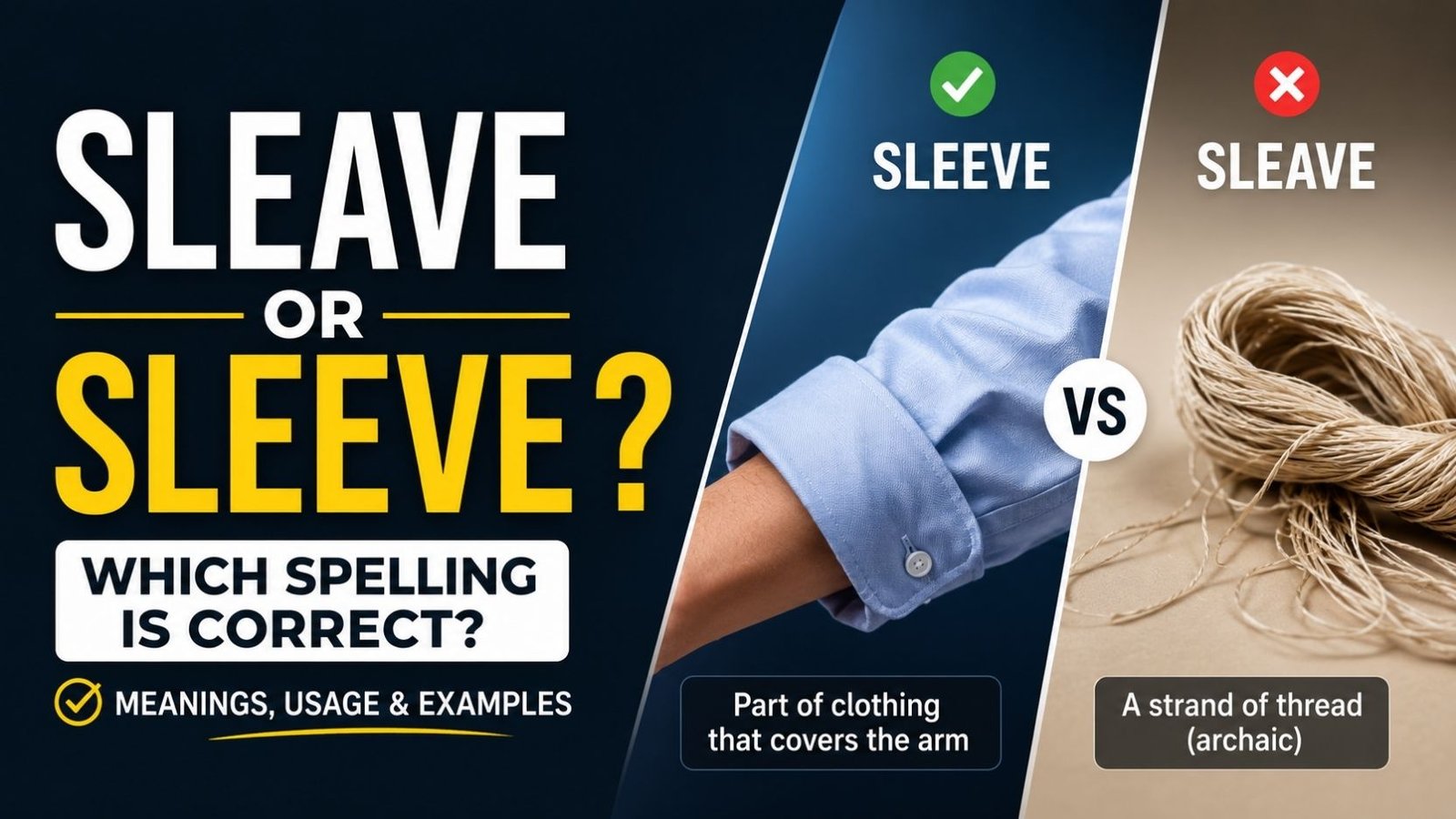
If you have ever paused mid-sentence wondering whether to write “long sleeve shirt” or “long sleave shirt,” you are not alone. The correct spelling for the part of a garment that covers your arm is sleeve, not sleave. Sleeve is the word you want for clothing, tattoos, laptop cases, and gastric sleeve surgery. Sleave is a real word too, but it means something completely different.
Understanding the difference matters because these two words look almost identical yet serve completely different purposes. One describes something you wear every day. The other is a rare, mostly historical word for a strand of thread. Knowing which one to use protects you from a small but noticeable spelling mistake, especially in writing that other people will read closely.
Sleave or Sleeve: The Simple Answer
For almost everything you want to say about clothing, tattoos, or covers, the correct word is sleeve.
- Sleeve refers to the part of a garment that covers the arm, or any tube-shaped cover that slides over an object.
- Sleave is a rare, mostly archaic word for a loose strand or skein of thread, especially raw or untwisted silk.
If your sentence involves a shirt, jacket, tattoo, laptop, knee brace, or leg covering, use sleeve. If you are quoting old poetry or discussing thread and weaving history, sleave may be the word you are looking for.
Sleave Or Sleeve Meaning At A Glance
| Word | Meaning | Common Use Today |
| Sleeve | The part of clothing that covers the arm; a tube-shaped cover or case | Everyday, extremely common |
| Sleave | A tangled or unravelled strand of thread, especially silk | Rare, mostly literary or historical |
This table sums up the core difference. Sleeve is part of daily English. Sleeve has almost disappeared from modern usage outside of specific literary references.
See More: Camouflage Or Camoflauge
What Does Sleeve Mean?
Sleeve is a noun. It has two closely related meanings that both come from the idea of something covering or enclosing a shape.
Meaning 1: The arm part of a garment
This is the meaning almost everyone thinks of first. A sleeve is the part of a shirt, coat, or dress that covers all or part of the arm.
- Example: She rolled up her sleeve before washing the dishes.
- Example: He bought a long-sleeve shirt for the cold weather.
Meaning 2: A tube-shaped cover or case
Sleeve also describes anything shaped like a tube that slides over another object to protect or hold it.
- Example: He kept his laptop in a padded sleeve.
- Example: The record was stored in a paper sleeve.
Both meanings share the same core idea. A sleeve wraps around something and covers part of it, whether that something is an arm, a laptop, a record, or even a body part in a medical context.
What Does Sleave Mean?
Sleave is also a noun, and less commonly a verb. It refers to a soft, loosely twisted strand of thread or silk, often one that has become tangled or separated into finer filaments.
- Noun: A skein or knot of loosely wound thread, especially raw silk.
- Verb (rare, mostly archaic): To separate threads into finer strands.
Sleave shows up almost exclusively in older literature, historical weaving texts, and one especially famous line from Shakespeare’s Macbeth, where sleep is described as something that “knits up the ravelled sleave of care.” In that line, sleave refers to tangled thread, and sleep is compared to something that smooths it out.
Outside of quoting or discussing that kind of historical text, you will rarely need the word sleave in everyday writing.
Sleave Vs Sleeve: Grammar And Part Of Speech
Both words are primarily nouns, though sleave can also function as a verb in older usage.
| Word | Part of Speech | Typical Sentence Role |
| Sleeve | Noun (occasionally used in compound verbs like “sleeve something”) | Subject or object referring to a garment part or cover |
| Sleave | Noun, rarely a verb | Subject or object referring to thread; verb meaning to separate strands |
Neither word changes form in unusual ways. Sleeve simply takes an s to become plural, as in sleeves. Sleave, when used at all, follows the same pattern, becoming sleaves in its rare plural form.
How To Pronounce Sleave And Sleeve
The two words are pronounced almost the same way, which is part of why people confuse the spelling.
- Sleeve is pronounced “sleev,” rhyming with “leave.”
- Sleave is pronounced “sleev” as well, though some older or regional pronunciations render it closer to “slave” or “slev.” Most modern dictionaries list “sleev” as the standard pronunciation.
Because both words often sound identical in casual speech, the spelling confusion usually comes from writing quickly rather than mishearing the word.
Sleeve Or Sleave: Origin And Word History
Sleeve comes from the Old English word sléfe or slíef, related to the idea of something that slips onto the arm. It has described the arm covering of a garment for centuries and is one of the older, more stable words in everyday English clothing vocabulary.
Sleave has a different and less common history. According to the Online Etymology Dictionary, the word is tied to an Old English root meaning to separate or split, describing the way thread is divided into thinner strands. This is why sleave historically referred to untwisted or divided silk thread rather than anything worn on the body.
The two words are unrelated in origin despite their nearly identical spelling and sound. That coincidence is the main reason people mix them up today.
Sleeve In Different Contexts
The word sleeve appears across many everyday and specialized situations. Here are the most common contexts where you will see it.
Clothing
This is the most familiar use. A sleeve covers part or all of the arm on shirts, jackets, dresses, and other garments.
- Long sleeve shirt
- Short sleeve button up
- Puff sleeve dress
- Black long sleeve dress
Tattoos
A tattoo sleeve refers to a large tattoo design that covers most or all of the arm, similar to how a garment sleeve covers the arm.
- Example: He spent three years completing his arm sleeve.
- Example: A leg sleeve tattoo works the same way, but on the leg instead of the arm.
Technology and Everyday Objects
Sleeve also describes any protective case shaped like a tube or cover.
- Example: A laptop sleeve protects a computer during travel.
- Example: A MacBook Air sleeve is designed to fit that specific laptop model closely.
Fitness and Medical Use
A knee sleeve or leg sleeve provides compression or support around a joint or limb, similar in shape to a clothing sleeve.
- Example: Runners often wear a compression leg sleeve to reduce muscle fatigue.
Medical Procedures
Gastric sleeve surgery is a weight loss procedure where part of the stomach is removed to create a narrower, sleeve shaped section. The name comes from the tube like shape of the remaining stomach, echoing the same core meaning of a sleeve as something narrow and tubular.
Sleave In Different Contexts
Because sleave is rare, its contexts are much more limited.
Literary And Historical Writing
Sleave appears almost exclusively in older texts, especially poetry and Shakespearean works, where it refers to tangled or loose thread.
Textile And Weaving History
Historical descriptions of silk production sometimes use sleave to describe raw, unfinished silk thread before it is twisted into stronger strands.
Outside of these two contexts, sleave essentially does not appear in modern writing.
Common Mistakes With Sleave And Sleeve
Because the words sound alike, writers sometimes swap them by accident. Here are the most frequent mistakes.
❌ Incorrect: She wore a long sleave shirt to the party.
✅ Correct: She wore a long-sleeve shirt to the party.
❌ Incorrect: He got a new tattoo sleave on his arm.
✅ Correct: He got a new tattoo sleeve on his arm.
❌ Incorrect: I need a sleave for my laptop.
✅ Correct: I need a sleeve for my laptop.
💡 Tip: If your sentence has anything to do with clothing, tattoos, laptops, or medical procedures, sleeve is almost always the word you need. Sleave belongs to a completely different, much narrower category tied to thread and historical texts.
Is Sleave A Word?
Yes, sleave is a real, recognized word listed in Merriam-Webster, Dictionary.com, and other major dictionaries. It is labeled archaic in most modern sources, meaning it survives mainly in older literature rather than everyday conversation. It is also a valid word in Scrabble and similar word games, since dictionaries still recognize it even though it is rarely used in speech or writing today.
Synonyms And Related Words
| Word | Meaning | How It Differs |
| Sleeve | Arm covering or tube shaped case | The everyday, common word |
| Cuff | The end part of a sleeve, near the wrist | A smaller, specific part of a sleeve, not the whole sleeve |
| Casing | A protective cover for an object | Broader term, not limited to arm shaped or tube shaped covers |
| Skein | A loosely coiled length of thread or yarn | Closest true synonym for the older meaning of sleave |
| Strand | A single thread or fiber | Related to sleave’s meaning but more general |
Skein is the closest modern synonym for sleave, since both describe loosely wound thread. Cuff and casing relate to sleeve but describe narrower or broader ideas rather than matching it exactly.
See More: Labeler Or Labeller
Sleave or Sleeve: Quick Reference Table
| Situation | Correct Word |
| Talking about a shirt or jacket | Sleeve |
| Describing a tattoo covering the arm | Sleeve |
| Referring to a laptop or phone case | Sleeve |
| Discussing gastric sleeve surgery | Sleeve |
| Describing a knee or leg compression garment | Sleeve |
| Quoting Shakespeare or older poetry about thread | Sleave |
| Discussing raw silk thread in a historical or weaving context | Sleave |
Frequently Asked Questions
Is it sleave or sleeve for a shirt?
It is sleeve. A shirt sleeve is the part of the garment that covers the arm. Sleave has nothing to do with clothing.
What does sleave mean?
Sleave means a loosely wound or tangled strand of thread, especially raw silk. It is an archaic word used mainly in older literature.
Is sleave a real word?
Yes. Sleave appears in major dictionaries, including Merriam-Webster and Dictionary.com, though it is labeled archaic and rarely used today.
Why do people confuse sleave and sleeve?
The two words sound almost identical when spoken, which makes it easy to misspell sleeve as sleave, especially when typing quickly.
What is the correct spelling for a tattoo sleeve?
The correct spelling is sleeve. A tattoo sleeve is a large tattoo covering most of the arm, named after the way it wraps the arm like a clothing sleeve.
Is sleave used in modern English?
Rarely. Sleave survives mostly in historical texts, poetry, and specific literary quotations rather than everyday conversation or writing.
What is the plural of sleeve?
The plural is sleeves, following the standard rule of adding an s.
Does sleave have a verb form?
Yes, though it is also archaic. As a verb, sleave means to separate thread into finer strands, a usage dating back to the 1600s.
Is sleave a Scrabble word?
Yes, sleave is a valid word in Scrabble and similar word games because it appears in recognized dictionaries.
What does gastric sleeve mean?
Gastric sleeve refers to a weight loss surgery where part of the stomach is removed, leaving a narrower, tube-shaped section, which is why the word sleeve is used in its name.
Final Thoughts
The confusion between sleave and sleeve comes down to how similar they sound, not how similar they mean. Sleeve is the word you need almost every time, whether you are describing a shirt, a tattoo, a laptop case, or a medical procedure. Sleave is a much older, narrower word tied to thread and silk, and it shows up mainly in historical or literary contexts today.
If you remember one simple rule, remember this: sleeve is for anything that covers or wraps around something, while sleave is reserved for thread. Keeping that distinction in mind will help you avoid the mistake in everyday writing, and it will also help you understand older texts that still use the word sleave in its original, thread related sense.

Danish Raza is the author of Grammavio, a trusted resource for simple and easy-to-understand English grammar guides. He creates helpful content covering grammar rules, word meanings, vocabulary, and common grammar mistakes to help readers improve their English skills.



One Comment