
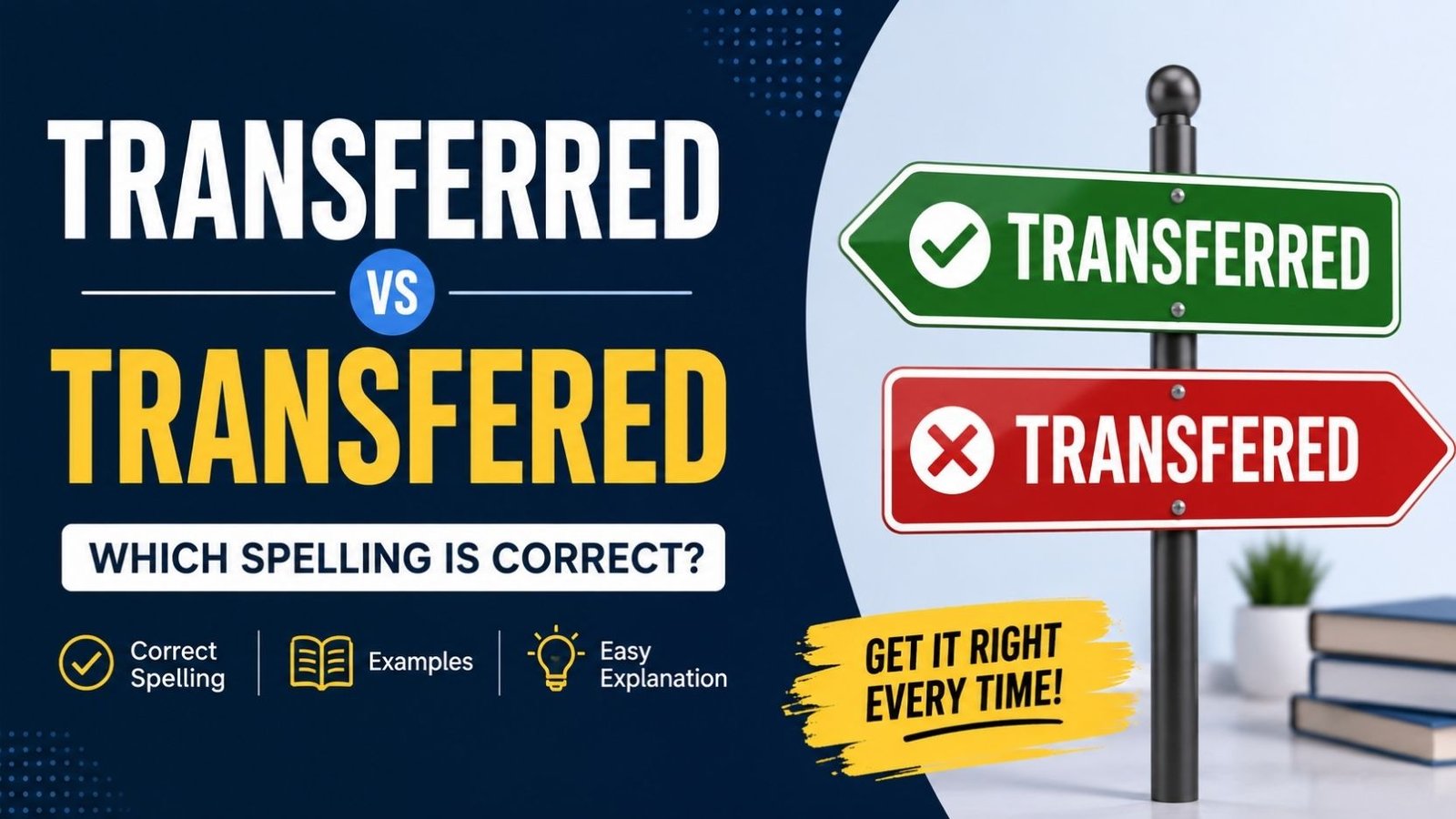
Transferred is the correct spelling. Transfered is a common misspelling that leaves out one of the two Rs the word actually needs. If you have ever paused mid-sentence wondering whether to write transferred or transfered, you are not alone. This mix-up happens because the base word, transfer, does not double its final letter, but the past tense form does.
This small spelling choice matters more than it seems. Transferred shows up in banking emails, school transcripts, job applications, and everyday writing about moving something from one place to another. Getting it wrong in a formal document, resume, or email can look like a careless mistake even when the meaning is perfectly clear. Understanding the simple rule behind this spelling will help you get it right every time, without needing to memorize the word.
Quick Answer
Transferred (with two Rs) is the only correct spelling in standard English, both in the United States and in the United Kingdom. Transfered (with one R) is incorrect and should be avoided in any formal or professional writing.
| Spelling | Correct? | Notes |
| Transferred | Yes | Standard past tense and past participle of transfer |
| Transfered | No | Common misspelling, missing one R |
What Does Transferred Mean?
Transferred is the past tense and past participle of the verb transfer. It describes the act of moving something, or someone, from one place, person, account, or condition to another.
Simple definition: Transferred means moved or passed from one place, person, or situation to another.
For example:
- “She transferred to a new school last fall.”
- “The money was transferred to his savings account.”
- “Ownership of the property was transferred to the new buyer.”
In each case, something changes location, ownership, or control. The word works for physical objects, money, information, responsibility, and even people changing jobs, schools, or teams.
See More: Sleave Or Sleeve
Why Transferred Has Two Rs
English spelling rules explain exactly why transferred needs a doubled R, and the reason is consistent, not random.
The rule works like this:
- Transfer ends in a single consonant (R).
- That consonant follows a single vowel (E).
- The stress in the word falls on the final syllable: trans-FER.
When a word meets all three conditions, English doubles the final consonant before adding an ending like ed or ing. This is the same pattern seen in prefer becoming preferred, occur becoming occurred, and admit becoming admitted.
Because the stress lands on “fer,” not “trans,” the final R doubles. If the stress landed on the first syllable instead, the rule would not apply, and the word would keep a single R. This is exactly why transfered looks tempting but is not correct: it skips a rule that English applies consistently to stressed final syllables.
Table: Similar Words That Follow the Same Rule
| Base Word | Stress | Past Tense | Doubled? |
| Transfer | trans-FER | Transferred | Yes |
| Prefer | pre-FER | Preferred | Yes |
| Occur | oc-CUR | Occurred | Yes |
| Offer | OF-fer | Offered | No |
| Enter | EN-ter | Entered | No |
Notice the difference between prefer and offer. Both end in the same letters, but prefer stresses the second syllable while offer stresses the first. That single difference in pronunciation decides whether the final consonant doubles.
Transferred or Transfered: Which One Should You Use?
Always use transferred. There is no context, formal or informal, American or British, where transfered is the accepted spelling. It is simply a spelling error, similar to writing “recieve” instead of “receive.”
✅ Correct: The call was transferred to another department.
❌ Incorrect: The call was transfered to another department.
✅ Correct: He transferred his credits to a different university.
❌ Incorrect: He transfered his credits to a different university.
If you search for transfered or transfered or transferred, dictionaries and grammar checkers will consistently point you back to transferred as the only standard form.
Transferred vs Transfered: US and UK Usage
Some past tense verbs differ between American and British English, such as traveled versus travelled. Transferred is not one of those cases.
- In American English: transferred
- In British English: transferred
Both varieties of English use the double R spelling. This makes transferred one of the more reliable words in English, since you do not need to adjust the spelling based on your audience’s country.
How to Pronounce Transferred
Transferred is pronounced with stress on the second syllable.
- Simple pronunciation: trans-FURD
- IPA: /trænsˈfɜːrd/
The stress on “ferred” is the same stress pattern that explains the doubled R in the spelling. Saying the word out loud, and noticing where the emphasis falls, can actually help you remember why the spelling doubles the R.
Transferred in Different Contexts
The word transferred adjusts slightly depending on what is being discussed, but the core meaning of moving something stays the same.
Transferred Money
When people search for transferred money, they usually mean funds that moved from one account to another.
- “The bank transferred five hundred dollars to my checking account.”
This is one of the most common everyday uses of the word, especially in banking, payroll, and online shopping contexts.
Transferred Calls
In customer service and digital marketing contexts, a transferred call means a phone call that moved from one representative or department to another.
- “Your call has been transferred to a specialist.”
Transferred Intent
In legal and academic writing, transferred intent is a specific term. It describes a situation where a person intends to harm one person but ends up harming a different person instead. The law treats the original intent as carrying over, or transferring, to the unintended victim.
- “Under the doctrine of transferred intent, the defendant was still held responsible.”
This is a more technical, specialized meaning, mostly used in legal studies rather than everyday conversation.
How Is Energy Transferred?
Outside of grammar, transferred is a common word in science, especially in physics and biology lessons about energy and heat.
Simple definition: Energy is transferred when it moves from one object, system, or place to another, rather than being created or destroyed.
Common examples include:
- Heat transferred by direct touch happens through conduction, when warmth moves between two objects that are physically touching, like a hot pan warming a metal spoon resting inside it.
- Heat transferred through air or liquid happens through convection, as warmer, less dense areas rise and cooler areas sink, creating a circulating flow.
- Heat transferred without direct contact happens through radiation, the same way sunlight warms your skin from a distance.
See More: Trainning Or Training
How Is Thermal Energy Transferred?
Thermal energy, another term for heat energy, is transferred through the same three methods: conduction, convection, and radiation.
The method depends mainly on whether the objects are touching, whether a fluid like air or water is involved, and whether the energy travels as waves through empty space.
How Much Energy Is Transferred Between Trophic Levels?
In ecology, a well known guideline states that only a small portion of energy, generally around ten percent, is transferred from one trophic level to the next in a food chain. The remaining energy is lost, mostly as heat, through natural life processes at each level.
Because this specific figure varies by source and ecosystem, treat ten percent as a common teaching estimate rather than a fixed law.
Grammar: Is Transferred a Verb?
Yes. Transferred functions as both:
- Past tense verb: “She transferred the files yesterday.”
- Past participle: “The files have been transferred.”
It can also work as a past participle adjective, describing a noun directly.
- “The transferred employee started her new role on Monday.”
Here, transferred describes the employee, similar to how “tired” or “finished” can describe a noun.
Common Mistakes With Transferred
Even confident writers slip up with this word sometimes. Here are the most frequent mistakes.
Mistake 1: Dropping the Second R
❌ Incorrect: The property was transfered to my name.
✅ Correct: The property was transferred to my name.
Mistake 2: Adding an Extra R
❌ Incorrect: The document was transferrred.
✅ Correct: The document was transferred.
Mistake 3: Confusing Transferred With Transferring
Transferred is past tense. Transferring is the present participle, used for ongoing action.
❌ Incorrect: I am transferred the files right now.
✅ Correct: I am transferring the files right now.
💡 Tip: If the action is happening right now, use transferring. If it already happened, use transferred.
Transferred vs Similar Words
Several words overlap with transfer in meaning, but each carries a slightly different shade of use.
| Word | Meaning | How It Differs From Transfer |
| Move | To change position or location | More general, often physical, not always official |
| Convey | To carry or communicate something | Often used for information, feelings, or legal property |
| Transmit | To send or pass something along, often signals or disease | More common in technical, medical, or broadcasting contexts |
Move vs Transfer
Move is broader and more casual. You can move furniture, move to a new city, or move an idea forward. Transfer usually implies a more formal or structured change, such as moving between accounts, institutions, or job roles.
Convey vs Transfer
Convey often applies to communication or legal processes, like conveying a message or conveying property ownership. Transfer applies more widely, covering money, people, data, and objects.
Transmit vs Transfer
Transmit usually involves sending something across a distance or a medium, such as transmitting a signal, a virus, or data over a network. Transfer is more general and does not require distance or a specific medium.
Synonyms For Transferred
Depending on context, these words can work as synonyms for transferred:
- Moved
- Relocated
- Shifted
- Passed on
- Reassigned
- Handed over
Choose the synonym that fits the specific situation. “Relocated” fits people and offices well, while “handed over” fits responsibility or control better than money or data.
Origin Of Transfer
Transfer comes from the Latin word transferre, formed from trans, meaning across, and ferre, meaning to carry or bring. The word entered English through French influence in the late medieval period, keeping its core meaning of carrying something across or over to a new place. Over time, the word expanded beyond physical carrying to include abstract transfers, like transferring rights, money, or information.
Examples of Transferred in Sentences
- “The nurse transferred the patient to a different ward.”
- “Company data was transferred to a new server overnight.”
- “He was transferred to the Chicago branch after his promotion.”
- “The professor transferred the class notes into a shared document.”
Each example follows the same pattern: something or someone moves from one place, role, or condition to another.
See More: Camouflage Or Camoflauge
Frequently Asked Questions
What does transferred mean?
Transferred means moved or passed from one place, person, or situation to another. It is the past tense of the verb transfer.
Is it transferred or transfered?
Transferred, with two Rs, is the only correct spelling. Transfered is a misspelling.
How do you spell transferred?
T, R, A, N, S, F, E, R, R, E, D. Notice the double R before the ending.
Is transferred a noun or a verb?
Transferred is a verb form, specifically the past tense and past participle of transfer. It can also act as an adjective, as in “the transferred funds.”
How do you pronounce transferred?
It is pronounced trans-FURD, with stress on the second syllable.
What is the difference between transferred and transferring?
Transferred describes a completed action in the past. Transferring describes an action that is currently happening.
Why does transfer double the R when adding ed?
Because the stress falls on the final syllable, “fer,” and that syllable ends in a single consonant after a single vowel. English doubles the final consonant in these cases before adding ed or ing.
Is transferred spelled the same in British and American English?
Yes. Both American and British English use the same double R spelling, transferred.
What is transferred intent?
Transferred intent is a legal concept where a person’s intent to harm one person legally carries over if a different, unintended person is harmed instead.
How is heat transferred?
Heat is transferred through conduction, direct contact between objects, convection, movement through air or liquid, and radiation, energy waves traveling through space without needing contact.
Conclusion
Transferred is the correct spelling, and transfered is simply a misspelling that drops one of the two Rs the word requires. The double R exists because transfer places its stress on the final syllable, which follows a consistent English spelling pattern shared by words like preferred and occurred. Once you notice that pattern, the correct spelling becomes much easier to remember without needing to guess each time you write it.
Whether you are writing about transferred money, a transferred phone call, or how energy is transferred through heat, the spelling stays the same in every context and in both American and British English. Keeping this one rule in mind, stress falls on the final syllable, so the final consonant doubles, will help you spell transferred correctly every time, in formal writing, schoolwork, and everyday communication alike.

Danish Raza is the author of Grammavio, a trusted resource for simple and easy-to-understand English grammar guides. He creates helpful content covering grammar rules, word meanings, vocabulary, and common grammar mistakes to help readers improve their English skills.



One Comment