
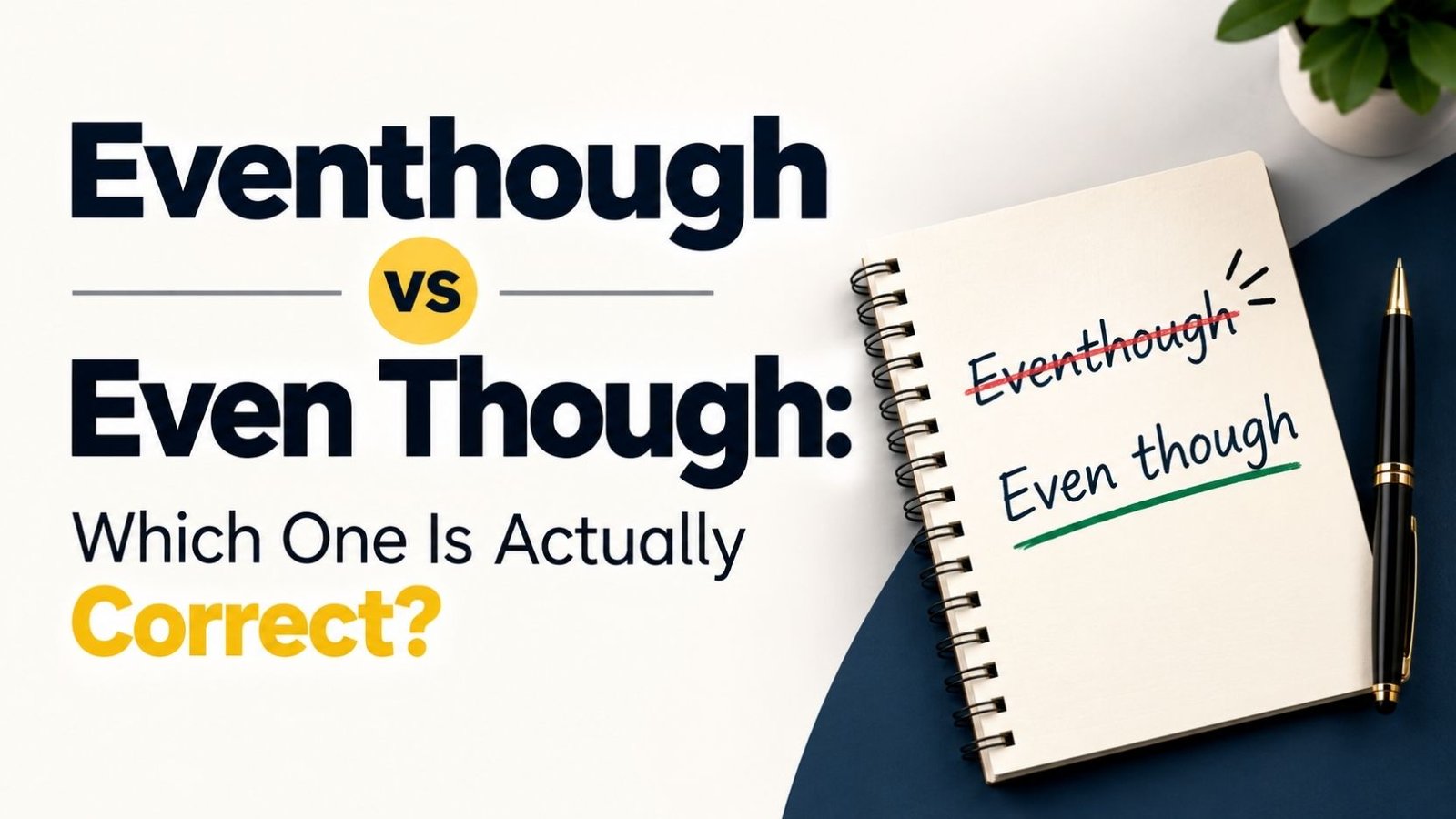
If you have ever paused mid-sentence wondering whether to write “eventhough” or “even though,” you are not alone. Only one of these is correct standard English, and the answer is simple once you see it clearly. Even though is the correct form, written as two separate words, and it works as a subordinating conjunction that introduces a contrast.
Understanding this difference matters more than it seems at first glance. Even though vs even though is one of the most common spelling mix-ups in English, especially in casual writing, texting, and social media. Getting it right instantly makes your writing look more polished and professional, whether you are writing an email, an essay, or a caption.
Even Though: The Correct Form
Even though is always written as two words. There is no version of English, formal or informal, where “eventhough” is accepted as correct spelling.
It functions as a subordinating conjunction, which means it connects a dependent clause to an independent clause. Its job is to introduce a fact that makes the main statement surprising or unexpected.
Example: Even though it was raining, they went for a walk.
Here, “even though it was raining” is the dependent clause, and “they went for a walk” is the independent clause. The word pair signals a contrast between the two ideas.
See More: Weiner Or Wiener
Is Eventhough A Word?
No, eventhough is not a word. It does not appear in any major dictionary, including Merriam-Webster, Oxford, or Cambridge. It is simply a common misspelling that happens when people merge the two words together while typing quickly.
This mistake is understandable. Many English words that started as two separate words did eventually merge into one, such as “already” or “nonetheless.” Even though has not followed that pattern, and it remains two words in every standard reference.
💡 Quick Tip: If you are ever unsure, mentally replace the phrase with “although.” If “although” fits the sentence, then “even though” is the correct choice, written as two words.
Eventhough vs Even Though: Quick Comparison
| Form | Correct? | Notes |
| Even though | Yes | Standard subordinating conjunction, always two words |
| Eventhough | No | Common misspelling, not recognized in dictionaries |
What Does Even Though Mean?
Even though means “despite the fact that” or “in spite of the fact that.” It is used to connect two ideas where the second idea happens or is true even though the first idea suggests it might not.
It introduces a condition or situation that does not change or prevent the outcome described in the main clause.
Example: Even though he was tired, he finished the report.
The tiredness would normally suggest he might not finish. Even though signals that he did it anyway.
Even Though vs Although
Even though and although are close synonyms, and in most everyday sentences, they can be used interchangeably.
| Word | Meaning | Tone |
| Even though | Despite the fact that | Slightly stronger emphasis on contrast |
| Although | Despite the fact that | Slightly more formal or neutral |
Example with although: Although it was raining, they went for a walk.
Example with even though: Even though it was raining, they went for a walk.
Both sentences mean the same thing. Even though tends to add a little more emphasis to the contrast, which is why it often feels more natural in spoken English and casual writing. Although is common in formal writing, academic text, and news reporting.
Even Though vs Even If
These two phrases look similar but carry different meanings, and mixing them up changes the meaning of a sentence.
| Phrase | Meaning | Example |
| Even though | A fact is true, and the outcome still happens | Even though it rained, we went hiking. |
| Even if | A situation is hypothetical, and the outcome would still happen | Even if it rains, we will go hiking. |
Even though refers to something that is already true or already happened. Even if refers to something that may or may not happen, a possibility rather than a fact.
Even So vs Even Though
Even so and even though are related, but they work differently in a sentence.
Even though connects two clauses inside one sentence, acting as a conjunction. Even so usually starts a new sentence and works more like a transition word, similar to “nevertheless” or “still.”
Example: He studied all night. Even so, he felt unprepared for the exam.
Example with even though: Even though he studied all night, he felt unprepared for the exam.
Even As vs Even Though
Even as focuses on timing, showing that two things happen at the same moment. Even though focuses on contrast, not timing.
Example with even as: Even as the sun set, the children kept playing.
Example with even though: Even though the sun had set, the children kept playing.
Even as emphasizes simultaneous action. Even though emphasizes that something happened despite another fact.
Grammar: Is Even Though a Subordinating Conjunction?
Yes, even though is classified as a subordinating conjunction. This means it introduces a dependent clause, which cannot stand alone as a complete sentence.
A sentence using even though generally needs two parts:
- A dependent clause, introduced by even though
- An independent clause, which can stand alone
Correct sentence structure: Even though [dependent clause], [independent clause].
Or:
[Independent clause] even though [dependent clause].
Example, clause first: Even though she was nervous, she gave a great presentation.
Example, clause second: She gave a great presentation even though she was nervous.
Both orders are grammatically correct. The comma is only needed when the even though clause comes first in the sentence.
Is Even Though a Transition Word?
Even though is not typically classified as a transition word in the traditional sense, such as “however” or “therefore.” Transition words usually connect separate sentences or ideas across a paragraph. Even though instead connects two clauses within a single sentence, which places it in the subordinating conjunction category rather than the transition word category.
See More: Sleave Or Sleeve
How to Use Even Though in a Sentence
Even though works well any time you want to show that something happened despite a contrasting fact. It fits naturally in spoken conversation, written essays, emails, and storytelling.
More examples:
- Even though I was hungry, I waited for dinner.
- Even though we ain’t got money, we still have each other.
- A static character stays the same even though there is conflict in the story.
- All the fat keeps going to my belly even though I train every day.
- We pray even though we don’t believe in a specific outcome.
These examples show how flexible even though is across everyday topics, from emotional statements to casual speech patterns like “even though we ain’t got money.”
Even Though in Religious and Reflective Context
Even though often appears in religious or reflective language, especially when expressing faith despite doubt or difficulty. A well known example comes from Psalm 23, which expresses trust even in fear: even though I walk through the valley of the shadow of death, I will fear no evil.
This use follows the same grammar pattern as everyday sentences. It introduces a difficult situation, then contrasts it with a stronger, unwavering response.
Even Though in Spanish
There is no single word translation, since even though is a phrase rather than one word. In Spanish, the closest equivalents are:
- Aunque
- A pesar de que
Example: Aunque llovía, salimos a caminar. (Even though it was raining, we went for a walk.)
Both aunque and a pesar de que introduce contrast in Spanish, similar to how even though works in English.
Synonyms for Even Though
Several words and phrases share a similar meaning to even though. Choosing between them often depends on tone and formality.
| Synonym | Formality | Example |
| Although | Neutral to formal | Although it was late, she finished the task. |
| Though | Casual | It was late, though she finished the task. |
| Despite the fact that | Formal | Despite the fact that it was late, she finished the task. |
| While | Neutral | While it was late, she finished the task. |
| Notwithstanding | Very formal | Notwithstanding the late hour, she finished the task. |
Common Mistakes With Eventhough vs Even Though
❌ Incorrect: Eventhough it was cold, we went outside.
✅ Correct: Even though it was cold, we went outside.
The correct form always keeps even and though as two separate words. Merging them into one word is a spelling error, not an accepted variation.
❌ Incorrect: Even though, it was cold, we went outside.
✅ Correct: Even though it was cold, we went outside.
A comma should not follow even though at the start of a clause. The comma belongs after the full dependent clause, right before the independent clause begins.
⚠️ Common Mistake: Confusing even though with even if. Remember, even though describes something real or already true, while even if describes a hypothetical possibility.
See More: Simpler Vs More Simple
Frequently Asked Questions
Is it “even though” or “eventhough”?
It is always even though, written as two separate words. Eventhough is not a correct spelling in any standard dictionary.
What does eventhough mean?
Eventhough itself has no meaning because it is not a real word. The correct phrase, even though, means “despite the fact that.”
Is eventhough a word?
No. Eventhough does not appear in Merriam-Webster, Oxford, or Cambridge dictionaries. The correct spelling is always two words.
Is even though a subordinating conjunction?
Yes. Even though introduces a dependent clause and connects it to an independent clause, which is the defining role of a subordinating conjunction.
What is the difference between even though and although?
They mean the same thing in most sentences. Even though tends to feel slightly more emphatic, while although often sounds a bit more formal or neutral.
What is the difference between even though and even if?
Even though refers to a fact that is already true. Even if refers to a hypothetical situation that may or may not happen.
Is even though a transition word?
Not in the traditional sense. It functions as a subordinating conjunction that joins two clauses within one sentence, rather than linking separate sentences.
Do you need a comma after even though?
No, not directly after the words even though. A comma is used after the entire dependent clause, before the main clause begins, but only when that clause comes first in the sentence.
What is another word for even though?
Common alternatives include although, though, despite the fact that, and while, depending on the tone you want.
How do you use even though in a sentence?
Place it before a fact that contrasts with the main idea of the sentence, such as: Even though she was busy, she answered every email.
Final Thoughts
The comparison of eventhough vs even though has a clear and simple answer. Even though is the only correct form, always written as two words, and it works as a subordinating conjunction that introduces contrast between two ideas. Eventhough, written as one word, is a common misspelling that does not appear in any standard dictionary.
Once you remember this small but important distinction, you can use even though confidently in essays, emails, conversations, and everyday writing. Whether you are contrasting it with although, even if, even so, or even as, knowing the exact meaning and structure of even though will help your sentences read clearly and correctly every time.

Danish Raza is the author of Grammavio, a trusted resource for simple and easy-to-understand English grammar guides. He creates helpful content covering grammar rules, word meanings, vocabulary, and common grammar mistakes to help readers improve their English skills.



2 Comments