
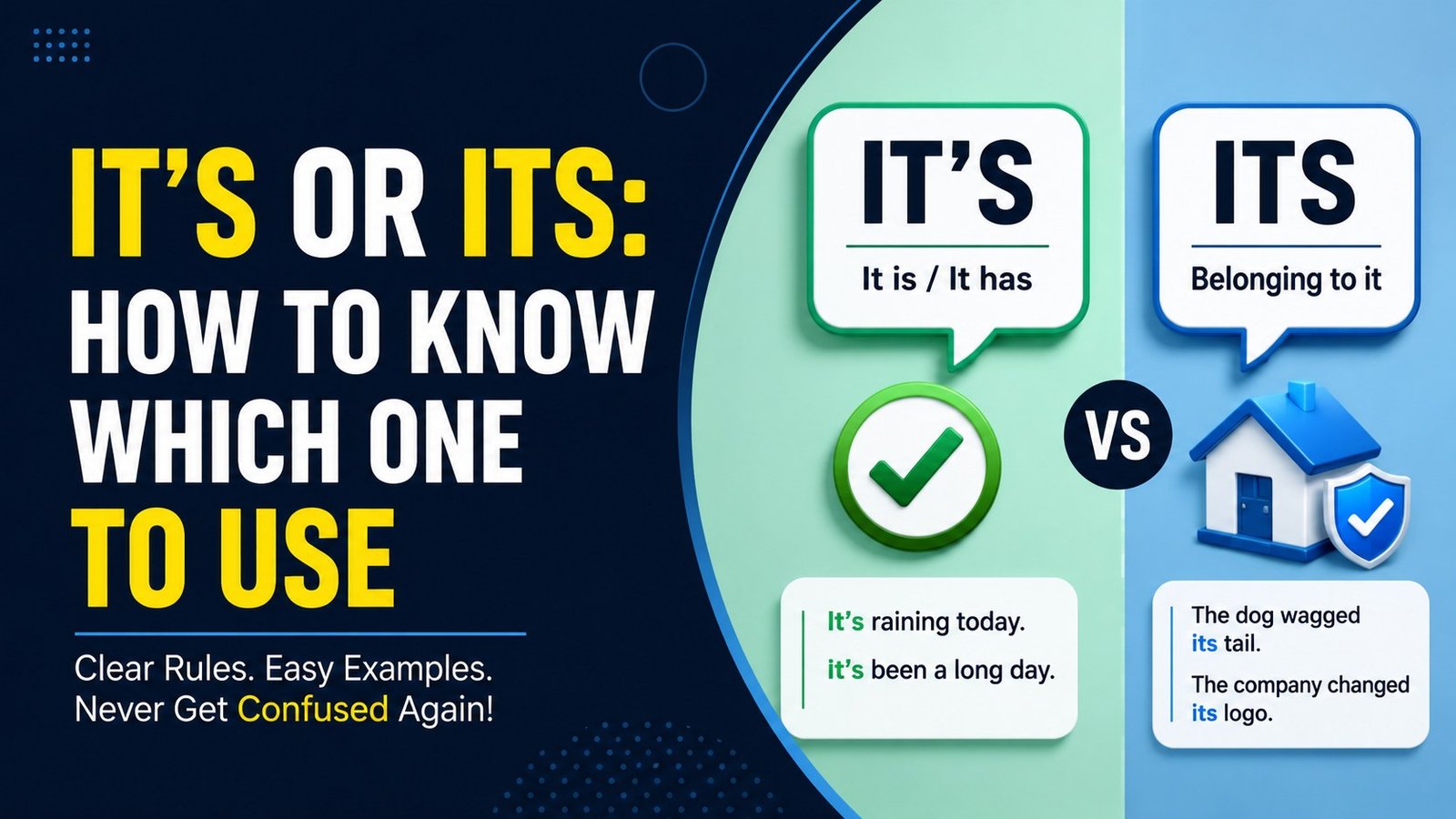
Most people mix up it’s or its at some point, even careful writers. The confusion makes sense because both words sound exactly the same when spoken. Yet they do completely different jobs in a sentence, and knowing the difference takes only a moment once you see the pattern clearly.
It shows ownership, similar to his or her. It’s is always a short way of writing it is or it has. This one rule solves almost every mix-up you will ever face with these two words, and the rest of this guide will show you exactly how to apply it with confidence.
What Does It’s Mean?
It’s is a contraction. A contraction joins two words together and uses an apostrophe to replace missing letters.
It’s stands for:
- It is, as in “It’s raining outside.”
- It has, as in “It’s been a long day.”
The apostrophe in it’s is not decorative. It marks the spot where a letter has been removed. In “it is,” the letter i disappears and the apostrophe takes its place, giving you it’s.
If you can replace it’s with “it is” or “it has” and the sentence still makes sense, you are using it correctly.
See More: Eventhough Vs Even Though
What Does Its Mean?
Its is a possessive pronoun. It shows that something belongs to or is connected to an object, animal, or idea that was already mentioned.
Its works the same way as my, your, his, her, and their. None of these possessive words use an apostrophe, and its follows that same pattern.
Example sentences:
- The dog wagged its tail.
- The company changed its logo last year.
- The car lost its value quickly.
In each case, its connects an object back to something it belongs to, without needing an apostrophe.
Its Or It’s: The Simple Test
Here is the fastest way to check which word you need.
Replace the word with “it is” in your sentence. If the sentence still makes sense, use it’s. If the sentence sounds wrong, use its.
Try it with these two sentences:
- The cat licked ___ paw. → “The cat licked it is paw” does not make sense, so the correct word is its.
- ___ getting cold outside. → “It is getting cold outside” makes perfect sense, so the correct word is it’s.
This test works almost every time and takes only a few seconds once it becomes a habit.
Its Or It’s: Quick Comparison Table
| Word | What It Means | When To Use It | Example |
| It’s | It is or it has | To shorten a sentence naturally | It’s a wonderful life. |
| Its | Belonging to it | To show ownership or connection | The bird built its nest. |
When To Use It’s
Use it’s whenever you could naturally say “it is” or “it has” in that spot instead.
Common situations where it’s fits:
- Describing weather or conditions: “It’s sunny today.”
- Talking about time: “It’s almost midnight.”
- Explaining a state or feeling: “It’s okay to not be okay.”
- Referring to something that has just happened: “It’s been a while since we talked.”
- Starting a casual statement: “It’s my birthday.”
Each of these examples works because “it is” or “it has” fits smoothly in place of it’s.
When To Use Its
Use its when you are describing something that belongs to, or relates to, a thing, animal, or idea already mentioned in the sentence.
Common situations where its fits:
- Describing parts of an object: “The phone lost its charge.”
- Describing animal behavior: “The dog chased its tail.”
- Describing company actions: “The business updated its website.”
- Describing natural features: “The river changed its course.”
None of these examples can be replaced with “it is” or “it has,” which confirms that its is correct.
Its Or It’s Possessive: Why There Is No Apostrophe
Many people assume that possession always needs an apostrophe, since words like “the dog’s bone” use one. This is where its causes confusion.
Its belongs to a special group of pronouns called possessive pronouns. These words already show ownership through their spelling, so they never take an apostrophe. This group includes:
- My
- Your
- His
- Her
- Its
- Our
- Their
None of these words use an apostrophe, and its follows the exact same rule. Adding an apostrophe to its would turn it into a contraction, changing its meaning completely.
See More: Diddo Or Ditto
Its’ Is Not A Word
You may see its’ written online, especially in casual writing or search queries. This form does not exist in standard English grammar.
There is no version of its that places the apostrophe after the s. Only two correct forms exist:
- Its, for possession.
- It’s, for the contraction of it is or it has.
If you ever see its’, treat it as a spelling mistake and choose either its or it’s instead.
Common Mistakes With It’s Or Its
Mixing up these two words is one of the most common grammar mistakes in English, even among experienced writers. Recognizing the pattern helps you avoid it going forward.
Incorrect: The company announced it’s new product line.
Correct: The company announced its new product line.
Why: The sentence describes something belonging to the company, so it needs the possessive form, its.
Incorrect: Its been a long week.
Correct: It’s been a long week.
Why: This sentence means “it has been a long week,” so it needs the contraction, it’s.
Incorrect: The dog wagged it’s tail happily.
Correct: The dog wagged its tail happily.
Why: The tail belongs to the dog, so the possessive form its is correct.
Incorrect: Its a wonderful life.
Correct: It’s a wonderful life.
Why: This phrase means “it is a wonderful life,” so the contraction it’s is needed.
Its Or It’s: More Example Sentences
Seeing both words used correctly, side by side, makes the difference easier to remember.
Its used correctly:
- The team celebrated its victory.
- The plant lost its leaves in winter.
- The government updated its policy.
It’s used correctly:
- It’s important to check your grammar.
- It’s been raining all morning.
- It’s a small world after all.
Reading through pairs like these helps the correct pattern feel natural over time, rather than something you need to consciously calculate every time.
Its Or It’s In Titles And Pop Culture
Many well-known titles and phrases use it’s correctly as a contraction, which is worth noting since these examples appear often in search results and everyday conversation.
- It’s a Wonderful Life, the classic film, uses it’s because the title means “it is a wonderful life.”
- It’s Always Sunny in Philadelphia follows the same pattern, meaning “it is always sunny.”
- It’s the Great Pumpkin, Charlie Brown also uses the contraction correctly.
These titles are useful reminders that it’s, with the apostrophe, always ties back to “it is” or “it has,” never to ownership.
British English Versus American English
The rule for its or it’s does not change between British English and American English. Both varieties of English treat its as a possessive pronoun and it’s as a contraction in exactly the same way.
This is one grammar rule you do not need to adjust based on your audience or location. Whether you are writing for readers in the United States, the United Kingdom, or anywhere else, the same test applies: if “it is” or “it has” fits, use it’s, and if not, use its.
Similar Words That Cause The Same Confusion
Its and it’s are not the only pair of words that get mixed up because they sound alike. Understanding the pattern here can help with other similar cases too.
| Word Pair | Difference |
| Your and you’re | Your shows possession; you’re means “you are.” |
| Their and they’re | Their shows possession, they’re means “they are.” |
| Whose and who’s | Whose shows possession, who’s means “who is” or “who has.” |
Notice the pattern. In every pair, the word without an apostrophe shows ownership, and the word with an apostrophe is a contraction. Its and it’s follow this exact same logic.
A Simple Way To Remember The Difference
If the short test feels hard to remember in the moment, try this instead.
Think of its as belonging to the same family as his and her. None of these words use an apostrophe, because they are already possessive on their own.
Think of it’s as a shortcut. The apostrophe stands in for a missing letter, exactly the way it does in words like don’t or can’t.
Once this connection clicks, the difference between its or it’s becomes far easier to catch, even while writing quickly.
See More: Simpler Vs More Simple
Frequently Asked Questions
What does it’s mean?
It’s is a contraction that means “it is” or “it has.” The apostrophe replaces a missing letter.
What does its mean?
Its is a possessive pronoun that shows something belongs to or is connected with an object, animal, or idea already mentioned.
Is it’s or its possessive?
Its is the possessive form. It’s is never possessive, since it always stands for “it is” or “it has.”
How do you know when to use it’s or its?
Try replacing the word with “it is” in your sentence. If the sentence still makes sense, use it’s. If it does not, use its.
Is its’ a real word?
No. Its’ is not a correct English word. The only correct forms are its and it’s.
Why doesn’t its have an apostrophe like other possessives?
Its belongs to a group of possessive pronouns, including his, her, and their, that never use an apostrophe because they already show ownership through their spelling.
Does the its or it’s rule change in British English?
No. The rule is the same in both British English and American English.
Can it’s ever mean belonging to it?
No. It never shows possession. It always means “it is” or “it has.”
What is a quick example showing the difference?
“It’s raining, and the storm lost its strength by evening” shows both forms correctly in one sentence.
Is it’s or its used more often in everyday writing?
Both are common, but it’s tends to appear more often in casual writing and conversation because of how frequently people say “it is” or “it has.”
Final Thoughts
Getting its or it’s right comes down to one simple test. If you can substitute “it is” or “it has” and the sentence still makes sense, it’s is the correct choice. If the sentence is instead showing ownership or connection, its, without an apostrophe, is what you need.
This distinction may seem small, but it is one of the most noticed grammar details in everyday writing, from emails to social media posts to published articles. With the test and examples in this guide, you now have a clear, reliable way to choose the correct word every time, without needing to guess or second guess yourself.

Danish Raza is the author of Grammavio, a trusted resource for simple and easy-to-understand English grammar guides. He creates helpful content covering grammar rules, word meanings, vocabulary, and common grammar mistakes to help readers improve their English skills.



One Comment