
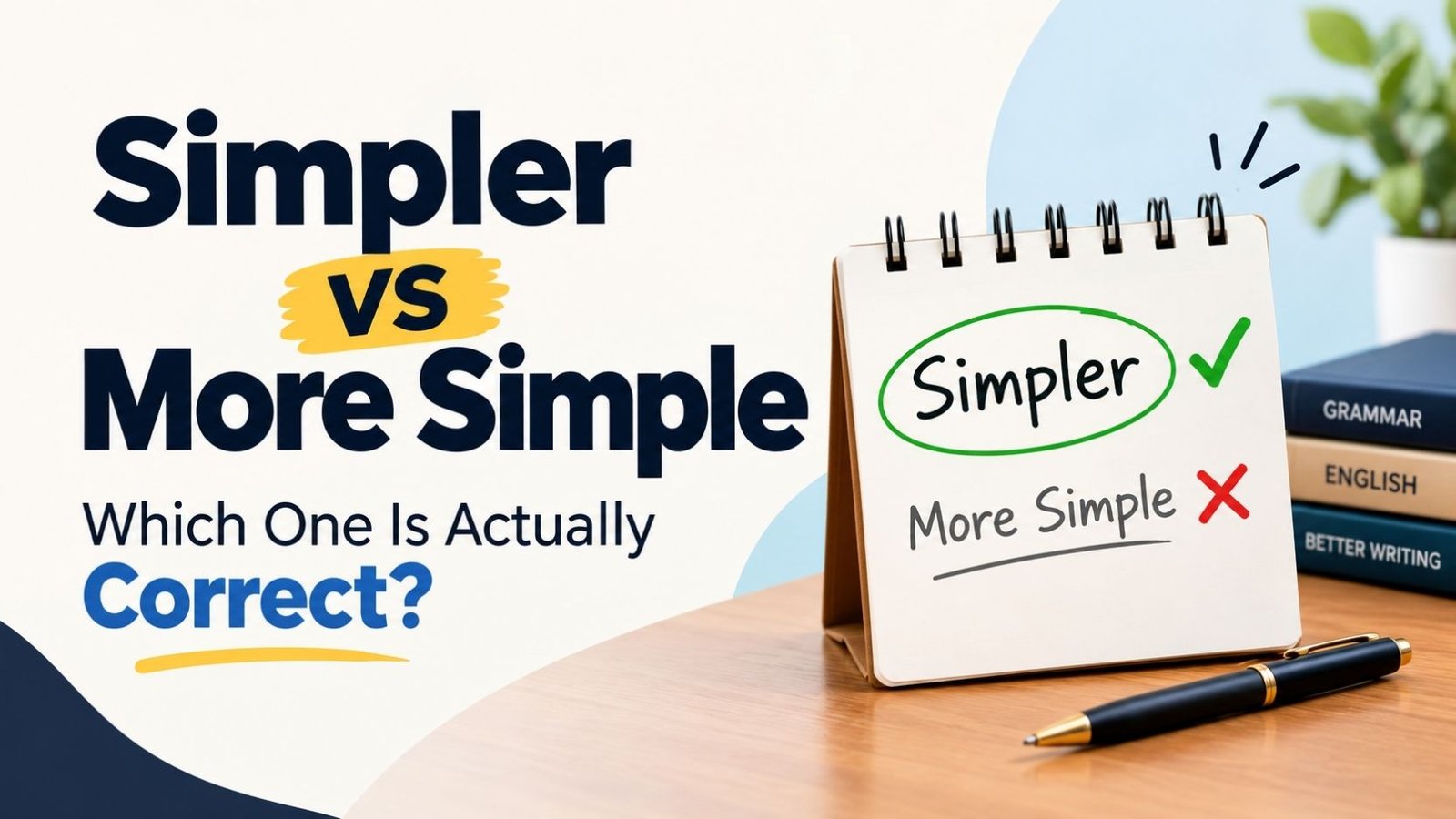
If you have ever paused mid-sentence wondering whether to write “simpler” or “more simple,” you are not alone. Both phrases show up in everyday writing, but only one follows standard English grammar rules. The short answer: simpler is the correct and preferred form in almost every situation.
Understanding why comes down to a simple rule about short adjectives. English usually adds “er” to short words instead of pairing them with “more.” Once you see the pattern, you will never have to guess again. This article walks through the grammar rule, the exceptions, real examples, and the small number of cases where “more simple” is still heard in casual speech.
What Does Simpler Mean?
Simpler is the comparative form of the adjective simple. It describes something that is easier to understand, easier to do, or less complicated than something else.
For example:
- This recipe is simpler than the one we tried last week.
- Can you find a simpler way to explain this?
- The new app has a simpler design than the old version.
In each case, simpler is comparing two things: one is less complicated than the other. It follows the same pattern as words like faster, cleaner, and smarter.
See More: Transferred Vs Transfered
Simpler or More Simple: The Grammar Rule
English forms comparative adjectives in two main ways.
Short adjectives (usually one or two syllables) take the ending “er.” Examples: fast becomes faster, small becomes smaller, simple becomes simpler.
Longer adjectives (usually three or more syllables) use “more” instead. Examples: expensive becomes more expensive, complicated becomes more complicated.
The word simple has two syllables: sim and ple. Two-syllable adjectives that end in a consonant plus “le” almost always take the “er” ending rather than “more.” Other examples in this same category include gentle (gentler), noble (nobler), and humble (humbler).
This is why simpler, not more simple, is the grammatically standard choice.
Quick Reference Table
| Adjective type | Rule | Example |
| One syllable | Add “er” | fast becomes faster |
| Two syllables ending in consonant plus “le” | Add “er” | simple becomes simpler |
| Two syllables, other endings | Often either “er” or “more” | polite becomes politer or more polite |
| Three or more syllables | Use “more” | difficult becomes more difficult |
Is Simpler or More Simple Correct?
Simpler is correct according to standard English grammar. Major dictionaries and grammar references list simpler as the comparative form of simple, and style guides consistently recommend it over more simple.
More simple is not technically wrong in the sense of being unintelligible. Native speakers use it in casual conversation, and listeners understand it without confusion. However, it goes against the standard comparative rule, so most editors, teachers, and grammar checkers will flag it as nonstandard or awkward.
💡 Tip: If you are writing for school, work, or any formal document, choose simpler. Save more simple for relaxed, spoken contexts, if you use it at all.
Simpler vs More Simple: Side-by-Side Comparison
| Form | Grammar status | Common use |
| Simpler | Standard, correct comparative | Writing, speech, formal and informal contexts |
| More simple | Nonstandard but understandable | Casual speech, sometimes for emphasis or rhythm |
Why Do People Say More Simple at All?
A few reasons explain why more simple still appears in speech and informal writing.
First, English has many longer adjectives that require “more,” so the pattern feels familiar and gets applied out of habit, even to short words like simple.
Second, some speakers use more simple for emphasis or a particular sentence rhythm, especially in spoken English. Saying “make it more simple” can sometimes feel more natural in the flow of a sentence than “make it simpler,” even though simpler remains the grammatically preferred choice.
Third, double comparatives and nonstandard comparative forms are common in everyday speech across many dialects. This does not make them grammatically standard, but it does explain why they persist.
See More: Camouflage Or Camoflauge
How to Use Simpler in a Sentence
Simpler works the same way as other comparative adjectives. It usually appears with “than” when comparing two specific things, or on its own when the comparison is implied.
With “than”:
- Walking is simpler than driving in this traffic.
- Her explanation was simpler than the textbook’s version.
Without “than” (comparison implied):
- Let’s find a simpler solution.
- I want a simpler life.
Common Mistakes With Simpler and More Simple
❌ Incorrect: This method is more simpler than the old one.
✅ Correct: This method is simpler than the old one.
This is a double comparative. Combining “more” with an “er” ending is grammatically incorrect, even though it sometimes slips into casual speech. Never use “more” and “er” together on the same adjective.
❌ Incorrect: Make it more simple, please.
✅ Correct: Make it simpler, please.
While understandable, “more simple” is not the standard comparative form and should be avoided in formal writing.
❌ Incorrect: This is the most simplest option.
✅ Correct: This is the simplest option.
The same double comparative problem applies to superlatives. Use simplest on its own, never most simplest.
Simpler vs Simplest: What Is the Difference?
Simpler is the comparative form, used when comparing two things. Simplest is the superlative form, used when comparing three or more things and identifying the one with the least complexity.
- Simpler: This plan is simpler than that one. (two things compared)
- Simplest: This is the simplest plan of all three. (three or more things compared)
Is Simpler a Word?
Yes, simpler is a standard English word. It is the comparative form of the adjective simple and appears in every major English dictionary. There is no debate among grammar authorities about whether simpler is a legitimate word; the only real question is whether to use simpler or more simple, and simpler wins that comparison.
Pronunciation of Simpler
Simpler is pronounced SIM pler, with the stress on the first syllable. It rhymes with words like dimpler when read aloud, though that word is far less common. The “le” at the end is pronounced as a soft “ul” sound, similar to the ending in table or apple.
Simpler or More Simple: What Do Style Guides Say?
Style and grammar references generally agree that two-syllable adjectives ending in “le,” such as simple, gentle, and noble, take the “er” ending rather than “more.” This is treated as a standard rule rather than a matter of personal preference.
Writers who want their work to read as polished and grammatically correct should default to simpler in nearly all contexts, reserving more simple only for situations where a specific rhythm or emphasis is intended in spoken or highly informal language.
Examples of Simpler in Real Sentences
- The instructions became simpler once the company redesigned the packaging.
- I switched to a simpler budgeting method, and it made saving money much easier.
- Their second product is simpler to use than their first one was.
- We need a simpler explanation for new employees during training.
- Life felt simpler before everyone carried a smartphone everywhere.
Related Words and Synonyms
| Word | Meaning | Difference from simpler |
| Easier | Less difficult to do | Focuses on effort, not necessarily complexity |
| Clearer | Easier to understand | Focuses on clarity, not overall complexity |
| Plainer | Less decorated or complicated | Often used for style or appearance |
| Less complicated | Fewer complex parts | A longer phrase, same general meaning as simpler |
Simpler is the most direct comparative choice when talking about complexity itself, while these related words shift the focus slightly toward effort, clarity, or style.
See More: Sleave Or Sleeve
Frequently Asked Questions
Is it simpler or more simple?
Simpler is the grammatically correct comparative form of simple. More simple is understood in casual speech but is considered nonstandard.
Is simpler a real word?
Yes. Simpler is listed in standard English dictionaries as the comparative form of simple.
Why is simpler correct instead of more simple?
Simple is a two-syllable adjective ending in a consonant plus “le.” Adjectives in this category typically take the “er” ending rather than pairing with “more.”
Can I ever use more simple?
You can, especially in casual spoken English, and people will understand you. It is just not the standard grammatical choice for formal writing.
What is the superlative form of simple?
The superlative form is simplest, used when comparing three or more things.
Is “more simpler” correct?
No. This is a double comparative and is considered incorrect. Use either simpler or more simple, never both together.
How do you pronounce simpler?
It is pronounced SIM-pler, with stress on the first syllable.
What is the difference between simpler and simplest?
Simpler compares two things. Simplest identifies the least complicated option among three or more things.
Is “simpler than” or “more simple than” correct?
Simpler than is the standard, grammatically correct phrase. More simple than is understandable but nonstandard.
What type of word is simpler?
Simpler is an adjective, specifically the comparative form of simple.
Final Thoughts
Simpler is the correct comparative form of simple, and it follows a clear, consistent grammar rule that applies to many short, two-syllable adjectives ending in “le.” While more simple appears in casual speech and is easily understood, it does not match standard English grammar, and careful writers should choose simpler instead, especially in formal or professional writing.
The next time you are deciding between simpler and more simple, remember the pattern behind it: short adjectives take “er,” not “more.” Trust that rule, and your writing will stay clear, correct, and easy for any reader to follow.

Danish Raza is the author of Grammavio, a trusted resource for simple and easy-to-understand English grammar guides. He creates helpful content covering grammar rules, word meanings, vocabulary, and common grammar mistakes to help readers improve their English skills.


