
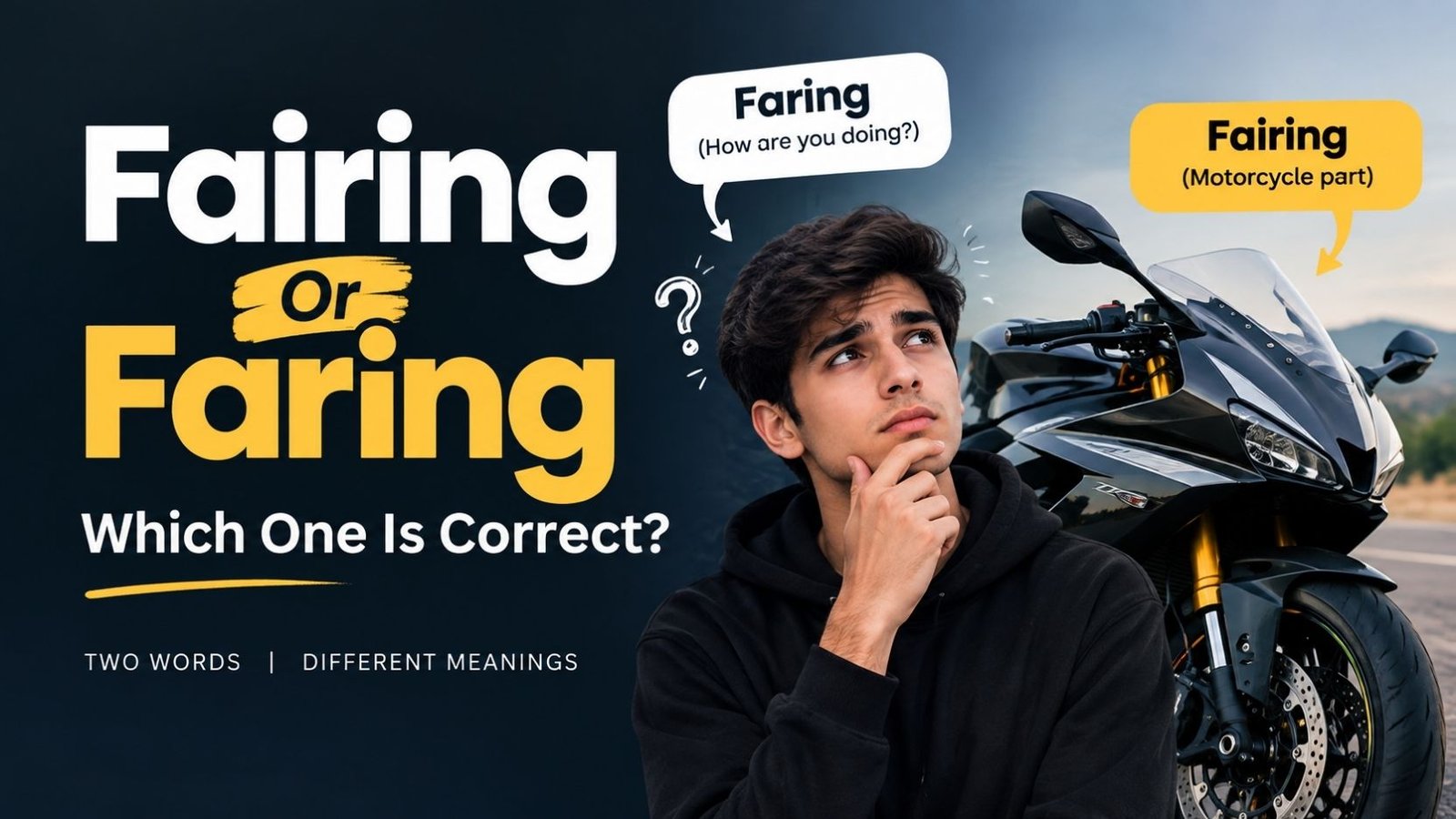
If you are asking someone how they are doing, the correct word is faring, as in “How are you faring?” Fairing is a completely different word. It usually refers to a curved motorcycle part or, less commonly, a small gift given at a fair. These two words sound alike, but they do not mean the same thing.
This mix-up happens because fairing and faring are near homophones. They sound almost identical when spoken aloud, so it is easy to type the wrong one, especially on a phone.
Getting this right matters more than it might seem. Using fairing instead of faring in a sentence like “How are you fairing?” is one of the most common small grammar mistakes in everyday English. It can make a message look careless, even when the rest of the writing is polished. Once you know the difference, you will never mix them up again.
Quick Answer: Fairing or Faring
Here is the short version before we go further.
| Word | Part of Speech | Meaning | Example |
| Faring | Verb (from “to fare”) | Doing, progressing, getting along | How are you faring today? |
| Fairing | Noun | A protective or streamlined outer shell, usually on a motorcycle | He installed a new batwing fairing on his Harley. |
If your sentence is about someone’s wellbeing, progress, or how a situation is going, use faring. If your sentence is about a motorcycle part, a curved shell, or a small trinket from a fair, use fairing.
Read More: Worse Case Or Worst Case
What Does Faring Mean?
Faring is the present participle of the verb to fare. The verb to fare means to get along, to progress, or to experience a certain outcome in a situation.
💡 Tip: If you can replace the word with “doing” or “getting along” and the sentence still makes sense, you need faring.
For example:
- How are you faring? means How are you doing?
- She is faring well in her new job means She is doing well in her new job.
- The team is faring poorly this season means The team is performing badly this season.
Faring almost always appears with a helping verb, such as is, are, was, or were, because it functions as part of a continuous verb form.
How Are You Faring Meaning
“How are you faring” is a polite, slightly formal way of asking how someone is doing, especially during or after a difficult situation, a challenge, a project, or a change in circumstances. It carries a small sense of checking on someone’s progress or coping, not just casual small talk.
- How are you faring after the move? Asks about adjustment to a new situation.
- How are you faring with the new software? Asks about progress or difficulty with a task.
- How are you faring during recovery? Asks about someone’s condition or progress while healing.
This phrase fits naturally in emails, check-ins, and conversations where you want to sound thoughtful rather than purely casual.
Faring Well Meaning
Faring well means doing well, succeeding, or coping successfully with a situation. It is often used to describe how someone or something is performing under certain conditions.
- The business is faring well despite the slow economy.
- He is faring well after the surgery.
- Local farmers are faring well this season thanks to good weather.
The opposite, faring poorly or faring badly, describes struggling or performing below expectations.
Faring Better Meaning
Faring better is a comparative form. It means doing better than before, or doing better than someone or something else.
- She is faring better than last month.
- Our team is faring better than expected this quarter.
- Patients who exercise regularly tend to be faring better in recovery.
What Does Fairing Mean?
Fairing is a noun with two accepted meanings, and both are genuinely useful to know.
Meaning 1: Motorcycle and Vehicle Fairing
In vehicles, especially motorcycles, a fairing is a shell or shield fitted around the frame. Its job is to reduce air resistance, protect the rider, and often improve the appearance of the bike.
This is by far the most common modern use of the word fairing, especially in motorcycle communities.
- He upgraded to a full fairing for better wind protection on the highway.
- The batwing fairing gives the front of the bike a rounded, aerodynamic look.
- A new fairing kit can completely change the look of an older motorcycle.
Different motorcycle brands and models have their own popular fairing styles, which is why terms like batwing fairing, road glide fairing, sportster fairing, and dyna fairing show up often in rider forums and product listings. These all describe the same basic idea: a shaped shell attached to the bike, just designed for a specific model or riding style.
Meaning 2: A Small Gift or Trinket
In older and more traditional British English, a fairing is a small gift or trinket, especially one bought or given at a country fair. This use is far less common today but still appears in older texts, poetry, and some regional British speech.
- She kept the little porcelain figure as a fairing from her grandmother.
- Fairings were once given as tokens of affection at village fairs.
This meaning is mostly historical now, but it explains where the word itself comes from.
Fairing vs Faring: Side by Side Comparison
| Feature | Fairing | Faring |
| Word type | Noun | Verb (participle) |
| Root word | Fair (a noun, an event) | Fare (a verb, to get along) |
| Common use | Motorcycle part | How someone is doing |
| Example sentence | The bike has a cracked fairing. | He is faring well after treatment. |
| Everyday frequency | High in motorcycle contexts | High in general conversation |
Read More: Through vs Thru
Why the Confusion Happens
Fairing and faring are separated by a single letter, and when spoken quickly, that letter barely changes the sound. Both words tend to blend the middle vowel sound, so listeners hear something close to “fair ing” either way.
Autocorrect makes this worse. Many phones and typing apps treat fairing as the more common or expected spelling, since it appears frequently in product names and shopping searches. This means people typing “How are you faring” sometimes get quietly corrected to “How are you fairing” without noticing.
⚠️ Common mistake: Typing “How are you fairing?” when you mean to ask about someone’s wellbeing. This is grammatically incorrect, since fairing is a noun describing an object, not a verb describing a state of being.
Grammar Breakdown
Faring: Grammar Details
Faring comes from the base verb to fare.
- Base form: fare
- Present participle: faring
- Past tense: fared
- Used with: is, are, was, were (continuous tense)
Correct structure: subject plus a form of “to be” plus faring.
- I am faring well.
- They are faring badly.
- She was faring okay before the delay.
Faring cannot stand alone as a full verb. It always needs a helping verb before it in a sentence.
Fairing: Grammar Details
Fairing is a countable noun.
- Singular: fairing
- Plural: fairings
Correct structure: fairing functions like any regular object noun, so it can take an article (a, the) and be modified by adjectives.
- The bike has a new fairing.
- These fairings are lightweight and durable.
- A cracked fairing can affect wind protection.
Because fairing is a noun, it never appears directly after am, is, are, was, or were in the way faring does. If you see “is fairing” or “are fairing” used to describe a feeling or condition, that is almost always a spelling mistake for faring.
How To Pronounce Fairing And Faring
Both words are pronounced very similarly in everyday speech, which is part of why the mix up is so common.
- Faring: FAIR ing (rhymes with “pairing”)
- Fairing: FAIR ing (also rhymes with “pairing”)
In careful, formal speech, some speakers slightly shorten the first syllable of fairing, but in natural conversation, most English speakers pronounce them the same way. This means pronunciation will not help you tell them apart. Spelling and grammar are the only reliable guides.
Origin Of The Words
Origin of Fare and Faring
Fare comes from the Old English word faran, meaning to travel or to journey. Over time, its meaning expanded from physical travel to a broader sense of getting along or experiencing an outcome in life. This is why we still say safe journey type phrases like “farewell,” which literally means “may your journey go well.”
Faring, as the continuous form of fare, developed naturally alongside this shift in meaning.
Origin of Fairing
Fairing comes from the noun fair, meaning a public gathering or market event, combined with the suffix ing, which historically indicated something associated with or produced for that event. A fairing was originally a small item purchased or given as a keepsake at a fair.
The motorcycle and vehicle sense of fairing developed much later, in the twentieth century, as engineers needed a word for the smooth outer covering used to reduce drag. The word was borrowed because the covering fits over the frame the way a shell or shield fits over something, though this use has no direct historical connection to fairs or fair events.
Fairing or Faring in Real Sentences
Here are natural examples that show the correct word in context.
- Correct: How is your sister faring since she started the new job?
- Incorrect: How is your sister fairing since she started the new job?
- Correct: The company installed a sleek fairing on the front of the new motorcycle model.
- Incorrect: The company installed a sleek faring on the front of the new motorcycle model.
- Correct: He is faring reasonably well, considering everything he has been through.
- Correct: The old fairing had a small crack near the headlight.
Common Mistakes
❌ Incorrect: I hope you are fairing well.
✅ Correct: I hope you are faring well. Why: Faring, not fairing, describes how someone is doing.
❌ Incorrect: How is the business faring these days? (when talking about the bike part)
✅ Correct: How is the business faring these days? is actually correct here, because faring fits progress and wellbeing. Note: This example shows that context decides the right word, not habit or spelling preference.
❌ Incorrect: He bought a new fareing for his motorcycle.
✅ Correct: He bought a new fairing for his motorcycle. Why: Fairing, not fareing, is the correct spelling for the motorcycle part.
Read More: Sensor Or Censor
Similar and Related Words
| Word | Meaning | Difference from Fairing or Faring |
| Fare | Base verb, or a noun meaning ticket price | Fare can be a verb (to fare) or a noun (bus fare), while faring is only the continuous verb form |
| Farewell | A parting goodbye | Comes from the same root as fare, but has become its own fixed word |
| Shielding | A protective covering | Similar concept to a motorcycle fairing, but shielding is a general term, not specific to vehicles |
Frequently Asked Questions
Is it “how are you fairing” or “how are you faring”?
It is “how are you faring.” Faring means doing or getting along, which fits the question about someone’s well-being. Faring is a noun, so it cannot follow “are you” in this way.
What does faring mean in simple words?
Faring simply means doing or getting along. If someone asks “How are you faring?” they are asking how you are doing.
What does fairing mean on a motorcycle?
A fairing is the curved shell fitted around a motorcycle’s frame. It reduces wind resistance, protects the rider, and often improves the bike’s appearance.
Is faring a real word?
Yes, faring is a real word. It is the present participle of the verb to fare, and it appears in standard dictionaries.
Is fairing a real word?
Yes, fairing is a real word. It is a noun that refers to a protective outer shell, most commonly on motorcycles, or, in older usage, a small gift from a fair.
What is the difference between fairing and faring?
Faring is a verb form describing how someone or something is doing. Fairing is a noun describing an object, usually a motorcycle part.
How do you use faring in a sentence?
Use faring after a helping verb like is, are, was, or were. For example, “She is faring well after the surgery.”
Can fairing ever mean the same thing as faring?
No. They are unrelated in meaning, even though they sound alike. Fairing never describes well-being or progress.
Why do people confuse fairing and faring?
The two words sound almost identical when spoken, and autocorrect tools sometimes change faring to fairing because fairing appears more often in product listings and shopping searches.
What type of word is faring?
Faring is a verb, specifically the present participle form of to fare.
What type of word is fairing?
Fairing is a noun.
Final Thoughts
Fairing and faring look almost the same and sound almost identical, but they belong to completely different parts of speech. Faring is a verb form used to describe how someone or something is doing, as in “How are you faring?” Fairing is a noun, most often referring to the curved shell on a motorcycle, and occasionally to a small gift from a traditional fair.
The easiest way to remember the difference is to think about the sentence itself. If you are asking about wellbeing, progress, or how a situation is going, faring is always the right choice. If you are talking about an object, especially a motorcycle part, fairing is the word you need. Once this distinction clicks, the mix-up disappears for good.

Danish Raza is the author of Grammavio, a trusted resource for simple and easy-to-understand English grammar guides. He creates helpful content covering grammar rules, word meanings, vocabulary, and common grammar mistakes to help readers improve their English skills.



4 Comments