
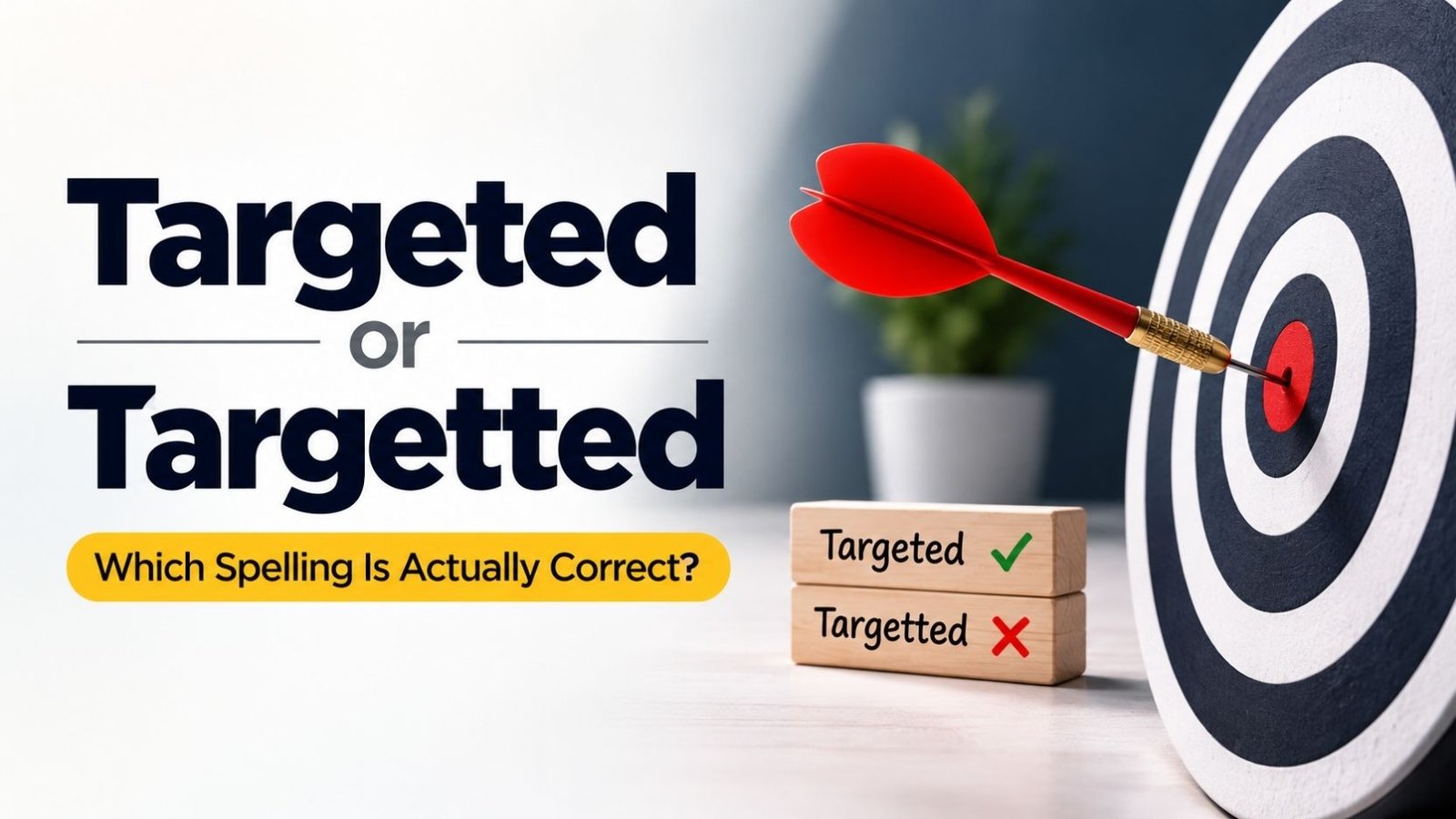
If you have ever paused halfway through typing this word and wondered whether it needs one T or two, you are not alone. The correct spelling is targeted, with a single T, in both American English and standard British English. Targetted, with a double T, is a common misspelling that shows up often in casual writing, social media posts, and even some marketing content. It is easy to see why people get confused, since many similar English verbs do double their final consonant before adding an ending.
This confusion matters more than it might seem. Marketers write about targeted advertising, doctors discuss targeted therapy, and journalists cover targeted individuals or targeted policies. Getting the spelling wrong in a headline, a resume, or a medical article can quietly undermine credibility. Understanding the simple grammar rule behind this word clears up the confusion permanently, and it also helps with dozens of similar English words that follow the same pattern.
Targeted or Targetted: The Simple Answer
Targeted is correct. Targetted is incorrect in every standard form of English, whether you are writing for a US audience, a UK audience, or any other English-speaking region. There is no regional variation here, unlike some other spelling differences between American and British English, such as color versus colour or organize versus organise.
The word target already ends in a consonant, but the rule that doubles a final consonant before adding ed only applies under specific conditions. Target does not meet those conditions, so it keeps a single T when it becomes targeted.
Read More: Sweeped Or Swept
Why People Think It Might Be Targetted
English has a well-known pattern where a short word ending in a single consonant doubles that consonant before adding a suffix like -ed or ing. Think of words like stop, which becomes stopped, or plan, which becomes planned. This pattern is real, and it applies constantly in everyday English. The problem is that people sometimes apply the rule too broadly, extending it to longer words where it does not belong.
Target looks similar to these short words on the surface. It ends in a consonant, and it seems to follow the same shape. But the target is a two-syllable word, and the doubling rule depends heavily on where the stress falls in the word, not just on the letters at the end.
The Grammar Rule Behind Targeted
English spelling for verbs ending in a single consonant follows a fairly consistent pattern once you understand the stress rule.
Rule for doubling the final consonant: A final consonant is doubled before adding ed or ing only when:
- The word ends in a single vowel followed by a single consonant
- The stress falls on the final syllable of the word
How target behaves:
- Target is pronounced TAR get, with the stress on the first syllable, not the second
- Because the stress falls on the first syllable, the final consonant does not double
- This gives you targeted, not targetted
Compare this with a word like permit. Permit is pronounced per MIT, with stress on the second syllable, so it becomes permitted with a doubled T. Target simply does not follow that same stress pattern, which is the entire reason the spelling differs.
Quick Comparison Table
| Word | Stress Pattern | Correct Past Tense | Why |
| Target | TAR get (first syllable) | Targeted | Final consonant not doubled because stress is not on the last syllable |
| Permit | per MIT (second syllable) | Permitted | Final consonant doubled because stress falls on the last syllable |
| Visit | VIS it (first syllable) | Visited | Same pattern as target, single T |
| Occur | oc CUR (second syllable) | Occurred | Stress on final syllable, so the R doubles |
This table shows the pattern clearly. Whenever the stress sits on the first part of the word, English tends to keep a single final consonant. Target and visit behave the same way, which is a helpful way to remember the rule.
Targeted or Targetted UK Spelling
A common search people run is targeted or targetted UK spelling, hoping there is a British exception. There is not. British English and American English agree completely on this word. Targeted is correct in both. This is different from many other spelling pairs where the UK and US diverge, so it is worth being clear that this particular rule has no exception on either side of the Atlantic.
If you check the Oxford English Dictionary or Cambridge Dictionary, both list targeted as the only accepted spelling. Merriam Webster, the standard American reference, agrees as well.
What Does Targeted Mean?
Now that the spelling is settled, it helps to look at what the word actually means, since it shows up in many different contexts.
Meaning 1: Aimed at a specific person, group, or goal: This is the most common everyday meaning. It describes something that is directed at a particular person or group rather than a general audience. Example: The company launched a targeted campaign for new parents.
Meaning 2: Chosen as the object of an attack, action, or criticism: This meaning appears often in news and legal contexts, where someone or something is singled out. Example: The activist felt targeted after receiving repeated threats online.
Meaning 3: Designed to affect a specific area, problem, or system: This is common in medicine, business strategy, and technology, where a solution is built to work on one specific issue rather than broadly. Example: The treatment uses a targeted approach that focuses only on cancer cells.
Targeted as a Grammar Form
Targeted is the past tense and past participle of the verb target. It can also function as an adjective when it describes a noun.
As a verb (past tense): The team targeted three new markets last year.
As a verb (past participle, used with have or be): This audience has been targeted by several competing brands.
As an adjective: The doctor recommended a targeted treatment plan.
This flexibility is one reason the word appears in so many different fields, from marketing to medicine to social commentary.
Targeted in Different Contexts
Because targeted appears across so many industries, it helps to see how the meaning shifts slightly depending on the setting.
Targeted Advertising and Targeted Marketing
In marketing, targeted advertising refers to ads shown to a specific audience based on interests, behavior, location, or demographics, rather than shown to everyone.
Targeted marketing works the same way, focusing resources on a defined group most likely to respond. This is different from broad or mass marketing, which does not narrow down the audience.
Targeted Therapy
In medicine, targeted therapy refers to treatments designed to act on specific molecules or pathways involved in disease, especially cancer, rather than affecting the entire body the way traditional chemotherapy does.
This is why you often see the phrase paired with specific cancer types, such as NSCLC targeted therapy, which refers to targeted treatments for non-small cell lung cancer. Ibrance targeted therapy is another real-world example, referring to a specific drug used in targeted breast cancer treatment.
Because this is a medical topic, it is worth noting that specific treatment decisions should always come from a licensed doctor, since individual cases vary significantly.
Read More: Homophone Vs Homograph
Targeted Individuals
The phrase targeted individuals is used by people who believe they are being secretly monitored, harassed, or attacked, often through surveillance or coordinated actions by unknown parties.
This term is widely discussed online, particularly in communities describing personal experiences of feeling targeted. It is a subjective, self-identified term rather than an official medical or legal classification.
Historical Context: Nazi Policy And Targeted Groups
Some readers search for information about what Nazi policy targeted people who had disabilities. During the Nazi regime, a program historically known as the T4 program targeted people with disabilities and certain mental illnesses, resulting in forced sterilization and mass killings.
This is a well-documented and tragic part of history, and it is an example of the word targeted being used in a serious historical and legal sense, referring to a group singled out for persecution.
Targeted Universalism
Targetted universalism, more accurately spelled targeted universalism, is a policy framework used in social and economic planning.
It sets one universal goal for everyone but allows different strategies to reach that goal depending on the specific needs of different groups. This term appears often in public policy and equity discussions.
Targeted Synonym Options
Depending on context, several words can substitute for targeted, though none are a perfect match in every situation.
| Word | Best Used When | Example |
| Focused | Describing effort or attention directed at one thing | A focused strategy for growth |
| Directed | Describing something aimed at a specific outcome | Directed criticism at the policy |
| Selected | Describing something chosen from a group | Selected customers received the offer |
| Aimed | Describing intent toward a specific goal | Aimed at reducing costs |
None of these words carry the exact same weight as targeted in specialized fields like medicine or advertising, so context should guide which synonym fits best.
Common Mistakes With Targeted
✅ Correct: The campaign targeted young professionals.
❌ Incorrect: The campaign targetted young professionals.
✅ Correct: This is a targeted approach to treatment.
❌ Incorrect: This is a targetted approach to treatment.
✅ Correct: Is it targeted or targetted?
❌ Incorrect: Is it targetted or targeted? (This phrasing is fine as a question, but only targeted is the correct spelling being asked about.)
The mistake almost always comes from overapplying the consonant doubling rule. Once you remember that target is stressed on the first syllable, the single T becomes much easier to recall permanently.
How To Pronounce Targeted
Targeted is pronounced TAR guh tid, with three syllables and the stress on the first syllable. The IPA pronunciation is commonly written as ˈtɑːr.ɡɪ.tɪd in American English.
The stress pattern here is the same clue that explains the spelling rule discussed earlier, so pronunciation and spelling are directly connected for this word.
Trek or Treck: A Related Spelling Question
While researching word spelling questions, many readers also search for trek or treck, which follows a completely different kind of confusion, though it comes from the same instinct to guess at spelling rather than check it.
The correct spelling is trek, not treck.
Trek refers to a long, difficult journey, often on foot. It can be used literally, describing a hike or expedition, or figuratively, describing any long and challenging process.
Example: They went on a trek through the mountains. Example: Finishing the project felt like a trek.
Treck is simply a misspelling. There is no dictionary, British or American, that lists treck as an accepted spelling. The confusion likely comes from words like check or deck, which do use the ck combination, leading some writers to assume trek should follow the same pattern. However, trek is a shorter, simpler word that never picked up that spelling convention.
Trek is also widely recognized because of the Star Trek franchise, which may reinforce the correct spelling for many readers, even if they are not consciously thinking about grammar rules when they see it.
Read More: Infront Or In Front
Trek as a Noun and Verb
Trek functions as both a noun and a verb.
As a noun: The trek to base camp took five days. As a verb: They plan to trek across the desert next spring.
The verb form changes slightly depending on tense.
| Form | Spelling | Example |
| Base form | Trek | We trek every summer. |
| Past tense | Trekked | We trekked for six hours yesterday. |
| Present participle | Trekking | They are trekking through Nepal now. |
Notice that trekked and trekking do double the final K. This is because trek is a single-syllable word, and the consonant doubling rule applies differently to one-syllable words than it does to multi-syllable words like target. Trek ends in a single vowel followed by a single consonant, and since it only has one syllable, that syllable automatically carries the stress, which triggers the doubling rule.
This is actually a useful comparison. Target and trek look like they might follow similar spelling logic, but they do not, because of syllable count and stress placement. Seeing them side by side helps explain why one word doubles its final letter, and the other does not.
Frequently Asked Questions
Is it targeted or targetted?
Targeted is correct. Targetted is a common misspelling and is not accepted in standard American or British English.
Which is correct, targeted or targetted?
Targeted is the only correct spelling. It applies in all English-speaking regions, including the United States and the United Kingdom.
Why is it targeted and not targetted?
Because the stress in the word target falls on the first syllable, not the last. English generally only doubles a final consonant before adding ed when the stress falls on the final syllable, so target keeps a single T.
Is targeted a noun or a verb?
Targeted is primarily a verb form, functioning as the past tense and past participle of target. It can also work as an adjective, as in a targeted approach.
How do you use targeted in a sentence?
You can use it as a verb, such as the company targeted new customers, or as an adjective, such as a targeted treatment plan.
What is targeted therapy?
Targeted therapy is a type of medical treatment, often used in cancer care, designed to act on specific molecules or pathways involved in disease rather than affecting the whole body broadly.
What does targeted individuals mean?
Targeted individuals is a term used by people who believe they are being secretly monitored or harassed, often through surveillance. It is a self-identified term rather than a formal clinical or legal category.
Is it trek or treck?
Trek is correct. Treck is a common misspelling with no accepted use in standard English dictionaries.
Why does trek double the K in trekking but target does not double the T in targeted?
Trek is a one-syllable word, so its single stressed syllable triggers the consonant doubling rule. Target has two syllables with stress on the first one, so the rule does not apply the same way.
Is targetted ever acceptable in informal writing?
No. Even in casual or informal writing, targetted is considered a spelling error, not an accepted variant.
Final Thoughts
Targeted is the correct spelling, with a single T, across every standard form of English. The confusion with targetted comes from a natural but mistaken attempt to apply a spelling rule that only works for words with different stress patterns. Once you remember that target is stressed on its first syllable, the single T becomes easy to recall for good.
Whether you are writing about targeted advertising, targeted therapy, or a targeted individual, using the correct spelling helps your writing look polished and professional. The same logic applies to trek, which stays as a simple four-letter word without the ck ending that some writers mistakenly add. Small spelling details like these might seem minor, but they quietly shape how readers judge the credibility of your writing.

Danish Raza is the author of Grammavio, a trusted resource for simple and easy-to-understand English grammar guides. He creates helpful content covering grammar rules, word meanings, vocabulary, and common grammar mistakes to help readers improve their English skills.



3 Comments