
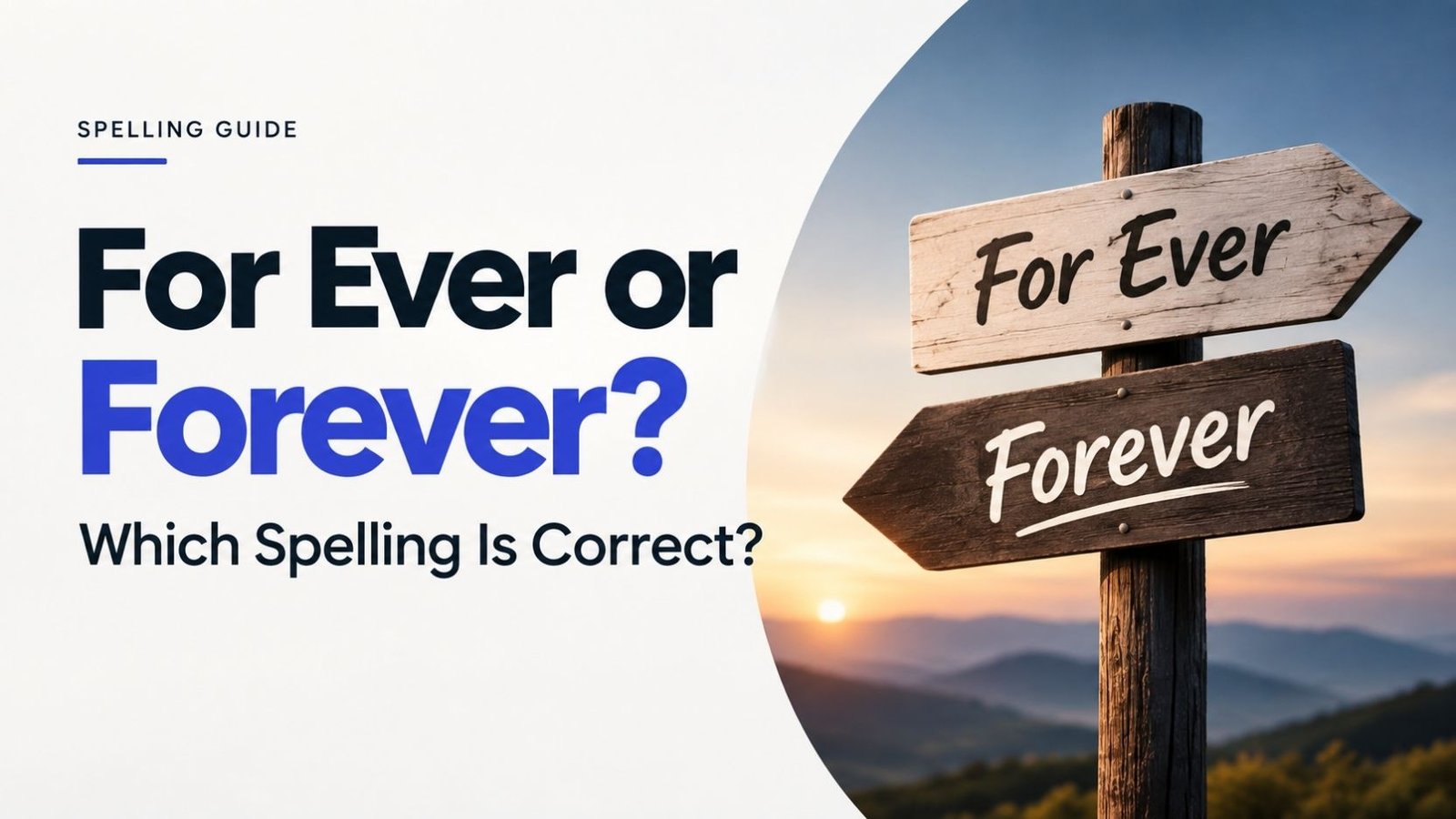
Forever is the correct spelling in almost every situation, especially in American English. For ever, written as two words, still appears in British English, but mainly in older or more formal writing. If you are asking whether to use for ever or forever in a normal sentence today, the safe answer is forever.
This small spelling choice confuses a lot of people because both versions look like they should mean the same thing, and in many cases they do. The difference comes down to region, formality, and sometimes a subtle shift in meaning that most dictionaries only mention in passing.
Understanding this word matters more than it seems. People search for ever or forever when writing wedding vows, tattoos, song lyrics, captions, and everyday messages. A small spelling mistake in a permanent context, like a tattoo or an engraved ring, is hard to undo. This guide explains the meaning, the grammar, the history, and the real-world usage so you never have to guess again.
For Ever or Forever: The Simple Answer
In American English, forever is always one word. There is no situation in modern US writing where for ever, written separately, is considered standard.
In British English, the picture is a little different. Forever is now the preferred and most common spelling, but for ever still shows up in formal writing, older texts, religious language, and some literary contexts, especially when the meaning leans toward eternal rather than continual.
Here is the short version in a table.
| Region | Preferred Spelling | Two Word Version Acceptable |
| American English | Forever | No |
| British English (modern, general use) | Forever | Yes, in formal or traditional contexts |
| British English (older or literary texts) | For ever | Yes, historically standard |
If you are writing for a US audience, a school assignment, a business document, or almost any modern content, forever is the correct choice. If you are writing British English and want a slightly formal or traditional tone, for ever is not wrong, but it is no longer necessary either.
Read More: Pastor Or Paster
What Does Forever Mean?
Forever is an adverb. Its core meaning is simple: for all future time, without end.
Meaning 1: Without End, Eternally
This is the meaning most people think of first. It describes something that continues without stopping, often used in emotional or dramatic contexts.
- I will love you forever.
- This memory will stay with me forever.
- Nothing lasts forever.
Meaning 2: Continually or Constantly
Forever can also describe something that happens repeatedly, often in an annoying or persistent way. This meaning is informal and common in everyday speech.
- She is forever losing her keys.
- He is forever complaining about the weather.
- They are forever changing their minds.
Meaning 3: A Very Long Time (Informal)
In casual conversation, forever often means a long time, not literal eternity. This is exaggeration, and everyone understands it that way.
- It took forever to get through security.
- Waiting for the bus felt like forever.
- I have not seen you in forever.
These three meanings share one thing in common: forever always points to time that stretches on, whether that is truly endless or just feels that way.
Is For Ever or Forever the Older Spelling?
For ever is actually the original form. Forever started as two separate words, a preposition (for) plus an adverb (ever), and the two gradually merged into a single word over centuries of use.
According to etymological records, the phrase can be traced back to around the year 1300, appearing in Middle English texts. At that time, writers used for ever as two distinct words, each carrying its own grammatical role. Over time, especially in American usage, the two words fused into the single, solidified form we now recognize as standard.
This explains why British English held onto the two word spelling longer than American English. Language change often moves at different speeds across regions, and Britain kept the traditional two word form in formal writing well into the twentieth century, even as the fused spelling became common in everyday use.
Today, most British dictionaries list both forever and for ever, with forever appearing first as the primary, more common entry. That order matters. It signals that even in the UK, forever has become the default.
For Ever or Forever: What Do Dictionaries Say?
Dictionaries are the most reliable place to settle this question, since usage guides and personal preference can vary.
American dictionaries: are consistent. Standard US dictionaries treat forever as the only correct spelling for the adverb meaning continually or eternally. For ever, as two words, is not listed as a standard American form at all.
British dictionaries: take a more flexible position. Major British dictionaries list forever and for ever as valid spellings for the meaning of “without end,” but note that forever is now the more commonly used and preferred form across most contexts.
Some usage guides draw a finer distinction. Older editions of certain British style guides once argued that for ever should be used specifically for the meaning of “eternally,” while forever should be reserved for the meaning of “continually” or “persistently,” as in “he is forever forgetting his umbrella.” However, more recent usage guides, including respected modern references, now describe the two-word spelling as largely old-fashioned, noting that the single-word form has become standard in both American and British English for practical purposes.
In short: if a dictionary lists both spellings, it almost always ranks forever first, because that is what the majority of speakers and writers actually use.
For Ever or Forever: Grammar Explained
Understanding the grammar behind this word helps explain why the confusion exists in the first place.
Forever as One Word
When written as a single word, forever functions as an adverb. It modifies a verb, adjective, or the sentence as a whole, describing how long something continues.
Example sentence structure:
Subject + verb + forever
- The bond between them will last forever.
- She promised to stay forever.
Forever can appear at the end of a sentence, in the middle, or occasionally at the beginning for emphasis.
For Ever as Two Words
When written as two words, for is a preposition and ever is an adverb. Together, this older phrase functions the same way forever does today, meaning “for all time.” Grammatically, this construction is a prepositional phrase rather than a single fused adverb, which is part of why some traditional British style guides preferred it for formal writing.
- They lived happily for ever. (traditional British style)
- Gone for ever, never to return. (older, literary tone)
Functionally, both versions do the same grammatical job in a sentence. The difference is spelling convention, not a difference in grammatical category for most modern readers.
Quick Grammar Reference
| Form | Part of Speech | Typical Use |
| Forever | Adverb (single word) | Standard in American and modern British English |
| For ever | Prepositional phrase (two words) | Traditional or formal British English, older texts |
Read More: Conducive To Or For
How to Pronounce Forever
Forever is pronounced with three syllables: fer EV er.
- American English: /fərˈɛvər/
- British English: /fəˈrɛvə/
The stress falls on the second syllable in both accents. The main difference between American and British pronunciation is the final “r” sound. American English pronounces it clearly, while many British accents soften or drop it, a common pattern in non-rhotic British speech.
Since for ever is spelled with a space but pronounced the same way as forever, pronunciation is not a factor in deciding which spelling to use. The choice is purely about writing convention, not sound.
For Ever or Forever: Which One Should You Use?
Use this simple decision guide based on what you are writing.
- Writing for an American audience: use forever, always one word.
- Writing British English for general or modern use: use forever, since it is now the more common and accepted form.
- Writing formal, literary, or traditional British English: for ever is acceptable, though not required.
- Writing a tattoo, engraving, wedding vow, or anything permanent: use forever unless you specifically want a traditional or old-fashioned British look, since forever is far less likely to be flagged as unusual or seen as a spelling mistake.
- Writing lyrics, poetry, or stylized text: either form can work for artistic effect, but forever remains the safer and more widely recognized choice.
If you are ever unsure, forever is almost always the right call. It works in both American and British contexts; it will not look wrong to most readers, and it matches how the majority of people actually write and read the word today.
Common Mistakes With Forever
Incorrect: I will love you for-ever.
Correct: I will love you forever. There is no hyphen in the word forever. A hyphenated version is not a recognized spelling in any standard dictionary.
Incorrect: They stayed togather forever.
Correct: They stayed together forever. This is not a forever spelling issue, but it commonly appears alongside forever in sentimental writing, so it is worth double-checking nearby words too.
Incorrect: Forever and ever, amen and ever.
Correct: Forever and ever, amen. This is a phrasing mistake rather than a spelling one, but it shows how easy it is to overcomplicate a simple, well-known expression.
Incorrect (in American writing): For ever, as two separate words, used casually.
Correct: Forever, one word, for standard American writing. Two-word spelling in American content often reads as an error to US readers, even though it is technically valid in traditional British English.
Forever and Ever, Forever More, and Other Related Phrases
Several set phrases build on forever, and each has a slightly different tone or use.
Forever and Ever
This phrase intensifies the sense of eternity, often used in religious, poetic, or emotional language. It appears in traditional prayers, vows, and expressions of deep commitment.
- Glory to you, now and forever and ever.
- I will stand by you forever and ever.
Forever More or Forevermore
Forevermore is typically written as one word in modern usage and means the same as forever, but with a more poetic or old-fashioned tone. It often appears in literature, formal writing, or lyrics rather than everyday conversation.
- From this day forward, and forevermore.
Forever Young
This phrase, popularized in music and pop culture, describes staying youthful in spirit or appearance, regardless of actual age. It is used both literally and as a metaphor.
For Ever and a Day
An informal, slightly playful way of emphasizing a very long or endless time, often used in casual speech rather than formal writing.
Synonyms and Related Words
Several words overlap with forever but carry their own shade of meaning.
| Word | Meaning | Difference From Forever |
| Eternally | Without end, timeless | More formal and often used in poetic or philosophical contexts |
| Always | At all times, consistently | Broader in use, does not always imply endless time |
| Permanently | In a fixed, unchanging way | Focuses on a state remaining the same, not just duration |
| Endlessly | Without stopping | Often used for repeated actions, similar to the “continually” sense of forever |
| Indefinitely | For an unspecified length of time | Suggests uncertainty about when something will end, unlike the definite endlessness of forever |
Choosing between these words depends on tone. Forever tends to feel warmer and more personal, which is why it appears so often in relationships, promises, and emotional writing, while eternally and permanently feel more formal or clinical.
Forever in Everyday Culture
Forever shows up constantly outside of grammar books, and its popularity in titles, brands, and phrases is part of why so many people search for its correct spelling.
The word appears in movie titles, song titles, and brand names, often stylized for emotional or memorable effect. Stamps in the United States that never expire in value are officially called forever stamps, a name that plays directly on the word’s meaning of permanence. Clothing and beauty brands sometimes use forever in their names to suggest timeless style or lasting quality.
None of these branded or stylized uses change the standard grammar rule. A brand name might choose unusual capitalization, spacing, or styling for marketing purposes, but that does not make for ever, as two words, the correct spelling in ordinary writing. When in doubt about a brand name specifically, it is best to check that brand’s own official spelling, since trademarks sometimes intentionally break standard spelling rules.
Read More: Chiefs Or Chieves
For Ever or Forever: Examples in Real Sentences
Seeing the word in different contexts helps confirm how natural forever sounds compared to the two-word form.
- Friendship like ours does not fade. It lasts forever.
- He promised they would be together forever.
- I have told you a thousand times, and I will keep telling you forever.
- This city will forever hold a special place in my heart.
- Some memories stay with you forever, long after everything else fades.
Each of these could technically be written with for ever in traditional British style, but forever reads as natural, correct, and modern in every single case.
Frequently Asked Questions
Is it for ever or forever?
Forever, written as one word, is correct in almost all modern writing, especially in American English. For ever, as two words, is only used in traditional or formal British English.
What does forever mean?
Forever means for all future time, without end. It can also mean continually, or informally, a very long time.
Is forever a noun, verb, or adverb?
Forever is primarily an adverb. It can also function informally as a noun, meaning an endless amount of time, as in “it took forever.”
Is for ever correct in British English?
Yes, for ever is grammatically valid in British English, particularly in formal or traditional writing. However, forever is now the more commonly used spelling, even in the UK.
Why do some people write for ever as two words?
This comes from the word’s history. Forever began as two separate words, for and ever, and only merged into one word over time. British English held onto the two-word spelling in formal contexts longer than American English did.
Is forever one word or two in American English?
Forever is always one word in American English. The two-word version is not considered standard in the United States.
How do you pronounce forever?
Forever is pronounced with three syllables, stressed on the second syllable, roughly as fer EV er.
What is the difference between forever and eternally?
Both describe unending time, but eternally tends to sound more formal or philosophical, while forever feels warmer and more personal, especially in everyday speech.
Is forevermore one word?
Yes, forevermore is typically written as a single word in modern usage. It means the same as forever, with a more poetic or old-fashioned tone.
Can forever mean something other than eternal?
Yes. Informally, forever can describe repeated or persistent behavior, such as “she is forever misplacing her phone,” or simply a long stretch of time, such as “that meeting felt like forever.”
Final Thoughts
Forever is the standard, correct spelling for nearly every situation, whether you are writing in American or British English. For ever, written as two words, survives mainly in traditional British usage, formal writing, and older literary texts, but even there, forever has become the more common choice.
If you take one thing away from this guide, let it be this: when in doubt, choose forever, one word, no hyphen, no space. It fits everyday writing, formal writing, emotional writing, and nearly every context in between, without ever looking out of place.

Danish Raza is the author of Grammavio, a trusted resource for simple and easy-to-understand English grammar guides. He creates helpful content covering grammar rules, word meanings, vocabulary, and common grammar mistakes to help readers improve their English skills.



One Comment