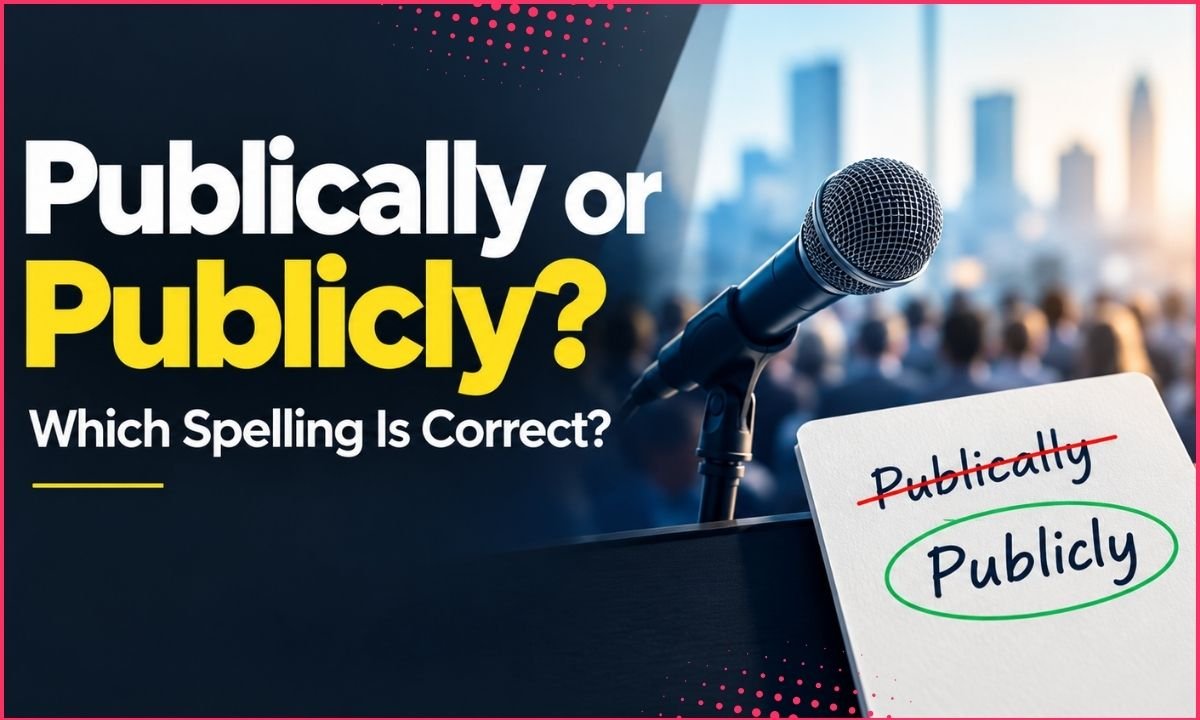
Publically or publicly? The correct spelling is publicly, with no extra “al.” It is an adverb that means openly, in a way people can see, hear, or access. This is the standard spelling in American, British, Canadian, and Australian English. “Publically” is a common misspelling, and major dictionaries do not treat it as the standard form.
Many writers add the extra “al” because most adjectives that end in “ic” take “ally” to form an adverb. Basic becomes basically, and tragic becomes tragically. Public is the exception. Getting it right matters in news, business, and school writing, where a spelling slip can weaken trust quickly.
Quick Answer: Publically or Publicly?
Correct: publicly
Incorrect: publically
Part of speech: adverb
Pronunciation: PUB-lik-lee (three syllables)
✅ The CEO spoke publicly about the new product.
❌ The CEO spoke publically about the new product.
If you are unsure, spell it publicly. This answer holds in the USA, the UK, Canada, and Australia. There is no regional version where “publically” is the preferred spelling.
Read More: Handsome or Hansom
What Does Publicly Mean?
Publicly describes something done in the open, rather than in private. It can also describe something done by or for the people as a whole. Here are the main meanings.
Meaning 1: Openly, where others can see or hear
The action is visible to anyone. She publicly thanked her team during the meeting.
Meaning 2: By the people, or for the public
The word can point to government or community involvement. The park is publicly funded.
Meaning 3: In business, open to public investors
Here it describes company shares that ordinary investors can buy on a stock exchange. The firm became a publicly traded company last year.
Publicly Grammar: Part of Speech and Word Forms
Publicly is an adverb. It usually tells you how, or in what way, something was done. It often sits before or after a verb.
| Form | Word | Example |
| Noun | public | The public has a right to know. |
| Adjective | public | They held a public meeting. |
| Adverb | publicly | The mayor publicly apologized. |
| Related noun | publicity | The film got a lot of publicity. |
| Related verb | publicize | They will publicize the results. |
The adverb does not change form. It has no plural and no past tense. If you need a comparison, use “more publicly.”
Why Is It Publicly and Not Publically?
Most English adjectives that end in “ic” form adverbs by adding “ally.” That is why you write basically, historically, and dramatically. Public does not follow this pattern. Its adverb simply adds “ly.”
| Adjective | Adverb | Pattern |
| basic | basically | ic + ally |
| tragic | tragically | ic + ally |
| economic | economically | ic + ally |
| public | publicly | Exception: ic + ly |
💡 Tip: Say the word out loud. You say three syllables, PUB-lik-lee. “Publically” would add a fourth syllable, and that is not how people say the word.
Because the “ally” pattern is so common, the wrong spelling feels natural. That is why it keeps appearing in emails, headlines, and search queries.
How to Pronounce Publicly
- Simple pronunciation: PUB-lik-lee
- IPA (American and British): /ˈpʌblɪkli/
- Stress: the first syllable
- Syllables: pub, lic, ly
The American and British pronunciations are essentially the same. The first vowel sounds like the “u” in “cup.”
Origin of the Word Public
The word public came into English from Old French, which took it from the Latin word publicus. The Latin word referred to the people as a whole. The adverb simply adds the usual “ly” ending to the adjective.
How to Use Publicly in a Sentence
Here are natural examples, grouped by common contexts.
Everyday and news usage:
- The singer publicly thanked her fans.
- The results were not publicly released until Friday.
Government and community usage:
- The library is publicly funded.
- The data is publicly available on the city website.
Business usage:
- The company is publicly traded on Nasdaq.
- Publicly listed firms must share regular financial reports.
Read More: Spiraled or Spiralled
Publicly Traded: What It Means
A publicly traded company is one whose shares can be bought and sold on a stock exchange. Anyone with a brokerage account can usually buy these shares. These companies must also share financial information with regulators and investors.
This is where many “is [company] publicly traded?” searches come from. People often want to know whether they can buy stock in a well-known firm. The answer depends on the company, and it can change over time.
Related Terms: Publicly Traded, Listed, Held, and Owned
| Term | Simple meaning | Example |
| Publicly traded | Shares trade on a public exchange | Apple is publicly traded. |
| Publicly listed | Same idea, listed on an exchange | A publicly listed bank |
| Publicly held | Owned by shareholders in the public | A publicly held corporation |
| Privately held | Owned by a small group, no public shares | A privately held startup |
| Publicly owned | Owned by the government or community | A publicly owned utility |
⚠️ Watch out: “Publicly owned” and “publicly traded” are not the same. A publicly owned utility belongs to the government. A publicly traded company belongs to shareholders.
Are These Companies Publicly Traded? A Status Check
Company status can change quickly, especially around an IPO (initial public offering). The notes below reflect what I found as of October 20, 2026. Please verify with a current source such as SEC filings or a stock exchange before making any financial decision. This is general information, not financial advice.
| Company | Status | Notes |
| SpaceX | Publicly traded | Began trading on the Nasdaq under the ticker SPCX on June 12, 2026 |
| xAI | Not separate | SpaceX acquired xAI in an all-stock merger in February 2026, so there is no standalone xAI listing |
| Anthropic | Not yet publicly traded | Confidentially submitted a draft registration statement to the SEC, which gives it the option to go public after review |
| OpenAI | Not publicly traded | Reported to have said its IPO would no longer happen in 2026 |
| Waymo | Not separately traded | A subsidiary of Alphabet, which is publicly traded |
| Anduril | Not confirmed as listed | One finance outlet describes its IPO as still ahead |
| Kalshi | Not confirmed | I could not verify a public listing |
On Anthropic, reports suggest a listing could come in the coming weeks. Bloomberg reported that the roadshow could start in the week of November, and as of late September, EDGAR showed no public S-1 from the company. Plans can slip, so treat any date as unconfirmed. For transparency, Anthropic is also the company that created me.
Publicly Available vs Publicly Accessible
“Publicly available” is a very common phrase. It means anyone can get or see the information without special permission.
- Publicly available data: open records, public reports, government statistics
- Publicly accessible: places or systems anyone can enter or use, such as a public website
The two phrases overlap. Use “available” for information and “accessible” when you stress ease of access.
Synonyms and Antonyms of Publicly
| Word | Meaning | Difference |
| Openly | Without hiding | Most common everyday synonym |
| In public | In a place others can see | Focuses on location |
| Overtly | Clearly and without secrecy | More formal |
| Privately | Away from public view | Opposite |
| Secretly | Hidden on purpose | Stronger opposite, implies hiding |
| Confidentially | Kept private by agreement | Used in business and legal settings |
Read More: Hooves or Hoofs
Common Mistakes With Publicly
Mistake 1: Adding “al” to the adverb
❌ The data was released publically.
✅ The data was released publicly.
The adverb of public is an exception to the “ically” pattern.
Mistake 2: Using the adjective instead of the adverb
❌ She spoke public about the issue.
✅ She spoke publicly about the issue.
The verb “spoke” needs an adverb to describe how she spoke.
Mistake 3: Mixing up publicly owned and publicly traded
❌ The water system is publicly traded.
✅ The water system is publicly owned.
Stock exchanges list companies, not government utilities.
Mistake 4: Using the wrong word order for emphasis
❌ Publicly, she did not speak.
✅ She did not speak publicly.
The second sentence is clearer and more natural.
Publicly in UK, US, Canadian, and Australian English
There is no spelling difference across major English varieties. Publicly is standard everywhere. Writers sometimes search “publically UK” because British spelling differs elsewhere, such as “colour” versus “color.” This is not one of those cases.
Frequently Asked Questions
Is it publically or publicly?
It is publicly. “Publically” is a misspelling.
Is publically ever correct?
Not in standard writing. Some people use it, but major style guides and dictionaries prefer publicly.
Is publicly a noun, verb, or adverb?
It is an adverb. The related noun is public, and the related verb is publicize.
How do you pronounce publicly?
Say PUB-lik-lee. It has three syllables, with stress on the first.
Is it spelled publicly or publically in the UK?
It is publicly in the UK, too.
What does publicly traded mean?
It means a company’s shares can be bought and sold on a stock exchange by the general public.
What is the difference between publicly and openly?
They are close in meaning. Publicly often suggests an audience or official setting, while openly stresses a lack of hiding.
Why do people write publically?
Because most adjectives ending in “ic” become adverbs with “ally.” Public is an exception.
Conclusion
The correct spelling is publicly, not publically. It is an adverb that means openly, in front of others, or by and for the people. In business, it also describes companies whose shares trade on a stock exchange.
For a simple rule, remember that public is the exception to the “ally” pattern. Say it as three syllables and spell it the same way. If a company’s status matters to you, check a current source, because IPO news changes fast.

Danish Raza is the author of Grammavio, a trusted resource for simple and easy-to-understand English grammar guides. He creates helpful content covering grammar rules, word meanings, vocabulary, and common grammar mistakes to help readers improve their English skills.