
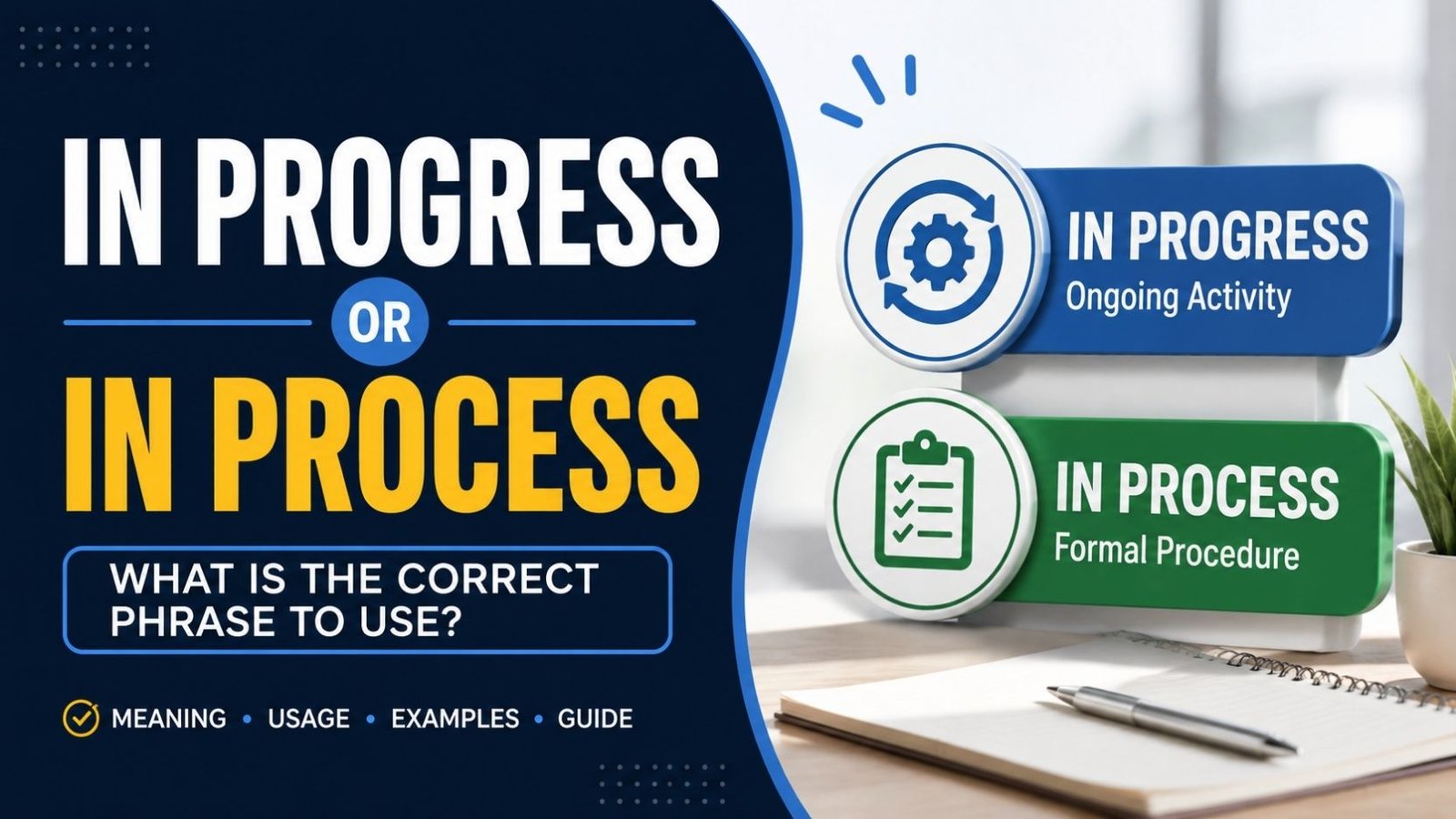
Both phrases show up everywhere, from order tracking pages to office chat messages. “In progress” is the phrase most native English speakers use to say something is currently happening. “In process” is a real phrase too, but it leans more formal, and it often points to a specific procedure or system rather than a general activity.
Knowing the difference matters more than it seems. The wrong phrase can sound slightly off in an email, a status update, or a sign on a meeting room door. This article breaks down the meaning, the grammar, and the real-world usage of both phrases, so you never have to guess again.
In Progress or In Process: The Quick Answer
“In progress” is correct almost all the time. It describes any task, project, event, or activity that has started but is not yet finished.
“In process” is used less often. It usually appears in technical, industrial, or procedural settings, such as manufacturing or formal business language.
Here is the simplest way to remember it:
- Use in progress for everyday situations, work updates, and general conversation.
- Use in process only when referring to a formal procedure, a system, or an industrial workflow.
If you are unsure which one fits, “in progress” is almost always the safer and more natural choice.
See More: Any Time Vs Anytime
What Does In Progress Mean?
“In progress” means something has already started and has not yet finished. It describes an ongoing state.
The phrase is an adjective phrase, and it usually follows the noun it describes. For example, a project can be “in progress,” a game can be “in progress,” or a download can be “in progress.”
Simple definition: happening now, not yet complete.
This phrase is common in:
- Software and app status labels
- Project management tools
- School and work assignments
- Everyday spoken English
Because it is so widely used, “in process” feels natural in almost any context, from a casual text message to a formal business report.
What Does In Process Mean?
“In process” also means something has started but is not finished. The core meaning is close to “in progress,” but the feel of the phrase is different.
“In process” is more commonly used in:
- Manufacturing and production environments
- Legal or bureaucratic procedures
- Government and institutional systems
- Formal business documentation
For example, a factory might describe unfinished goods as “in process” inventory. A government office might say an application is “in process” while it moves through several review stages.
Simple definition: currently moving through a formal or structured procedure.
The phrase is grammatically correct, but it is less flexible than “in progress.” Native speakers rarely use it in casual conversation.
In Progress vs In Process: Key Differences
The table below compares both phrases side by side.
| Feature | In Progress | In Process |
| Common usage | Everyday, general | Formal, technical, procedural |
| Typical setting | Conversation, work updates, apps | Manufacturing, legal, institutional |
| Tone | Neutral and widely accepted | Slightly formal or industry specific |
| Example | The meeting is in progress. | The order is in process at the warehouse. |
| Frequency | Very common | Less common |
Both phrases are grammatically valid. The real difference is context, not correctness.
Grammar: Part of Speech and Sentence Structure
Both “in progress” and “in process” function as prepositional phrases that act like adjectives. They describe the state of a noun.
Structure:
Subject + verb (usually “is,” “are,” or “was”) + in progress/in process
Examples:
- The renovation is in progress.
- The negotiations are in process.
- The investigation was in progress when the news broke.
Neither phrase changes form. There is no plural version, no verb form, and no comparative form. They stay the same no matter the subject.
💡 Tip: These phrases always come after a linking verb like “is,” “was,” or “remains.” They rarely start a sentence on their own.
Work in Progress or Work in Process
This is one of the most searched versions of the phrase, and the answer depends on the field.
Work in progress is the common everyday version. It describes any task, creative project, or piece of work that is not yet finished. Writers, artists, and professionals use this phrase constantly.
Work in process is a specific accounting and manufacturing term. It refers to partially finished goods that are still moving through a production line. Businesses track “work in process inventory” as part of their financial reporting.
| Phrase | Best Used For |
| Work in progress | Creative projects, general tasks, everyday updates |
| Work in process | Manufacturing inventory, accounting, production tracking |
If you are talking about a painting, a report, or a personal project, say “work in progress.” If you are talking about factory inventory or accounting terms, “work in process” is the correct industry phrase.
In Progress or In Process in Everyday Situations
Both phrases appear across different real-world contexts. Here is how they typically show up.
Status Updates and Software
Most software systems, including project trackers and order platforms, use “in progress” as a status label. It clearly signals that a task has started but is not complete.
Some systems, particularly those tied to formal application processing, may use “in process” instead. For example, a workplace system status labeled “in process” usually means an application or request is still being reviewed internally.
Signs and Notices
You may see signs that say “meeting in progress” or “testing in progress” outside a room. This use is standard and expected. “In progress” fits naturally on signage because it reads as clear, direct, and easy to understand at a glance.
See More: Manuel Vs Manual
Crime Reporting
The phrase “crime in progress” is a fixed expression used specifically in law enforcement and emergency communication. It means a crime is actively happening at that moment. This phrase almost never changes to “crime in process,” because it has become a standard term in policing and news reporting.
Orders, Deliveries, and Transactions
Retailers and service providers often use “in process” to describe an order that is being prepared, verified, or handled internally before shipping. This reflects the more procedural tone of “in process,” since it suggests movement through a system rather than a simple ongoing action.
Examples of In Progress and In Process in Sentences
Below are natural, real-world examples for both phrases.
In progress:
- The project is in progress and should be finished by Friday.
- Please do not enter. Interview in progress.
- Her research is still in progress.
In process:
- The application is in process and may take several business days.
- The company reported a rise in work in process inventory this quarter.
- The legal review is currently in process.
Notice how “in progress” fits general updates, while “in process” fits formal procedures or systems.
Common Mistakes
Even confident English speakers sometimes mix up these two phrases. Here are the most frequent errors.
❌ Incorrect: The meeting is in process, please wait outside.
✅ Correct: The meeting is in progress; please wait outside.
Why: Meetings are everyday events, not formal procedures, so “in progress” fits better.
❌ Incorrect: The factory tracks its progress inventory every month.
✅ Correct: The factory tracks its work-in-process inventory every month.
Why: This is a specific accounting term, and “in process” is the standard phrase in that field.
❌ Incorrect: She said the download was in process on her phone.
✅ Correct: She said the download was in progress on her phone.
Why: Everyday technology terms almost always use “in progress.”
Similar Words And Related Phrases
Several phrases share meaning with “in progress” and “in process,” though each carries a slightly different shade of meaning.
| Phrase | Meaning | Typical Use |
| Ongoing | Continuing without a fixed end point | General, flexible use |
| Underway | Already started and moving forward | Formal or narrative tone |
| Pending | Waiting to happen or be completed | Often used for approvals or decisions |
| Under review | Being examined or evaluated | Formal, procedural contexts |
These words can sometimes replace “in progress” or “in process,” but none of them are exact synonyms. Each one carries its own nuance.
See More: Transferred Vs Transfered
Frequently Asked Questions
Is it correct to say in progress or in process?
Both are grammatically correct. “In progress” is the more common and natural choice in everyday English. “In process” fits formal or procedural situations, such as manufacturing or applications moving through a system.
What does in progress mean?
It means something has started and is still happening. It has not yet reached completion.
What does in process mean?
It means something is currently moving through a formal system, procedure, or production stage.
Is work in progress the same as work in process?
Not exactly. “Work in progress” refers to any unfinished task or project in general use. “Work in process” is a specific term used in manufacturing and accounting for partially completed inventory.
Why does Workday sometimes show in process instead of in progress?
Workday and similar HR or business systems often use “in process” because it reflects a structured, multi-step procedure, such as an application or approval moving through internal review.
Is crime in progress or crime in process the correct phrase?
“Crime in progress” is the correct and standard phrase. It is used consistently in law enforcement, emergency dispatch, and news reporting.
Can I use in progress and in process interchangeably?
In casual writing, they are often understood the same way. In formal or industry-specific writing, using the correct one shows more precision and professionalism.
Which phrase is more common in spoken English?
“In progress” is far more common in spoken and everyday written English. “In process” mostly appears in formal or technical writing.
Does in process only apply to businesses?
Mostly, yes. It is most often used in manufacturing, legal procedures, government systems, and formal business processes, rather than in personal or casual conversation.
Is one phrase more formal than the other?
Yes. “In process” generally sounds more formal and procedural, while “in progress” works naturally in both formal and informal settings.
Conclusion
“In progress” and “in process” both describe something that has started but is not yet finished, but they are not used the same way. “In progress” is the natural, flexible choice for everyday situations, from meetings and projects to software status updates. “In process” belongs to more formal or procedural settings, especially manufacturing, accounting, and structured business systems like application reviews.
When in doubt, choose “in progress.” It works in almost every situation and sounds natural to native English speakers. Save “in process” for the specific moments when you are describing a formal procedure or a system moving something through defined steps. Understanding this small distinction can make your writing sound more accurate, more professional, and more natural.

Danish Raza is the author of Grammavio, a trusted resource for simple and easy-to-understand English grammar guides. He creates helpful content covering grammar rules, word meanings, vocabulary, and common grammar mistakes to help readers improve their English skills.



2 Comments