
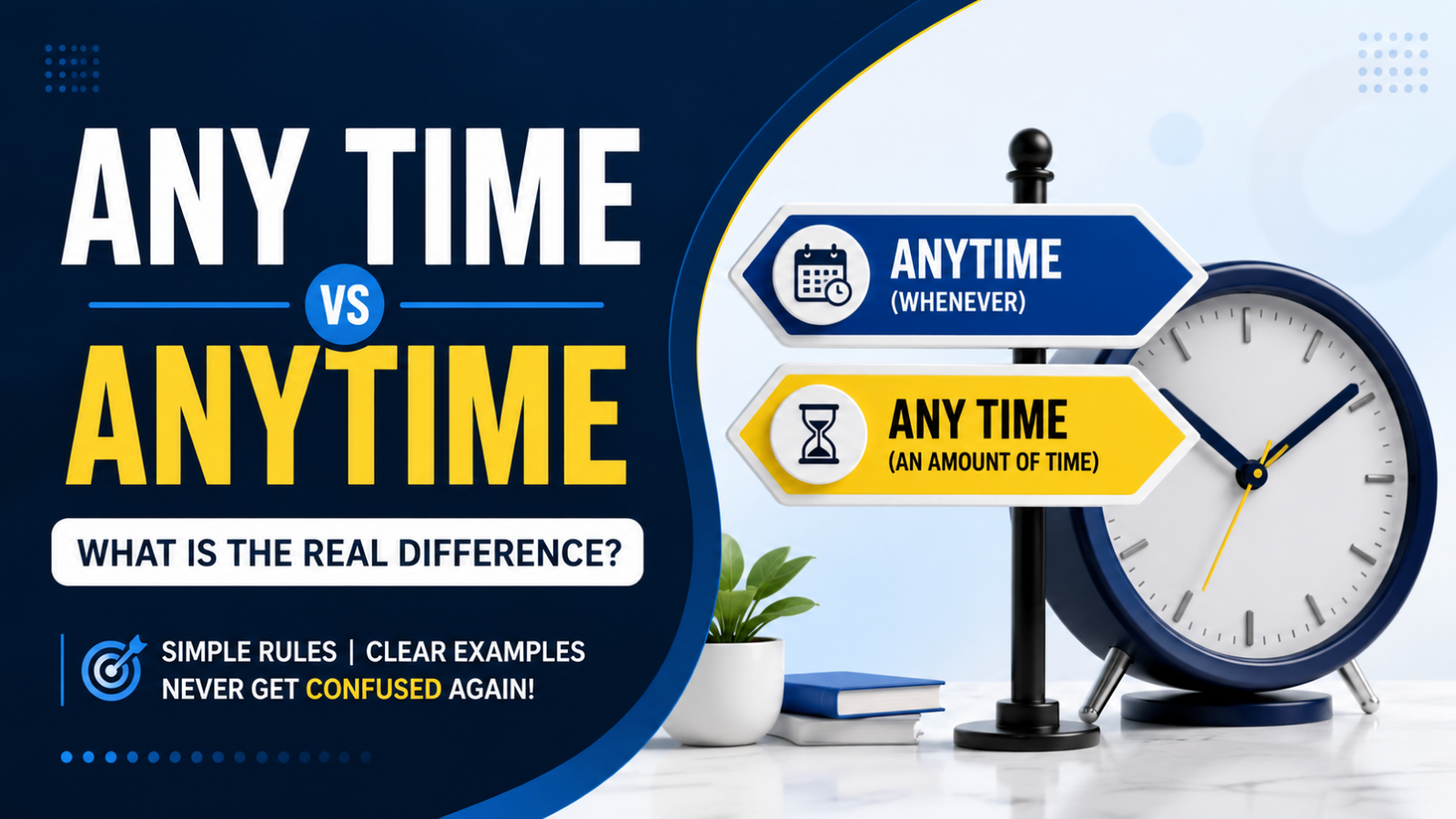
Anytime means “whenever,” and it works as a single adverb in casual, everyday sentences. Any time means “any amount of time” or “any point in time,” and it works as a two-word noun phrase, especially after words like at, for, or that. Both are correct English. The one you need depends on the sentence you are building.
This difference matters because using the wrong form can look careless in formal writing, even though most readers understand either version in conversation. Once you understand the small grammar rule behind these two forms, you will never second-guess yourself again. This guide breaks it down clearly, with simple examples, a quick test you can use, and answers to the most common questions people ask about any time vs anytime.
Any Time vs Anytime: The Simple Definition
Here is the core idea in one line.
- Anytime (one word) is an adverb. It means “whenever” or “at any time, without restriction.”
- Any time (two words) is a noun phrase. It means “any amount of time” or “any particular point in time.”
💡 Quick tip: If you can replace the phrase with “whenever” and the sentence still makes sense, use anytime. If you can replace it with “a time” or “an amount of time,” use any time.
Example:
- “Call me anytime.” → “Call me whenever.” This works, so anytime is correct.
- “I don’t have any time to help.” → “I don’t have any amount of time to help.” This works, so any time is correct.
Anytime Meaning: When to Use One Word
Anytime is an adverb. It describes when an action can happen, and it means there is no fixed or required time.
It usually appears in relaxed, informal sentences like invitations, offers, or casual instructions.
- “You can visit anytime.”
- “Text me anytime you want.”
- “The store is open anytime after 8 a.m.” (informal usage)
Anytime often follows a verb directly, without a preposition in front of it. That is one of the clearest signals that the one word form is correct.
See More: Manuel Vs Manual
Any Time Meaning: When to Use Two Words
Any time is a noun phrase. The word “time” here is a noun, and “any” is simply describing it, the same way “any” describes other nouns like “any money” or “any help.”
Any time is the correct choice in two common situations:
- After a preposition, such as at, for, in, or during.
- “You may leave at any time.”
- “We appreciate any time you can give us.”
- Before a clause that starts with words like “that” or “you need.”
- “Take any time you need.”
- “There isn’t any time left.”
⚠️ Common mistake: Many writers use “anytime” after a preposition, as in “at anytime.” This is grammatically incorrect in standard English, because a preposition needs a noun phrase after it, not an adverb.
At Any Time vs Anytime
This is one of the most searched comparisons, and the rule is straightforward.
After the word “at,” always use the two word form: any time.
- ✅ Correct: “You can cancel at any time.”
- ❌ Incorrect: “You can cancel at anytime.”
This same rule applies to other prepositions, including for, during, and in.
- “Feel free to reach out for any time you need.” (two words, after “for”)
- “The office may close during any time of the year.” (two words, after “during”)
If you remove the preposition, the sentence often becomes correct with anytime instead.
- “You can cancel anytime.” (adverb, no preposition, correct)
Quick Comparison Table
| Form | Part of Speech | Meaning | Example |
| Anytime | Adverb | Whenever, without restriction | “Call anytime.” |
| Any time | Noun phrase | An amount of time or a specific point in time | “I don’t have any time.” |
| At any time | Preposition plus noun phrase | Whenever, used formally | “You may cancel at any time.” |
Any Time vs Anytime Grammar Rule Explained Simply
Grammar guides, including major style references, generally agree on one core rule: anytime works as an adverb meaning “whenever,” while any time works as a noun phrase meaning “an amount of time” or “a particular time.” The two word form is the older and more traditional choice, and it is required after a preposition.
Some dictionaries note that anytime developed later, as speakers combined “any” and “time” into a single word for convenience, similar to how “any more” became “anymore” in casual use. Formal writing and style guides that favor traditional grammar, such as many editorial and legal style guides, tend to prefer the two word form any time in almost every situation, even where anytime would be acceptable elsewhere. If you are writing something formal, official, or professional, any time is the safer choice.
Any Time vs Anytime Examples
Seeing the two forms side by side in real sentences makes the difference easier to remember.
Anytime (adverb):
- “Anytime works for me.”
- “You are welcome to stop by anytime.”
- “We can talk anytime this week.”
Any time (noun phrase):
- “Do you have any time to review this?”
- “Thank you for any time you spent on this project.”
- “I need any time you can spare.”
Notice that in every “any time” example above, the phrase is answering the question “how much time,” not “when.” That is the clearest test you can apply.
Any Time vs Anytime in Response to Thank You
This phrase appears often in casual replies, and both forms show up in real usage.
- “Anytime!” is common as a short, friendly response, similar to saying “no problem” or “happy to help.”
- “Any time!” is also used, especially by writers who prefer the traditional two word form.
Because this is a short, informal reply, both versions are widely accepted. Style guides do not strictly regulate casual replies like this one, so personal preference plays a role here.
See More: Transferred Vs Transfered
Any Time vs Anytime Soon
“Anytime soon” is the standard, correct form. It functions as an adverb phrase describing a near future time frame, usually in questions or negative sentences.
- “Are you finishing this anytime soon?”
- “I don’t think it will rain anytime soon.”
You would not use “any time soon” as two words in this expression, because “anytime soon” behaves as a set adverbial phrase, not a noun phrase describing an amount of time.
Any Time vs Anytime AP Style
AP Style, a widely used journalism and media style guide, generally favors any time as two words, following traditional grammar rules. If you are writing for a news publication, a formal report, or any document that follows AP conventions, use the two word form any time in most contexts, especially after prepositions like “at.”
Casual publications, blogs, and everyday business writing often accept anytime as one word, particularly in adverbial use such as “call anytime” or “visit anytime.”
Common Mistakes With Any Time vs Anytime
Here are the mistakes people make most often, along with the correct version.
❌ Incorrect: “You can cancel at anytime.”
✅ Correct: “You can cancel at any time.”
❌ Incorrect: “I don’t have anytime today.”
✅ Correct: “I don’t have any time today.” (This refers to an amount of time, so it needs two words.)
❌ Incorrect: “Anytime you need is fine.”
✅ Correct: “Any time you need is fine.” (This refers to a quantity of time before a clause.)
❌ Incorrect: “We are open any time.” (Used adverbially, without a preposition or noun meaning)
✅ Correct: “We are open anytime.” (Adverb describing when, no restriction)
The easiest way to avoid these mistakes is to test whether the phrase answers “when” or “how much time.” Adverbs answer “when.” Noun phrases answer “how much” or “which time.”
Any Time vs Anytime: Similar Words and Related Forms
A few related word pairs follow the same one word versus two word pattern in English.
| Word Pair | One Word Meaning | Two Word Meaning |
| Anytime / Any time | Whenever (adverb) | An amount of time (noun phrase) |
| Anymore / Any more | Any longer (adverb, mainly in negatives) | Additional amount (noun phrase) |
| Everyday / Every day | Ordinary, routine (adjective) | Each day (adverb phrase) |
These pairs are useful to know because they follow the same underlying logic: the one word form is usually an adverb or adjective, while the two word form usually describes an actual noun.
Pronunciation of Any Time and Anytime
Both forms are pronounced the same way in normal speech, since spacing does not change pronunciation.
- Anytime: EH-nee-tym
- Any time: EH-nee tym
The stress falls on the first syllable of “any” in both cases, followed by a slightly softer stress on “time.” Native speakers do not pronounce these differently, so pronunciation will not help you choose the correct written form. Only grammar and sentence structure will.
Real World Usage: Insurance, Fitness, and Everyday Questions
Many everyday questions use this phrase in practical situations, such as asking whether something can be changed or canceled without restriction. In sentences like “Can I cancel my car insurance at any time?” or “Can I change my HSA contribution at any time?”, the two word form any time is correct because it follows the preposition “at.”
The same rule applies to fitness memberships, subscriptions, and similar services. If a company name uses the one word “Anytime,” such as a gym brand, that is simply a proper noun or brand name, and it follows its own capitalization rather than a grammar rule. Brand names do not change the grammar rule for regular sentences.
Any Time vs Anytime Quiz
Test yourself with these quick questions. Choose the correct form for each sentence.
- “You can call me ______ after 9 a.m.” (anytime / any time)
- “I don’t have ______ to finish this today.” (anytime / any time)
- “The package can arrive ______ this week.” (anytime / any time)
- “Thank you for ______ you can spend on this.” (anytime / any time)
- “Are you leaving ______ soon?” (anytime / any time)
Answers:
- Anytime (adverb, no preposition before it)
- Any time (noun phrase, amount of time)
- Anytime (adverb, describes when)
- Any time (noun phrase, after “for”)
- Anytime (fixed phrase, “anytime soon”)
See More: It’s Or Its
Frequently Asked Questions
What does anytime mean?
Anytime means “whenever” or “at any time, without a fixed schedule.” It works as a single adverb in a sentence.
What does any time mean?
Any time means “an amount of time” or “a particular point in time.” It works as a two word noun phrase, especially after prepositions like at, for, or during.
Is anytime one word or two words?
Anytime can correctly be written as one word when it functions as an adverb meaning “whenever.” It should be written as two words, any time, when it refers to an amount of time or follows a preposition.
Is it correct to say “at any time” or “at anytime”?
“At any time” is correct. Prepositions like “at” must be followed by a noun phrase, and “any time” fills that role. “At anytime” is a common mistake.
Can I use anytime in formal writing?
You can, but many formal style guides, including AP Style, prefer the two word form any time in most situations. If you are unsure, any time is the safer choice for professional or academic writing.
Is “anytime soon” correct?
Yes. “Anytime soon” is the standard, accepted phrase, usually used in questions or negative sentences about the near future.
Does Merriam-Webster recognize anytime as a word?
Yes, major dictionaries recognize anytime as a legitimate adverb. However, many editorial style guides still prefer any time as two words in formal contexts, even though anytime is dictionary-recognized.
How do you respond to “thank you” using this phrase?
Both “Anytime!” and “Any time!” are used as casual, friendly responses to thank you. Either is acceptable in informal conversation.
Why do people confuse any time and anytime?
The confusion happens because both forms sound identical when spoken, and both are grammatically correct in different situations. The written form depends on the sentence’s structure, not on pronunciation.
Final Takeaway
Anytime and any time are both correct, but they serve different grammatical roles. Anytime is a single word adverb that means “whenever,” and it fits naturally into casual sentences without a preposition in front of it. Any time is a two word noun phrase that means “an amount of time” or “a specific time,” and it is required after prepositions like at, for, and during.
The simplest way to choose correctly is to ask what the phrase is doing in your sentence. If it describes when something happens, anytime usually fits. If it describes an amount or a specific point of time, especially after a preposition, any time is the correct choice. Keep this one distinction in mind, and you will use both forms with confidence in any type of writing.

Danish Raza is the author of Grammavio, a trusted resource for simple and easy-to-understand English grammar guides. He creates helpful content covering grammar rules, word meanings, vocabulary, and common grammar mistakes to help readers improve their English skills.



2 Comments