
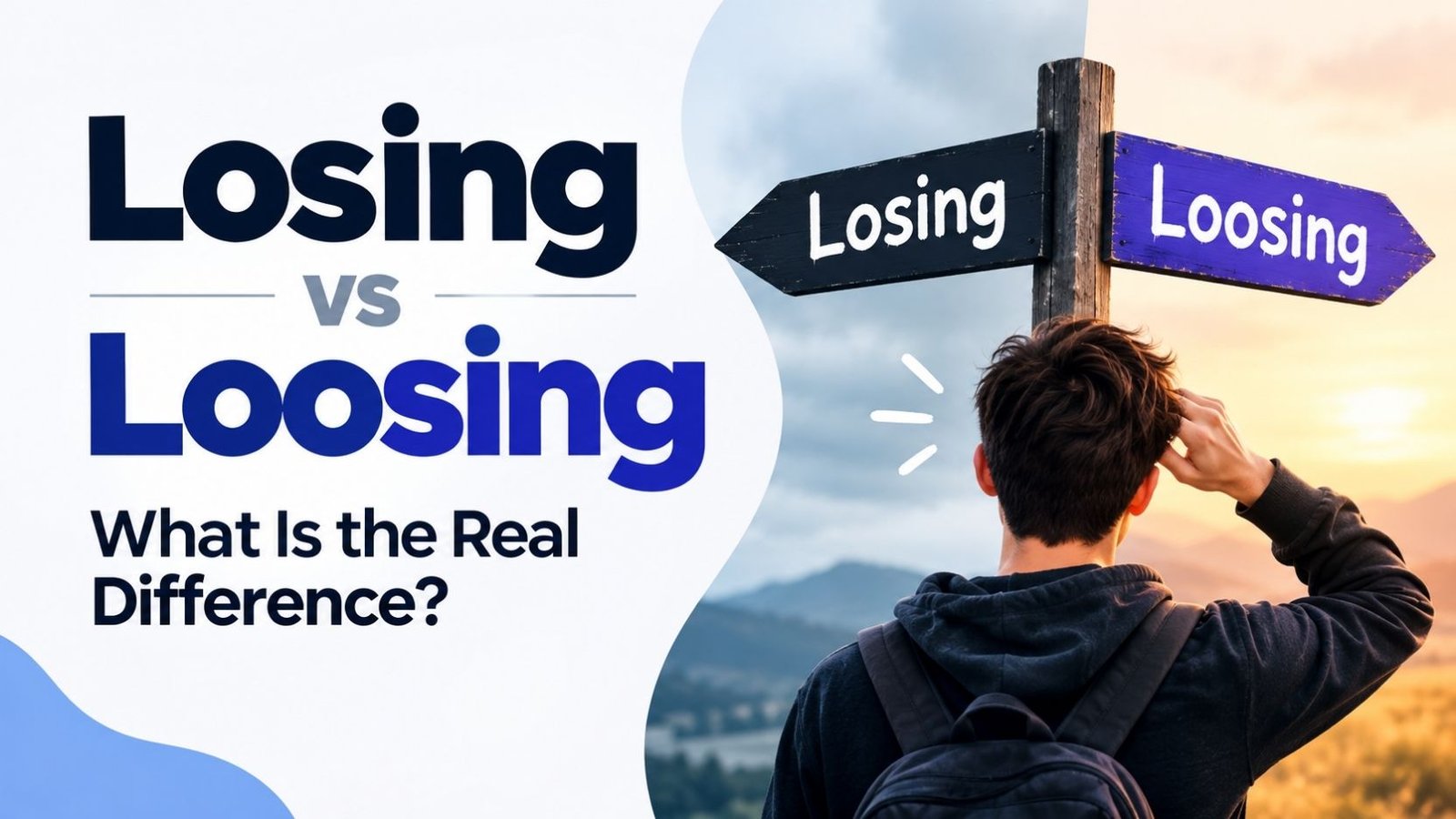
If you have ever paused mid-sentence wondering whether to type losing or loosing, you are not alone. Losing means failing to keep, win, or find something, while loosing means setting something free or letting it go from a fixed position. The two words look almost identical, but they come from completely different root verbs.
This mix-up happens because the words differ by a single letter, yet that one extra “o” changes the entire meaning. Getting it right matters in emails, essays, and everyday texts, since the wrong choice can confuse a reader instantly. This guide breaks down the meaning, grammar, pronunciation, and origin of both words so you never have to guess again.
Losing vs Loosing at a Glance
Before going deeper, here is a quick snapshot of how these two words differ.
| Word | Base Verb | Meaning | Example |
| Losing | Lose | Failing to keep, win, or find something | She is losing her patience. |
| Loosing | Loose | Releasing, untying, or setting something free | He is loosing the dog from its leash. |
Losing is by far the more common word in everyday English. Loosing is rare and mostly appears in formal, historical, or specific technical writing.
Read More: Puting Or Putting
What Does Losing Mean?
Losing is the present participle of the verb lose. It describes the act of no longer having something, failing to win, or being unable to find something.
Losing covers a wide range of situations:
- Misplacing an object, as in losing your keys
- Failing to win a game or contest, as in losing the match
- No longer having a feeling, quality, or ability, as in losing patience or losing weight
- Experiencing the death of someone close, as in losing a loved one
Example sentences:
- I keep losing my phone charger somewhere in the house.
- Our team is losing by two points with one minute left.
- He is losing confidence after the recent setback.
What Does Loosing Mean?
Loosing is the present participle of the verb loose, which means to untie, unfasten, or release something that was held tight or restrained. It shares its spelling family with the adjective loose, meaning not tight.
Loosing is far less common in modern English, but it still appears in specific contexts:
- Releasing an arrow from a bow, as in loosing an arrow at the target
- Untying an animal, as in loosing the horse from its post
- Letting go of control or restraint, often in older or literary writing
- Religious and legal texts, where it describes formally releasing someone from an obligation
Example sentences:
- The archer stood still before loosing the arrow.
- The farmer began loosing the cattle from the pen at sunrise.
- The old script uses loosing in the sense of setting a prisoner free.
💡 Tip: If you can replace the word with “releasing” or “untying” and the sentence still makes sense, loosing is likely correct.
Losing vs Loosing: Grammar Breakdown
Both words are verb forms, but they come from different base verbs and follow different grammar patterns.
| Feature | Losing | Loosing |
| Base verb | Lose | Loose |
| Part of speech | Present participle/gerund | Present participle/gerund |
| Common usage | Very common | Rare |
| Typical meaning | Failure to keep, win, or find | Release or untying |
| Related noun | Loss | Looseness |
Lose is an irregular verb. Its forms are lose, lost, lost, and losing. Loose, by contrast, is a regular verb. Its forms are loose, loosed, loosed, and loosing.
Since lose already ends in a single “e,” that “e” is dropped before adding “ing,” which gives losing. Loose ends in two vowels before the final “e,” so the “e” is dropped the same way, giving loosing. This is exactly why the spelling looks so close, even though the meanings are unrelated.
Losing vs Loosing: Spelling Difference
The spelling difference comes down to one letter: the double “o.”
- Losing has one “o.” Think of it alongside the word loss, which also has one “o” followed by a double “s.”
- Loosing has two “o’s.” Think of it alongside the word loose, which also has a double “o.”
✅ Correct: I am losing weight steadily this month.
❌ Incorrect: I am loosing weight steadily this month.
✅ Correct: She began loosing the ribbon from the gift box.
❌ Incorrect: She began losing the ribbon from the gift box.
How to Remember the Difference
A few simple memory tricks make this distinction easy to keep straight.
- Match the vowels: Loose and loosing both have two o’s. Lose and losing both have one o.
- Think of the noun: Loss connects to losing. Looseness connects to loosing.
- Ask what is happening: If something is being set free, use loosing. If something is being failed to keep, use losing.
- Frequency check: If you are unsure, losing is almost always the word you actually need, since loosing rarely appears in everyday writing.
Pronunciation of Losing and Loosing
The two words also sound different, which can help you choose the right one in speech.
- Losing is pronounced LOO-zing, with a soft “z” sound in the middle.
- Loosing is pronounced LOO-sing, with a soft “s” sound in the middle.
The vowel sound at the start is similar in both words, but the middle consonant is the real giveaway. Losing has a voiced “z,” while loosing has an unvoiced “s,” matching the same sound pattern found in lose versus loose.
Origin of Losing and Loosing
Losing comes from the Old English word losian, meaning to perish or to become unable to find. Over time, this evolved into the modern verb lose, and its present participle form became losing.
Loosing comes from the Old English word losian as well, but through a different branch that developed into the adjective loose and the verb loose, both connected to the idea of something not being fastened tightly. The verb to loose has been used in English for centuries to describe releasing something that was bound, tied, or restrained.
Both words share a distant linguistic root, which is part of why they look so similar today, even though their meanings moved in different directions.
Read More: To Bad Vs Too Bad
Losing vs Loosing in Everyday Sentences
Seeing the words side by side in real sentences makes the difference easier to internalize.
| Situation | Correct Word | Example |
| Misplacing an item | Losing | I am always losing my umbrella on rainy days. |
| Untying a knot | Loosing | He worked slowly at loosing the tight knot. |
| Failing a game | Losing | The home team is losing the championship game. |
| Releasing an animal | Loosing | The shepherd began loosing the sheep into the field. |
| Losing weight | Losing | She has been losing weight through regular exercise. |
| Setting free in a formal sense | Loosing | The decree spoke of loosing the captives. |
Common Mistakes
The most frequent error is writing loosing when losing is meant, since losing is used far more often in daily English.
❌ Incorrect: I don’t want to be loosing this argument again.
✅ Correct: I don’t want to be losing this argument again.
❌ Incorrect: He is losing the rope to let the boat drift free.
✅ Correct: He is loosing the rope to let the boat drift free.
⚠️ Common mistake: Autocorrect tools sometimes fail to catch this error, since both words are spelled correctly on their own. Always double check which meaning your sentence actually needs.
Losing vs Loosing Weight
This is one of the most searched versions of this confusion, and the answer is simple: the correct phrase is always losing weight.
Weight loss refers to a reduction in body weight, which connects directly to the verb lose, not loose. Loosing weight is never correct in standard English, even though the phrase sounds natural when spoken aloud.
- ✅ Correct: She has been losing weight without trying, thanks to a busier schedule.
- ❌ Incorrect: She has been loosing weight without trying.
If you remember only one rule from this article, remember this one: weight is something you lose, never loose.
Losing My Religion: What Does the Phrase Mean?
The phrase “losing my religion” gained wide recognition through the R.E.M. song of the same name, released in 1991. The title comes from an old Southern American expression meaning to lose one’s temper or civility, similar to saying someone is at the end of their rope.
Michael Stipe, the band’s lead singer, wrote the lyrics about disillusionment and unrequited love, rather than religious faith itself. The phrase works as an idiom, meaning it should not be taken literally. Someone “losing their religion” is expressing frustration or emotional strain, not describing an actual loss of faith.
This is a good example of how the word losing extends beyond physical objects into feelings, patience, and composure.
Binding and Loosing in the Bible
The phrase “binding and loosing” appears in the Bible in Matthew 16:19 and Matthew 18:18, where Jesus speaks about the authority to bind and to loose. In these verses, Jesus tells Peter that whatever he binds on earth will be bound in heaven, and whatever he looses on earth will be loosed in heaven.
The phrase originally comes from rabbinic tradition and refers to the authority to make decisions that are binding on a religious community, including interpreting religious law and deciding who is included in or excluded from that community. Different Christian traditions interpret this authority somewhat differently, so readers researching this topic for religious study should compare interpretations across trusted theological sources rather than relying on a single explanation.
In this context, loosing keeps its original grammatical meaning: releasing or setting free, rather than the everyday sense of losing something by mistake.
When Do Kids Start Losing Teeth?
Children typically begin losing their baby teeth, also called primary teeth, around age six, though the exact timing varies from child to child. This process continues gradually over several years as permanent teeth grow in underneath.
Note that the correct spelling here is always losing teeth, not loosing teeth, even though a tooth becoming loose is part of the process. The tooth becomes loose before it falls out, but the act of the tooth falling out or being lost is described with losing.
For specific concerns about a child’s dental development, a pediatric dentist is the right source for personalized guidance.
Losing the Mucus Plug and Labor Timing
Many expectant parents search for information connecting the loss of the mucus plug to the start of labor. The mucus plug is tissue that seals the cervix during pregnancy, and its loss can happen anywhere from several weeks before labor to just before labor begins.
Because the timing varies so widely between individuals, losing the mucus plug is not a reliable way to predict exactly when labor will start. Anyone with specific questions about pregnancy symptoms or labor timing should speak directly with an obstetrician or midwife, since this is a medical topic that depends on individual circumstances.
Grammatically, this phrase always uses losing, since it describes something no longer being present or held in place, not something being untied or released in the loosing sense.
Why Am I Losing So Much Hair?
Hair loss can happen for many reasons, including stress, hormonal changes, nutrition, genetics, and underlying health conditions. The correct phrase is always losing hair, since hair that falls out is something the body is failing to keep, which matches the meaning of lose rather than loose.
If hair loss feels sudden, heavy, or unusual, a doctor or dermatologist can help identify the specific cause and recommend next steps. This article focuses on the language itself rather than medical explanations, so treat this section as a starting point for further conversation with a professional, not a diagnosis.
Read More: High School Or HighSchool
Is Earth Losing Gravity?
This is a common curiosity search rather than a real scientific concern. Earth’s gravity depends on its mass, and the planet is not meaningfully losing mass or gravitational pull on any timescale that would affect daily life. The phrase “losing gravity” uses losing correctly in the sense of a gradual decrease, even though the underlying science shows this is not something happening in any noticeable way.
Similar and Related Words
A few other word pairs follow the same lose versus loose pattern, and understanding one helps with the others.
| Word | Meaning | Difference from Losing or Loosing |
| Lose | To fail to keep, win, or find | Base verb of losing |
| Loose | Not tight, not fastened | Base verb of loosing |
| Loss | A noun describing something lost | Related to losing, not a verb form |
| Loosen | To make something less tight, often gradually | Related to loose, but a distinct verb |
Loosen and loosing are often confused as well. Loosen means to make something looser over time, such as loosening a screw, while loosing describes the actual act of setting something free.
Frequently Asked Questions
What does losing vs loosing mean?
Losing means failing to keep, win, or find something. Loosing means releasing or untying something that was held tight.
Is it losing or loosing weight?
It is always losing weight. Loosing weight is incorrect in standard English.
Is it losing or loosing a person?
When talking about someone dying or a relationship ending, the correct word is losing, as in losing a loved one or losing touch with someone.
How do you pronounce losing and loosing?
Losing is pronounced with a “z” sound, like LOO zing. Loosing is pronounced with an “s” sound, like LOO sing.
Is loosing my mind correct?
No. The correct phrase is losing my mind, since it describes failing to maintain composure or clarity, not releasing something.
What part of speech is losing?
Losing is the present participle, or gerund form, of the verb lose.
What part of speech is loosing?
Loosing is the present participle, or gerund form, of the verb loose.
Why do people confuse losing and loosing?
The two words differ by only one letter and sound similar when spoken quickly, which makes the spelling easy to mix up even for confident writers.
Is loosing ever correct?
Yes, loosing is a real word. It is correct when describing the act of releasing, untying, or setting something free, though this usage is uncommon in everyday English.
What is the difference between losing money and loosing money?
Losing money is correct, since it describes failing to keep money, such as losing money in a bad investment. Loosing money is not standard usage.
Final Thoughts
The difference between losing and loosing comes down to one letter and two completely different root verbs. Losing, from lose, describes failing to keep, win, or find something, and it covers everyday situations from misplaced keys to losing weight to losing a loved one. Loosing, from loose, describes releasing or untying something, and it shows up mainly in specific contexts like archery, animal handling, or older and religious texts.
Whenever you are unsure which word fits, ask yourself whether something is being failed to keep or actively set free. In almost every everyday sentence, especially involving weight, hair, teeth, or emotions, losing is the word you need. Keep the double “o” rule in mind for loosing, and this common spelling mix-up will stop tripping you up for good.

Danish Raza is the author of Grammavio, a trusted resource for simple and easy-to-understand English grammar guides. He creates helpful content covering grammar rules, word meanings, vocabulary, and common grammar mistakes to help readers improve their English skills.



2 Comments