
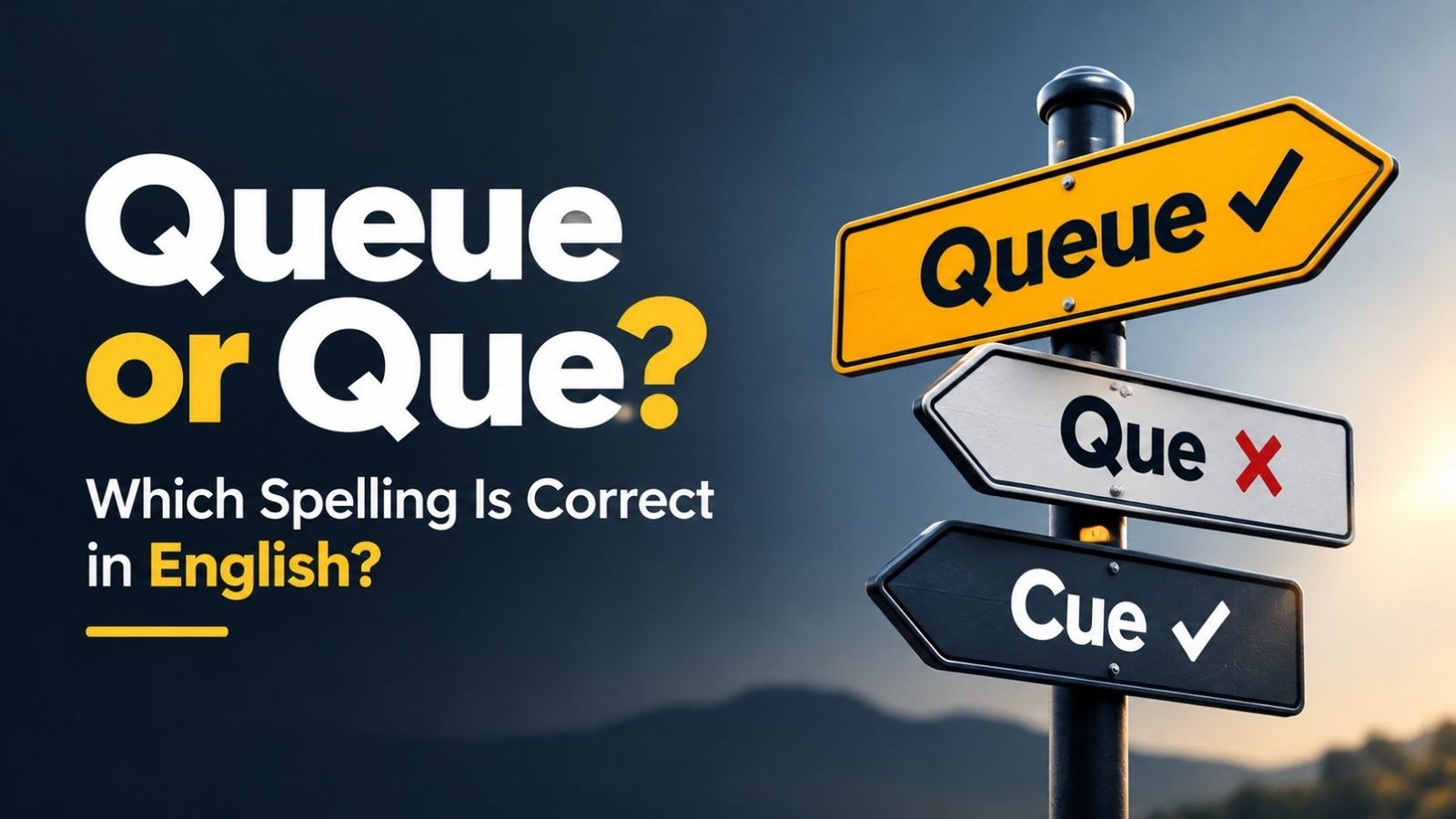
Queue is the correct English spelling. It means a line of people or things waiting for their turn, and it is also a verb meaning “to line up.” Que is not an English word. It is a common word in Spanish, French, and Portuguese, where it usually means “what” or “that.”
People mix the two up because queue sounds like the letter Q, and “que” looks like a shorter, easier way to write it. The word cue sounds exactly the same, which adds to the confusion. This guide explains the meaning, pronunciation, origin, and correct use of each word, plus how queue is used in tech and everyday speech.
Quick Answer: Queue, Que, or Cue?
Here is the short version before the details.
| Word | Language | Simple meaning | Example |
| Queue | English | A line of people or things waiting | “We stood in the queue for an hour.” |
| Que | Spanish, French, Portuguese | What, that, or than | “¿Qué pasa?” means “What’s happening?” |
| Cue | English | A signal to act or speak, or a pool stick | “That’s my cue to leave.” |
💡 Tip: If you are writing in English about a line, a waiting list, or a playlist, use queue. If you mean a signal, use cue. Skip “que” unless you are writing in another language.
Read More: Rhythm or Rythm
Queue Meaning and Definition
Queue has a few related meanings. They all come back to the idea of things waiting in order.
Meaning 1: A line of people. This is the most common meaning, especially in British English. People wait in a queue at a bank, a bus stop, or a shop.
Meaning 2: A list of things waiting to be handled. This covers a print queue, a ticket queue, a music queue, or a video queue. Each item waits until its turn comes.
Meaning 3: A data structure in computing. Programmers use a queue to store items in the order they arrive. The first item added is the first one taken out.
Meaning 4: A braid of hair. This is an old meaning, now rare. You will mostly see it in historical writing.
Is Queue a Noun or a Verb?
Queue works as both a noun and a verb.
• Noun: “There was a long queue outside the theater.”
• Verb: “Fans queued overnight to buy tickets.”
The verb forms are simple:
| Form | Word | Example |
| Base | queue | “Please queue here.” |
| Third person | queues | “She queues every morning.” |
| Past | queued | “They queued for hours.” |
| Present participle | queueing or queuing | “We are queueing for entry.” |
⚠️ Spelling note: Both queueing and queuing are accepted. Queueing keeps all the vowels and is the more common choice in many dictionaries and in technical writing. Queuing is also widely used. Pick one and stay consistent.
How to Pronounce Queue
Queue sounds like the letter Q. It has one syllable.
• Simple pronunciation: kyoo
• IPA: /kjuː/
• American and British English: The same in both
The spelling looks strange because it has five letters but only one sound. After the first “q” and “u,” the final “ue” is silent. A handy way to remember the spelling is that queue is simply the letter Q followed by four silent letters, “ueue.”
Is “Que” Ever Correct in English?
Not as an English word. Que does not appear in standard English dictionaries as a word for a line or a waiting list. Writing “que” instead of “queue” will be read as a typo.
There are a few exceptions where you may see it in English text:
• Borrowed phrases. “Que sera, sera” is a famous phrase that people use in English.
• Names and brands. Some businesses use “Que” as part of a name.
• Informal typing. Some people shorten words in texts, but this is not standard.
If you are writing an email, essay, report, or article in English, use queue.
What Does “Que” Mean in Other Languages?
Many readers searching “que” are actually looking for the Spanish, French, or Portuguese word. It is one of the most common words in those languages.
| Language | Common meaning | Example |
| Spanish | that, what, than | “Creo que sí.” (I think so.) |
| French | that, what, than | “Je pense que oui.” (I think so.) |
| Portuguese | that, what, than | “O que você quer?” (What do you want?) |
Que vs Qué in Spanish
In Spanish, an accent changes the job of the word.
• Que (no accent): Usually means “that” or “than.” Example: “Dice que viene mañana.” (He says that he is coming tomorrow.)
• Qué (with accent): Means “what” in questions and exclamations. Example: “¿Qué quieres?” (What do you want?)
Por Que, Porque, and Por Qué
These four forms are a classic point of confusion in Spanish.
| Form | Meaning | Example |
| Por qué | Why (in questions) | “¿Por qué llegas tarde?” |
| Porque | Because | “Llego tarde porque perdí el bus.” |
| Porqué | The reason (a noun) | “No entiendo el porqué.” |
| Por que | “For which” or “so that,” in some structures | “La razón por que lo hizo…” |
Useful Spanish and Other Phrases With Que
Some common phrases that people search for include:
• Que tal: Spanish for “How are you?” or “How is it going?”
• Que pasa: Spanish for “What’s happening?” or “What’s going on?”
• Que sera sera: A well-known phrase often translated as “whatever will be, will be.” It is used in English, but it is not standard Spanish. A grammatically correct Spanish version would sound different, so treat it as a borrowed English phrase.
• O que fazer: Portuguese for “what to do,” as in a question about what actions to take.
• Para que sirve: Spanish for “what is it used for?”
• Que faire: French for “what to do?”
Read More: Must vs Should
Queue vs Cue: What Is the Difference?
Queue and cue sound identical. They are homophones. Their meanings are not related in daily use.
| Word | Meaning | Example |
| Queue | A line of people or things waiting | “Join the queue at gate five.” |
| Cue | A signal that tells someone to act | “The lights dimming was our cue.” |
| Cue | A stick used in pool, snooker, or billiards | “He chalked the cue before his shot.” |
Common Phrases With Cue
• On cue: At exactly the right moment. “On cue, the music started.”
• Take your cue from someone: Follow their lead.
• Cue the music: A direction to start the music at a certain moment.
• Cue up a song: Prepare a track so it is ready to play.
Queue a Song or Cue a Song?
Both are used, and they mean slightly different things.
• Queue a song: Add it to a list so it plays later. This is common in music apps. “I’ll queue that track after this one.”
• Cue a song: Prepare it to start at a chosen point. DJs and audio technicians use this meaning.
If you are adding songs to a playlist, queue is the standard choice.
Common Mistakes With Queue
❌ Incorrect: “There is a long que at the bank.”
✅ Correct: “There is a long queue at the bank.”
❌ Incorrect: “That was my queue to speak.”
✅ Correct: “That was my cue to speak.”
❌ Incorrect: “The song started on queue.”
✅ Correct: “The song started on cue.”
The rule is easy. If something is waiting in line, it is a queue. If something is a signal or prompt, it is a cue.
In the Queue or On the Queue?
Both prepositions appear, but one is far more common.
• In the queue: The normal choice for people waiting. “She is in the queue for tickets.”
• In my queue: Used for lists on apps and services. “That show is in my queue.”
• On the queue: Less common. You may see it in technical writing when something is placed “on a queue” of tasks.
• On queue: Usually a mistake. The phrase people mean is “on cue.”
A related phrase is queue up, which means “to line up” or “to prepare something in order.” For example, “Queue up the next episode.”
Queue in Everyday Life
Here are the places most readers meet this word.
• Shopping and services: Stores, banks, airports, and help desks all have queues.
• Customer support: Callers wait in a call queue until an agent is free. Support teams also keep a ticket queue of open requests.
• Entertainment: Streaming services and music apps use a queue for what plays next. For instance, in Spotify, you can open the queue view and remove items, and the app includes an option to clear the list. Menus can change between app versions, so check your current version if the option looks different.
• Gaming: Online games use a matchmaking queue. When you are “in queue,” you are waiting to be placed in a match. This is how the phrase appears in searches for games like Arc Raiders.
Queue in Computing
Queue is also a basic idea in programming. This is a major reason the word is searched so often.
What Is a Queue in Programming?
A queue stores items in order. It follows a rule called first in, first out, often shortened to FIFO. The first item added is the first item removed. Think of a line at a ticket window.
Priority Queue
A priority queue is different. Each item has a priority. The item with the highest priority is removed first, even if it arrived later. An emergency room works this way: the most urgent patient is seen first.
Dead Letter Queue
A dead letter queue is a special holding area in messaging systems. When a message cannot be processed or delivered, the system moves it there. Developers then review those failed messages and fix the problem.
Queue in Python and Java
| Language | Common tools | What they do |
| Python | The queue module, collections.deque, heapq | Standard queues, double ended queues, and priority heaps |
| Java | The Queue interface, LinkedList, ArrayDeque, PriorityQueue | Queue behavior, with several ready to use classes |
In Python, the queue module offers a PriorityQueue class for priority behavior. In Java, PriorityQueue is a built in class that orders items by natural order or a custom comparator. For a full coding tutorial, official documentation for each language is the most reliable source.
Origin of the Word Queue
Queue came into English from French. The French word queue means “tail.” It goes back to the Latin word cauda, which also means “tail.”
The tail idea explains the older meaning of a braid of hair, like a tail hanging down the back. Later, the word came to describe a line of people, since a line looks like a long tail. The “line of people” meaning became common in English in the 1800s.
Interestingly, the word cue for a billiards stick also comes from the French word for “tail.” The theatrical cue, meaning a signal to act, has a less certain history. One popular explanation is that it comes from the letter Q, but dictionaries treat that origin as uncertain.
Read More: Climactic vs Climatic
British English vs American English
Both varieties use queue, but not in the same way.
| Use | British English | American English |
| People waiting | Queue | Line (queue is understood) |
| To wait in a line | Queue up | Wait in line, stand in line |
| Tech and computing | Queue | Queue |
For example, a British speaker might say, “Join the queue.” An American speaker would likely say, “Get in line.” Both understand each other. In technology, American English uses queue just like British English does.
Since your target audience is in the United States, use “line” for people in everyday writing and “queue” for computing, apps, and customer support systems.
Synonyms and Related Words
| Word | Meaning | Difference |
| Line | People waiting one behind another | The usual American word |
| Waiting list | A list of people waiting for something | Often for limited items like appointments or housing |
| Backlog | A pile of unfinished tasks | Suggests work that has built up |
| Lineup | An arrangement of people or items | Can mean a team roster or event schedule |
| Sequence | Items in a set order | No waiting involved |
Frequently Asked Questions
Is it queue or que?
It is queue. Que is not an English word. It belongs to Spanish, French, and Portuguese.
What does queue mean?
Queue means a line of people or things waiting for their turn. It can also mean to line up, and it names a data structure in programming.
How do you pronounce queue?
Queue is pronounced “kyoo,” the same as the letter Q and the word cue.
Is it queue or cue?
Use queue for a line and cue for a signal. They sound the same but have different meanings.
Is que short for queue?
No. Que is not a short form of queue in English. If you see it used that way, it is likely a typing shortcut or mistake.
What does que mean in Spanish?
In Spanish, que usually means “that” or “than.” The accented form qué means “what” in questions.
Is it “in the queue” or “on the queue”?
“In the queue” is the common phrase. “On the queue” appears only in some technical contexts.
Can I say “queue a song”?
Yes. It means adding the song to a list to play later. “Cue a song” means getting it ready to start at a certain point.
What is the verb form of queue?
The verb forms are queue, queues, queued, and queueing or queuing. Both spellings of the “ing” form are accepted.
What does “in queue” mean in games?
It means you are waiting to be matched with other players or placed into a game.
Conclusion
Queue is the correct English spelling for a line of people or things waiting their turn. It is pronounced “kyoo,” works as a noun and a verb, and comes from the French word for “tail.” Que is a different word from a different language, and cue is a separate English word that only sounds the same.
The easiest way to get it right is to ask what you mean. If it is a line or a waiting list, write queue. If it is a signal, write cue, and if you are writing in Spanish, French, or Portuguese, que is the word you want.

Danish Raza is the author of Grammavio, a trusted resource for simple and easy-to-understand English grammar guides. He creates helpful content covering grammar rules, word meanings, vocabulary, and common grammar mistakes to help readers improve their English skills.



2 Comments