
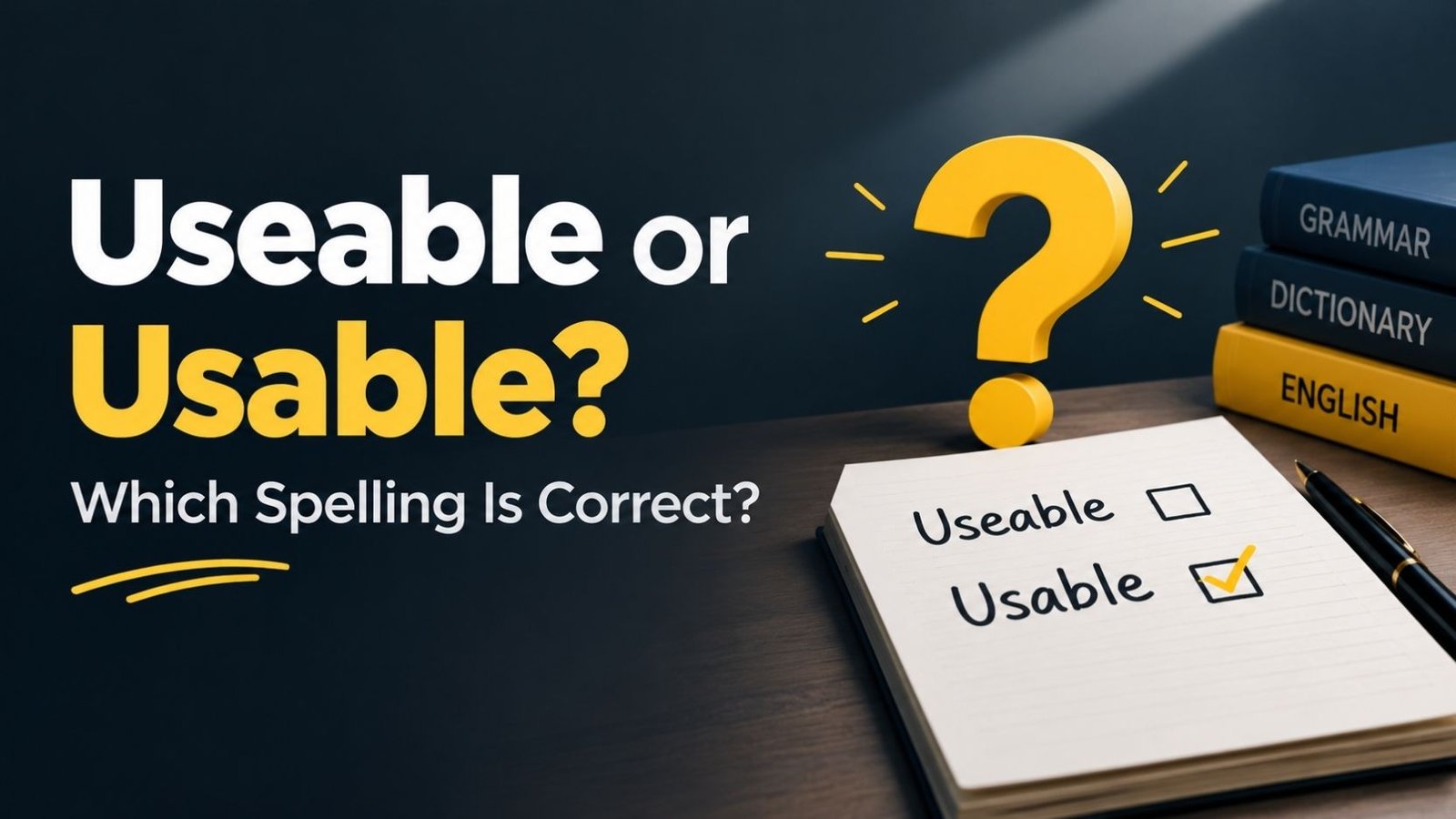
Both spellings are accepted, but usable is the standard choice. Most dictionaries list “usable” first and treat “useable” as a less common variant. Both words mean “able to be used,” and they sound exactly the same.
If you are writing for a US audience, use “usable.” It is the safer option for school papers, business writing, websites, and news content. The “useable” spelling is not a mistake, but it can look odd to editors and readers.
Quick Answer: Useable or Usable?
| Spelling | Status | Best for |
| Usable | Standard and most common | All formal and professional writing |
| Useable | Accepted variant, much less common | Only if a style guide or client requires it |
💡 Tip: If you are unsure, pick “usable.” You will almost never be wrong.
Read More: Queue or Que
What Does Usable Mean?
Usable is an adjective. It describes something that can be used or is in a condition to be used. It can also describe something that is practical and easy to use.
- Meaning 1, able to be used: The old laptop is still usable.
- Meaning 2, fit for a purpose: After the repairs, the road was usable again.
- Meaning 3, easy to use: The app is clean and usable, even for beginners.
In simple terms, usable answers one question: can this be used? It does not ask whether the thing is good or helpful. That is a different word, which we cover below.
Why Are There Two Spellings?
The word is built from two parts: use plus able. English has a common rule for this. When a word ends in a silent e, the e is usually dropped before able.
- Love becomes lovable.
- Move becomes movable.
- Size becomes sizable.
- Use becomes usable.
Some writers keep the e to show that the first syllable is pronounced “yooz,” not “yoos.” That is how “useable” appears. Other words keep the e to protect the sound of a soft c or g, as in noticeable and manageable. “Use” does not need that protection, which is why “usable” is the cleaner form.
Which Spelling Do Dictionaries and Style Guides Prefer?
Major dictionaries such as Merriam-Webster, Oxford, and Cambridge give “usable” as the main entry. They record “useable” as an alternative spelling. Style guides generally lean the same way. AP style, which many US newsrooms follow, uses “usable.”
If your school, employer, or publisher has its own style guide, follow it. Otherwise, use “usable” and stay consistent within one piece of writing.
Useable or Usable in British, American, Canadian, and Australian English
This is not a spelling split like color and colour. Both countries and regions accept both forms, and “usable” leads everywhere.
| Region | Preferred spelling | Is the other form accepted? |
| United States | Usable | Yes, as a variant |
| United Kingdom | Usable | Yes, as a variant |
| Canada | Usable | Yes, as a variant |
| Australia | Usable | Yes, as a variant |
So there is no need to switch spellings depending on your audience. “Usable” works for all of them.
How to Pronounce Usable
Both spellings are pronounced the same way.
- Simple pronunciation: YOO zuh bul
- IPA: /ˈjuːzəbəl/
- Syllables: us·a·ble (three syllables)
- Stress: on the first syllable
The American and British pronunciations are essentially identical.
Part of Speech and Word Forms
Usable is an adjective. It usually appears before a noun or after a linking verb like is or seems.
| Form | Example |
| Before a noun | We found a usable parking spot. |
| After a linking verb | The old charger is still usable. |
| Noun form | The usability of the website improved. |
| Adverb form | The tool was usably simple. (rare) |
| Opposite | The phone is unusable. |
Usability is the noun most people use. It refers to how easy something is to use, and it is common in web design and product design.
Read More: Rhythm or Rythm
Usable vs. Useful: What Is the Difference?
These words look alike but answer different questions.
| Word | Core idea | Example |
| Usable | Can it be used? | The tool is usable. It works. |
| Useful | Is it helpful? | The tool is useful. It saves time. |
Something can be usable but not useful. A working fax machine is usable, but it may not help you at all. Something can also be useful but not usable. A great recipe in a language you cannot read is useful in theory, but you cannot use it.
Synonyms and Antonyms of Usable
Synonyms
| Word | How it differs |
| Functional | Works as it should |
| Workable | Practical enough to work in real life |
| Serviceable | Good enough to do the job, not fancy |
| Operational | Running and ready, often used for machines |
| Available | Free to be used right now |
| Practical | Sensible and easy to apply |
Antonyms
- Unusable
- Useless
- Broken
- Impractical
Using Usable in Real Life: Common Contexts
Search results show that people look for this word in many specific settings. Here are the most common ones.
Usable Space: Usable vs. Rentable Square Feet
In commercial real estate, usable square feet is the space a tenant can actually occupy and use. Rentable square feet is larger. It includes the tenant’s usable space plus a share of shared areas like lobbies, hallways, and restrooms. Tenants usually pay rent based on rentable space, so the two numbers matter when comparing leases. Measurement standards can vary by building and region, so always check how a landlord calculates them.
Usable Energy
In science, “usable energy” means energy that can be put to work. In biology, cells convert the energy in food into a usable form, a molecule called ATP. In power generation, tides are the ocean movement used by power plants to produce usable energy, through tidal power.
Usable Life
Usable life is how long something stays fit for use. It appears in product labels, equipment manuals, and storage guides. Example: “The battery has a usable life of several years if stored properly.” Note that “useful life” is a separate term in accounting, where it refers to how long an asset is expected to provide value.
Usable Data
Raw data points become usable when they are cleaned, organized, and put into a format people can analyze. Fixing errors, removing duplicates, and labeling columns are typical steps.
Usable Meat
When people ask how much usable meat comes from a cow, they usually mean the edible portion after trimming bones, fat, and waste. The amount depends on the animal, the cut, and how the butcher trims it, so no single figure applies to every case. A butcher can give a realistic estimate for a specific animal.
Common Mistakes With Useable and Usable
⚠️ Mistake 1: Treating “useable” as a serious error
- ❌ Incorrect: “Useable” is not a real word.
- ✅ Correct: “Useable” is a real but less common variant of “usable.”
Mistake 2: Mixing both spellings in one document
- ❌ Incorrect: The files are usable, but the tools are useable.
- ✅ Correct: The files are usable, and the tools are usable too.
Mistake 3: Using “non usable” or “nonusable”
- ❌ Incorrect: The phone is non usable.
- ✅ Correct: The phone is unusable. (or: The phone is not usable.)
Mistake 4: Confusing usable with useful
- ❌ Incorrect: This advice is very usable. (when you mean helpful)
- ✅ Correct: This advice is very useful.
Example Sentences
- The software is usable on both phones and tablets.
- After the storm, only one road was usable.
- The report was full of facts, but none of them were usable.
- Good design makes a website more usable.
Read More: Must vs Should
Useable or Usable in Hindi
In Hindi, usable is commonly translated as उपयोगी (upayogi) or प्रयोग करने योग्य (prayog karne yogya). The first can lean toward “useful,” while the second is closer to “able to be used.”
Where Does the Word Come From?
The word is a simple combination of use and the suffix able. “Use” came into English from Old French and traces back to Latin roots related to using. The suffix able means “capable of” or “fit for.” Put together, usable means “capable of being used.” The variant “useable” comes from keeping the final e of “use” when adding the suffix.
Frequently Asked Questions
Is it useable or usable?
Both are accepted, but “usable” is the preferred and more common spelling.
Is “useable” a real word?
Yes. Dictionaries list it as a variant of “usable.”
Which spelling is correct in British English?
“Usable” is preferred in British English too. “Useable” is accepted but less common.
What does usable mean?
It means able to be used, in good enough condition to use, or easy to use.
Is usable a noun or an adjective?
It is an adjective. The related noun is “usability.”
How do you pronounce usable?
It is pronounced YOO zuh bul, with stress on the first syllable.
What is the opposite of usable?
The most common opposite is “unusable.” Other options include “useless” and “impractical.”
What is the difference between usable and useful?
Usable means something can be used. Useful means something is helpful.
What does usable vs. rentable square feet mean?
Usable space is what a tenant occupies. Rentable space adds a share of common areas.
Does AP style use usable or useable?
AP style uses “usable.”
Conclusion
“Usable” and “useable” mean the same thing: able to be used. “Usable” is the standard, preferred spelling in the US, UK, Canada, and Australia. “Useable” is an accepted variant, but it is much less common and can look like a typo to some readers.
For clean, professional writing, choose “usable” and stay consistent. If you need the opposite, write “unusable” or “not usable,” and if you mean “helpful,” reach for “useful” instead.

Danish Raza is the author of Grammavio, a trusted resource for simple and easy-to-understand English grammar guides. He creates helpful content covering grammar rules, word meanings, vocabulary, and common grammar mistakes to help readers improve their English skills.


