
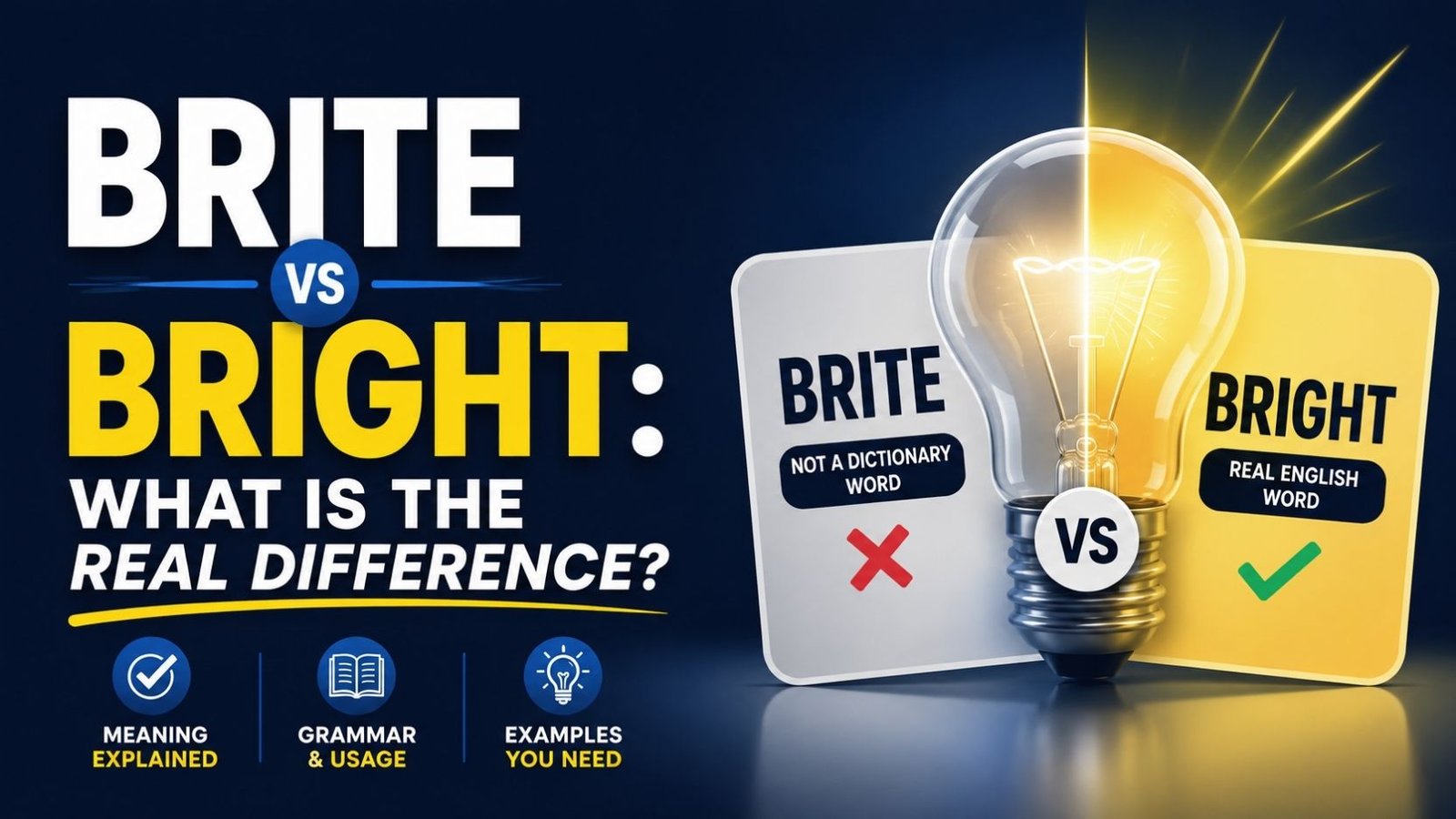
“Brite” and “bright” sound exactly the same, but only one of them is a real English word. Bright is the standard word for something full of light, vivid in color, or quick to understand. Brite is not a dictionary word at all; it is a stylized spelling that companies use for branding.
Understanding this difference matters more than it looks. If you are writing a school paper, an email, or any formal text, brite will always read as a spelling mistake. If you are talking about a product name like Scotch Brite or Lite-Brite, though, that spelling is completely correct because it is part of the trademark.
Brite vs Bright: Quick Comparison
| Brite | Bright | |
| Is it a dictionary word? | No | Yes |
| Part of speech | Not applicable (brand spelling) | Adjective (also used as an adverb and noun) |
| Correct in formal writing? | No | Yes |
| Where you will see it | Brand and product names | Everyday speech, writing, literature |
| Example | Scotch-Brite, Lite-Brite, Rainbow Brite | The room is bright. She is a bright student. |
See More: Thats Vs That’s
What Does “Brite” Mean?
Brite has no independent meaning in standard English. It is simply a phonetic respelling of bright, dropping the “gh” to make the word look shorter, punchier, or more modern on a label or logo.
Companies use this trick for a few reasons:
- It shortens the word visually.
- It looks distinctive on packaging.
- It can be trademarked more easily than a common dictionary word.
- It still sounds identical to bright when read aloud.
You will almost never find “brite” used as a normal word in a sentence outside of a brand name. If you search a dictionary for brite on its own, you will not find a separate entry with its own meaning. It exists because of marketing, not grammar.
What Does “Bright” Mean?
Bright is a common English adjective with several related meanings, all connected to the idea of light, clarity, or sharpness.
- Meaning 1: Giving off a lot of light. The sun was bright this afternoon.
- Meaning 2: Vivid or strong in color. She wore a bright red jacket.
- Meaning 3: Intelligent or quick to learn. He is one of the brightest students in the class.
- Meaning 4: Cheerful or lively. She gave him a bright smile.
- Meaning 5: Promising or full of hope. The company has a bright future ahead.
Bright can also work as an adverb in a few fixed expressions, such as “bright and early,” meaning very early in the morning. It even appears as a noun in some contexts, such as “the brights” referring to high beam headlights on a car.
Brite Vs Bright: Grammar
Grammatically, only bright belongs in standard English grammar rules.
- Bright is an adjective. It describes a noun, such as a bright light or a bright idea.
- Bright can be compared: bright, brighter, brightest.
- Bright can take the suffix “ly” to form the adverb brightly, as in “the lamp shone brightly.”
- Brite cannot take any of these grammatical forms. You will not see “briter” or “britest” in standard writing, because brite is not recognized as an adjective by grammar rules. It only exists as a fixed spelling inside brand names.
If brite ever shows up in your own writing outside of a brand name, it is a spelling error, not a grammar choice.
How To Pronounce Brite And Bright
Both words are pronounced exactly the same way.
- Pronunciation: brahyt
- IPA: /braɪt/
- Rhymes with: kite, light, night, sight, white
There is no difference in sound between brite and bright. The only difference is in spelling and in whether the word is standard English or a branding choice.
Where Does “Bright” Come From?
Bright has deep roots in English. It comes from the Old English word “beorht,” meaning shining, radiant, or clear. This word traces back further to a common Germanic root related to light and brilliance. Over centuries, the spelling shifted from “beorht” to “bryght” and eventually settled into the modern “bright” that English speakers use today.
Brite, on the other hand, has no historical origin of its own. It only became common in the twentieth century, once brands began simplifying spellings to make product names catchier. So while bright has centuries of linguistic history behind it, brite is a modern marketing invention built on top of that older word.
Why So Many Brands Use “Brite” Instead of “Bright”
If you search for brite online, most results are brand names rather than dictionary entries. Here are some of the most searched examples and what they actually refer to.
| Brand or Product | What It Is |
| Scotch Brite | A line of cleaning products, including scouring pads and sponges, made by 3M |
| Lite Brite | A classic light-up toy first released by Hasbro in 1967, where children arrange colored plastic pegs on a lit panel to form pictures |
| Rainbow Brite | An American media franchise created by Hallmark Cards in 1984, including an animated character, TV series, and toy line |
| Shiny Brite | A brand of glass Christmas tree ornaments, popular from the mid-twentieth century onward |
| Eventbrite | An online platform used for creating, promoting, and selling tickets to events |
| Retainer Brite | A cleaning tablet product designed for dental retainers and other removable dental appliances |
| Trolli Sour Brite Crawlers | A gummy candy product line known for its sour coating and worm shaped design |
None of these brand names follow standard spelling rules. Each company chose “brite” instead of “bright” as a stylistic decision, and in most cases, that spelling is legally protected as a trademark. This is exactly why you cannot correct these names to “bright” even though that is the grammatically standard spelling.
💡 Tip: When you are writing about one of these brands, always keep the brand’s exact spelling. Changing “Scotch Brite” to “Scotch Bright” would be factually incorrect, since you would be misspelling a registered trademark.
See More: Hide Or Hid
“Brite Tank” And “Bright Tank” In Brewing
One place where both spellings genuinely overlap outside of pure branding is in brewing. A brite tank, sometimes also written as a bright tank, is a sealed vessel used near the end of the beer making process.
Brewers use it to carbonate, clarify, and store beer just before packaging or serving. Both spellings are used across the brewing industry, and neither one is considered incorrect in that specific trade context. This is one of the few cases where “brite” functions almost like a real technical spelling rather than a pure brand invention.
Common Mistakes With Brite And Bright
❌ Incorrect: The kitchen felt very brite after we painted it.
✅ Correct: The kitchen felt very bright after we painted it.
❌ Incorrect: She is one of the britest people I know.
✅ Correct: She is one of the brightest people I know.
❌ Incorrect: Writing “bright” when referring to a specific trademarked product name that officially uses “brite.”
✅ Correct: Keep the brand’s exact spelling, such as Scotch Brite or Lite Brite, even in formal writing.
A related mix up shows up in searches like “bell’s quite brite vs bright white.” This usually points to a specific paint, coating, or product listing that uses a stylized color name rather than a standard grammar term. When you come across a product description like this, treat it the same way you would treat any brand name: the spelling used on the product listing is the correct one for that specific item, even if it does not follow standard dictionary spelling.
Synonyms And Related Words For Bright
| Word | Meaning | Typical Use |
| Radiant | Giving off light or warmth strongly | Often used for light, faces, or emotions |
| Vivid | Very intense in color or detail | Common for colors, memories, or descriptions |
| Brilliant | Extremely bright or extremely intelligent | Used for both light and intelligence |
| Luminous | Producing or full of light | Often used in more poetic or scientific writing |
| Sharp | Quick to understand or notice things | Used mainly for intelligence, not light |
These words share meaning with bright, but each carries a slightly different shade of use. Radiant leans toward warmth, vivid leans toward color intensity, and sharp leans almost entirely toward intelligence rather than light.
See More: Input Or Imput
Bright In Titles, Colors And Everyday Phrases
Because bright is such a common and flexible word, it shows up in book titles, product names, and everyday descriptions that have nothing to do with the brand spelling brite.
- Book and film titles such as Remarkably Bright Creatures and All the Bright Places use “bright” in its normal, standard sense, often pointing toward intelligence, hope, or vivid personality.
- Fragrance names like Bright Crystal use bright to suggest a light, fresh, sparkling scent.
- Company names such as Bright Horizons, Bright Now Dental, and various bright named lending or real estate services use the word to suggest optimism, clarity, or a positive outlook, not literal light.
- Everyday color descriptions, such as bright red blood in stool or bright yellow urine, use bright simply to describe a strong, vivid shade of that color. These are descriptive language terms, not medical diagnoses. If you notice an unusual or concerning color change in your body, it is best to speak with a doctor rather than rely on a general word definition.
In every one of these cases, bright is functioning as the correct, standard English word. None of them use the brand style spelling brite.
Frequently Asked Questions
What does brite mean?
Brite is not a standard dictionary word. It is a stylized spelling of bright, used almost exclusively in brand and product names.
What does bright mean?
Bright means full of light, vivid in color, intelligent, cheerful, or full of promise, depending on the context.
Is brite a real word?
No. Brite is not recognized in standard dictionaries as an independent word. It only appears correctly inside specific trademarks and brand names.
How do you pronounce brite and bright?
Both are pronounced the same way, like the word kite, with the sound /braɪt/.
Is brite a noun, adjective, or verb?
Brite is not classified as any part of speech, since it is not a standard word. Bright is primarily an adjective, though it can also work as an adverb or a noun in specific expressions.
Why do brands like Scotch Brite and Lite Brite spell it without the “gh”?
Companies often shorten and simplify spellings to make a name more memorable, easier to trademark, and more visually distinct on packaging.
Is brite tank the same as bright tank?
Yes. In brewing, both spellings refer to the same type of tank used for carbonating and storing beer before packaging.
Should I use brite or bright in my own writing?
Use bright in all normal writing. Only use brite when you are referring to an actual brand name that officially spells it that way.
Is Rainbow Brite spelled the same as bright?
No. Rainbow Brite is the official spelling of the Hallmark Cards media franchise, and it should always be written with the brand’s own spelling, not changed to bright.
Can brite ever be used correctly outside of a brand name?
Rarely. Outside of brand names and a few industry terms like brite tank, using brite instead of bright is considered a spelling mistake.
Final Thoughts
Bright is the real, standard English word, rooted in Old English and used every day to describe light, color, intelligence, and hope. Brite is not a dictionary word at all. It survives only because companies have turned it into a recognizable, trademarked style of spelling bright, from cleaning pads to toys to candy.
The easiest way to remember the difference is this: if you are writing normal English, use bright. If you are typing out an actual product or brand name, keep that brand’s spelling exactly as the company registered it, even when it looks like a mistake. Once you know which situation you are in, choosing between brite and bright becomes simple.

Danish Raza is the author of Grammavio, a trusted resource for simple and easy-to-understand English grammar guides. He creates helpful content covering grammar rules, word meanings, vocabulary, and common grammar mistakes to help readers improve their English skills.



3 Comments