
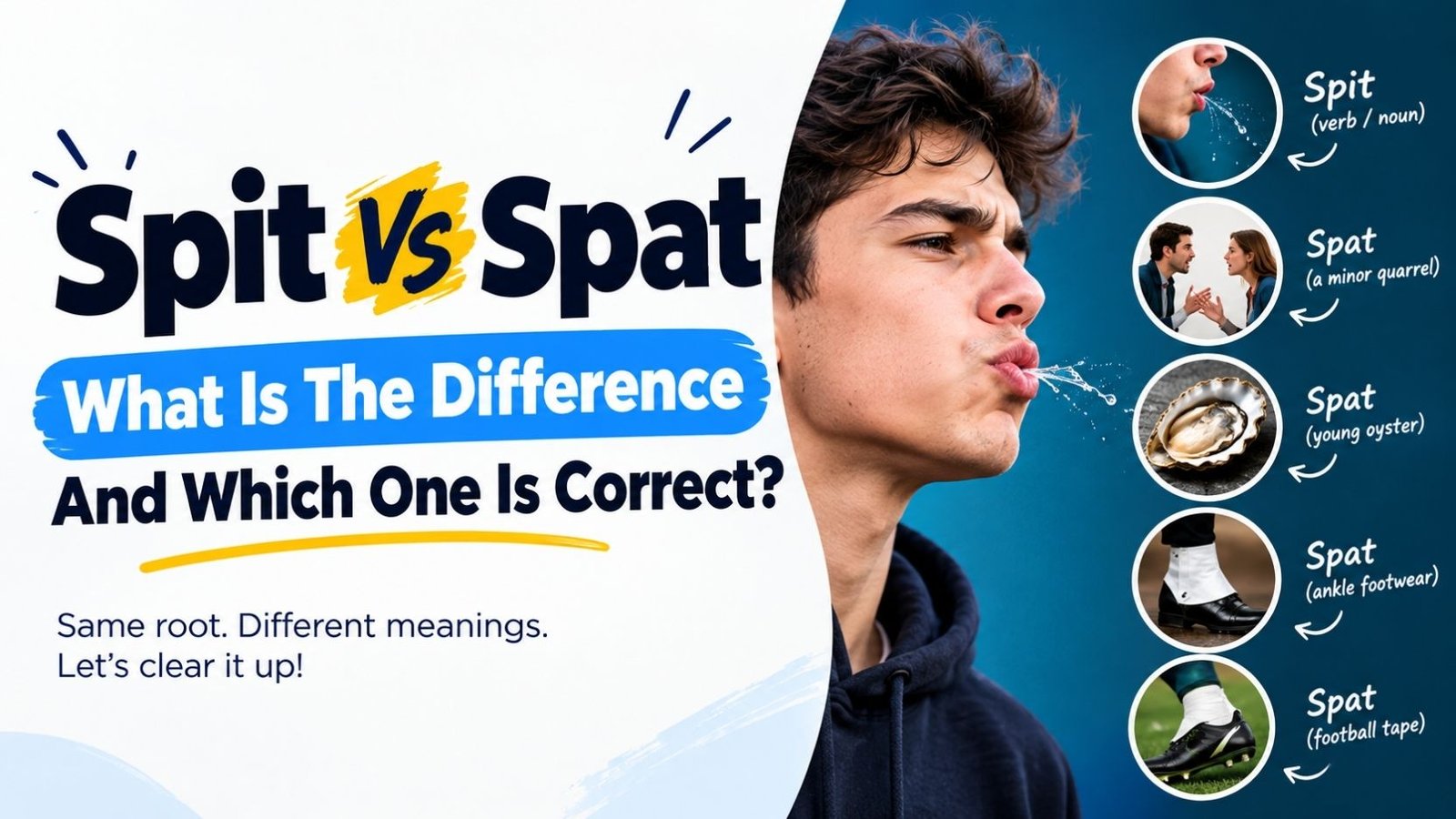
Spit and spat both come from the same verb, but they are not identical. Spit is the base form of the verb that means to force saliva or something else out of your mouth. Spat is one accepted past tense form of that same verb. In American English, spit is also used as the past tense, so both spit vs spat are correct depending on style and region.
Spat is more than just a verb form, though. It also stands on its own as a separate word with several unrelated meanings. A spat can be a small argument, a young oyster, a piece of ankle wear, or tape wrapped around a football cleat. Knowing which meaning applies depends entirely on context, and this guide walks through every version clearly.
Spit Vs Spat: Quick Answer
| Word | Type | Simple Meaning |
| Spit | Verb, present tense | To force saliva or another substance out of the mouth |
| Spit | Noun | Saliva, or a thin strip of land reaching into water |
| Spat | Verb, past tense of spit | Spit out saliva or an object in the past |
| Spat | Noun (quarrel) | A short, minor argument |
| Spat | Noun (oyster) | A young oyster or shellfish |
| Spat | Noun (footwear) | An ankle covering worn over shoes |
The table above covers the core answer. The sections below explain each meaning and usage in full detail.
Read More: Modeling Vs Modelling
What Does Spit Mean?
Spit works as both a verb and a noun in English.
As a verb, spit means to push saliva out of the mouth. It can also mean to force out any small object with a similar motion, such as a seed or a piece of food.
- “Please don’t spit on the sidewalk.”
- “He spit the watermelon seeds into the grass.”
As a noun, spit refers to the saliva itself.
- “There was spit on the pavement.”
Spit has a second, unrelated noun meaning as well. In geography, a spit is a narrow strip of land that extends out into a body of water.
- “The lighthouse sits at the end of a sandy spit.”
Spit Grammar: Past Tense And Past Participle
This is where most of the confusion starts. Spit is an irregular verb, so it does not simply add “ed” to form the past tense.
| Form | Word | Example |
| Present | spit | “I spit the gum into the trash.” |
| Past tense | spat or spit | “She spat the medicine back out.” |
| Past participle | spat or spit | “He has spat on the ground before.” |
| Incorrect form | spitted | Not accepted in standard English |
Both spat and spit are recognized as correct past tense and past participle forms of spit. Spat follows the same pattern as other irregular verbs such as sit and sat, or hit and hit. Spitted is not considered standard English by major dictionaries.
American English Vs British English
Usage differs slightly by region.
- British English leans more heavily toward spat, in both speech and writing.
- American English accepts spit as the past tense more often, especially in casual or spoken contexts.
- Formal and academic writing in both regions tends to favor spat, because it matches the pattern of similar irregular verbs.
- Spat also appears more naturally after “have” or “has,” as in “I have spat,” which most readers find more familiar than “I have spit.”
💡 Tip: When you are unsure which form to use, spat is the safer choice for formal writing.
Spat: All The Different Meanings
Spat is not only a verb form. It is also an independent word with several distinct meanings. These meanings are unrelated to each other in origin, even though they share the same spelling.
Meaning 1: A Minor Quarrel
The most common standalone use of spat is as a noun meaning a short, petty argument. This is often called a verbal spat.
- “The couple had a small spat over dinner plans.”
- “It was just a lovers’ spat, nothing serious.”
A spat is usually brief and low stakes. It is different from a serious fight or a long-running dispute. Common synonyms include squabble, tiff, and bickering.
| Word | Meaning | Typical Intensity |
| Spat | A brief, minor quarrel | Low |
| Argument | A more serious disagreement | Medium to high |
| Feud | A long-running, deep conflict | High |
Meaning 2: A Young Oyster (Oyster Spat)
In marine biology, spat refers to the spawn or larvae of a shellfish, most often an oyster. Once oyster larvae attach themselves to a hard surface, that stage of growth is called spat.
- “Oyster farmers collect spat on shells before growing them further.”
- “Cold water can slow the settlement of oyster spat.”
This meaning has nothing to do with quarrels or the verb spit. It comes from a separate word history, which is covered in the origin section below.
Meaning 3: Ankle Footwear (Spat Shoes)
A spat, usually used in the plural as spats, is a cloth or leather covering that fits over the top of a shoe and around the ankle. Spats were originally designed to protect shoes and socks from mud.
Spats were common in the late 1800s and early 1900s. They started as a practical accessory and later became a fashion statement, closely associated with formal dress and, later, with a stylish or old fashioned look.
- “He wore white spats with his tuxedo.”
- “Spats went out of everyday fashion by the 1930s.”
Meaning 4: Football Spat Tape And Cleat Spats
In American football, a spat refers to tape wrapped around a player’s cleats and ankles. This practice is often called spatting.
Players and trainers use spat tape, usually stretchy athletic tape, to add ankle support and reduce the risk of rolling or twisting an ankle. Some players use pre-made cleat covers, sometimes called cleat spats or slip on spats, instead of wrapping tape by hand.
- “The trainer helped spat his cleats before the game.”
- “Cleat spats also help keep turf pellets and debris out of the shoe.”
Both tape spats and cleat spat covers serve the same basic purpose: ankle support and shoe protection, though many players also wear them for a matching, uniform look on the field.
Read More: Cool Off Vs Call Off
Pronunciation Of Spit And Spat
Both words are one syllable and easy to pronounce.
- Spit is pronounced with a short “i” sound, like the word “sit.”
- Spat is pronounced with a short “a” sound, like the word “cat.”
Neither word carries stress ambiguity, since each has only one syllable. The difference in sound is simply the vowel: “i” for spit, and “a” for spat.
⚠️ Note: If you are searching for “wie spät ist es in Deutschland,” that phrase is German, not English. It means “what time is it in Germany.” The German word spät means “late,” and it is unrelated to the English word spat. The two words only look similar on the page.
Where Does Spit Come From?
Spit comes from Old English forms such as spittan and spætan, which meant to expel saliva. These trace back further to a Proto-Germanic root and an even older root that was imitative, meaning it likely developed to sound like the action it describes.
The past tense form spat developed over time to follow the same pattern as other strong, irregular English verbs.
Where Does Spat Come From?
Spat has more than one origin, depending on which meaning is involved.
- As a past tense verb form, spat developed naturally from spit, following the same irregular pattern as sit and sat.
- As a noun meaning a minor quarrel, spat first appeared in American English around 1804. Its exact origin is uncertain, though it may be linked to the idea of a slap or a sharp, sudden sound.
- As a term for young oysters, spat dates to the 1660s. Its origin is also uncertain, but some sources connect it to the past tense of spit, possibly because oyster spawn was once thought to resemble expelled matter.
- As a term for ankle footwear, spat is a shortened form of spatterdash, an older word combining spatter and dash. Spatterdashes were long gaiters worn to protect trousers from mud splashes, and the shortened spats became common by the late 1700s.
These separate histories explain why one short word carries so many different meanings today.
Common Mistakes With Spit And Spat
❌ Incorrect: “He spitted the seeds onto the ground.”
✅ Correct: “He spat the seeds onto the ground,” or “He spit the seeds onto the ground.”
Spitted is not a recognized past tense form in standard English, even though it looks like a regular “ed” ending.
❌ Incorrect: “They had a big spat that lasted for months.”
✅ Correct: “They had a big argument that lasted for months.”
A spat is meant to describe something small and brief. Using it for a long, serious conflict does not match its actual meaning.
❌ Incorrect: “The oyster farm collects spit every spring.”
✅ Correct: “The oyster farm collects spat every spring.”
In the context of shellfish, the correct word is spat, not spit. Mixing up these two spellings changes the meaning of the sentence entirely.
Similar And Confusing Words
| Word | Meaning | How It Differs From Spat |
| Spit | Present tense verb, or saliva | Spat is its past tense form |
| Spate | A sudden, large amount of something | Different word, different meaning entirely |
| Spar | To box lightly, or argue in a controlled way | Closer to sparring than a casual spat |
| Tiff | A small quarrel | Very close in meaning to spat as a noun |
Spat and spate are sometimes confused because they look alike, but they are unrelated. A spate refers to a sudden rush or flood of something, such as “a spate of bad weather,” while a spat is a small disagreement.
Read More: Pliers Or Plyers
A Quick Note On The Spit Card Game
Spit is also the name of a fast-paced, two-player card game. Each player deals out a row of stock piles and races to play all of their cards onto two shared center piles in ascending or descending order.
There is no turn-taking, since both players move at the same time, and speed matters more than luck. This use of the word spit is a proper noun for the game title, and it is unrelated to the grammar or quarrel meanings covered above.
Frequently Asked Questions
What does spit mean?
Spit means to force saliva or another small object out of the mouth. It can also refer to saliva itself as a noun.
What is the past tense of spit?
Both spat and spit are accepted past tense forms. Spat is more common in formal writing and in British English.
Is spitted a real word?
No. Spitted is not considered a standard past tense form of spit by major dictionaries.
What does spat mean as a noun?
As a noun, spat most often means a short, minor quarrel. It can also mean a young oyster, an ankle covering worn over shoes, or tape wrapped around football cleats.
What is a verbal spat?
A verbal spat is a brief, low-stakes argument, usually between two people who are otherwise on good terms.
What is oyster spat?
Oyster spat refers to young oysters, specifically the stage right after the larvae attach themselves to a hard surface.
What is spat tape used for in football?
Spat tape wraps around a player’s cleats and ankle to add support and reduce the risk of ankle injury. It can also help keep debris out of the shoe.
Are spats still worn today?
Rarely as everyday footwear. Spats were common in formal fashion from the late 1800s through the early 1900s but fell out of common use after that.
How do you pronounce spit and spat?
Spit uses a short “i” sound, like “sit.” Spat uses a short “a” sound, like “cat.”
Is spit or spat correct in American English?
Both are correct. American English accepts spit as the past tense, especially in casual speech, while spat remains common in formal writing.
Final Thoughts
Spit and spat are connected through grammar, but spat has also grown into a word of its own. As a verb form, both spit and spat work as the past tense of spit, with spat favored in formal writing and spit more common in casual American speech. Spitted is never correct.
Beyond grammar, spat carries several independent meanings worth knowing: a minor quarrel, a young oyster, an ankle covering, or tape wrapped around a football cleat. Once you separate these meanings by context, spit vs spat stops being confusing and simply becomes another example of how one small word can carry a surprising amount of history.

Danish Raza is the author of Grammavio, a trusted resource for simple and easy-to-understand English grammar guides. He creates helpful content covering grammar rules, word meanings, vocabulary, and common grammar mistakes to help readers improve their English skills.


