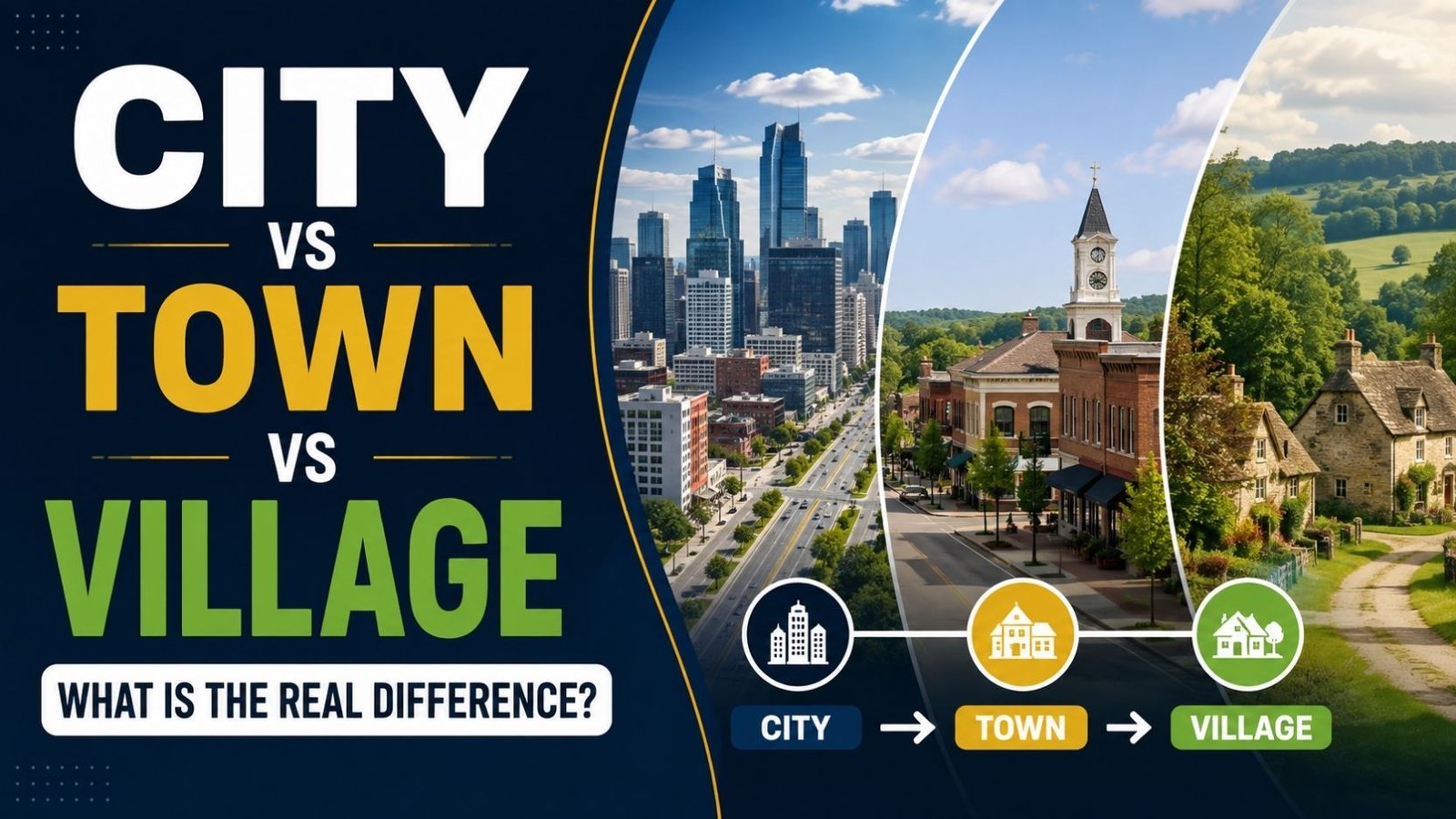
A city is a large, densely populated place with its own government, services, and legal status granted by a state or country. A town sits in the middle: bigger than a village, smaller than a city, with some shops, schools, and local government, but fewer services overall. A village is the smallest of the three, usually rural, with a small population and a simple, close-knit community life.
These three words describe places of increasing size and complexity, from village to town to city. The difference matters because each term carries its own legal meaning, population range, and set of expectations about infrastructure, government, and daily life. Understanding city vs town vs village helps you read maps, census data, travel guides, and everyday conversation more accurately.
What Does City Vs Town Vs Village Actually Mean?
At the simplest level, these three words describe how big a place is and how it is organized.
- A city is a large settlement with a formal government structure, extensive infrastructure, and usually a legal charter or official designation.
- A town is a mid-sized settlement, larger and more developed than a village, but smaller and less complex than a city.
- A village is a small settlement, often rural, with a limited population and simple community structure.
The exact population numbers that separate these categories are not fixed worldwide. They change depending on the country, the state, and even the specific law being applied. This is one of the most common points of confusion, so it is worth explaining clearly.
City Vs Town Vs Village: Quick Comparison Table
| Feature | Village | Town | City |
| Typical population | Small, often a few hundred to a few thousand | Medium, often a few thousand to tens of thousands | Large, often over 50,000, sometimes millions |
| Government | Minimal, often informal or a parish council | Local council or town government | Formal municipal government with a mayor or council |
| Infrastructure | Basic roads, few shops | Schools, shops, some public services | Hospitals, universities, public transport, utilities |
| Economy | Mostly agriculture or small trade | Mixed local businesses | Diverse industries, commerce, and services |
| Legal status | Usually not incorporated | May or may not be incorporated | Usually incorporated with a charter |
This table gives a general picture. Real-world examples do not always follow these patterns exactly, because naming often depends on history and local law rather than strict population counts.
See More: To Fast Or Too Fast
City Meaning And Definition
A city is a large human settlement with its own system of local government, well-developed infrastructure, and enough population density to support varied economic activity. In many countries, a place only becomes a city when it receives an official charter or designation from a higher level of government.
In the United States, city status is usually granted by a state, and the population needed can vary widely. A place with only a few thousand residents can be legally called a city in one state, while another state might reserve that title for places with tens of thousands of people. In the United Kingdom, city status has traditionally been linked to having a cathedral, though this is no longer a strict rule, and cities are now designated directly by royal charter.
Key features of a city usually include:
- A formal local government, often led by a mayor
- Public transportation systems
- Hospitals, universities, and major cultural institutions
- A diverse economy with multiple industries
- High population density compared to surrounding areas
Town Meaning And Definition
A town is a settlement that is larger and more organized than a village but smaller and less complex than a city. Towns usually have some form of local government, a defined commercial center, and enough population to support schools, shops, and basic services.
The word town does not always require a specific population threshold. In many US states, a town is simply an incorporated municipality that has not been designated a city, regardless of size. In the United Kingdom, a town traditionally lacks a cathedral and does not hold city status, even if it has a large population.
Common features of a town include:
- A town hall or local council
- A central shopping or business district
- Schools and basic medical facilities
- A mix of residential and commercial land use
- Population that is smaller than a nearby city but larger than nearby villages
Village Meaning And Definition
A village is the smallest of the three settlement types. It is usually rural, with a modest population, simple infrastructure, and a close knit community where people often know their neighbors personally. Villages often grew historically around a shared resource, such as a water source, farmland, or a crossroads.
Villages typically do not have their own full municipal government. Many are governed as part of a larger township, county, or parish system rather than having independent city or town status.
Common features of a village include:
- A small, stable population
- Limited commercial activity, sometimes just a general store or a few small shops
- Strong reliance on agriculture or nearby larger towns for employment
- A simple or informal local governing body, such as a parish council
- Close social ties among residents
See More: Beginning Or Begining
City Vs Town Vs Village Population: How Size Differs
Population is the factor people ask about most, but it is important to understand that there is no single global population rule for these three categories. Different countries and even different states within the same country use different thresholds.
In general terms, based on common usage across English-speaking countries:
- Village: Often ranges from a few dozen people to a few thousand.
- Town: Often ranges from a few thousand to tens of thousands.
- City: Often starts at a few thousand and can extend into the millions, depending on legal designation rather than population alone.
It is worth repeating that legal status often matters more than raw population numbers. A small place with historic city status can remain a city even if its population shrinks, and a large unincorporated area can remain classified as a town or village if it never received a formal city charter.
City Vs Town Vs Village Vs Hamlet: Adding a Fourth Category
Many readers also ask about hamlets, which sit below villages in size and complexity. A hamlet is typically a tiny settlement, sometimes just a cluster of homes and a few buildings, without its own local government or significant commercial activity.
| Term | General Size | Local Government | Typical Features |
| Hamlet | Very small, often under a few hundred people | Usually none, governed by a larger area | A few homes, maybe a church or small store |
| Village | Small | Minimal or informal | Basic shops, strong community identity |
| Town | Medium | Local council or town government | Schools, shops, some services |
| City | Large | Full municipal government | Hospitals, universities, extensive infrastructure |
Some regions also use terms like township, borough, or municipality, which add further legal nuance. These terms often describe administrative boundaries rather than settlement size, so they can overlap with any of the categories above.
City Vs Town Vs Village In The USA
In the United States, the classification of a place as a city, town, or village depends heavily on state law rather than a single national standard.
- Some states, such as New York, formally distinguish between cities, towns, and villages as separate legal categories, each with its own government structure.
- Other states use the word town loosely to describe any small incorporated community, without a strict population rule.
- Village status in some states, like Illinois or New York, comes with its own specific legal definition and level of local government, distinct from a town.
Because of this variation, two places with almost identical populations can carry different official titles simply because they are located in different states.
City Vs Town Vs Village In The UK
In the United Kingdom, the distinction is based more on tradition and formal designation than on population.
- A city in the UK is granted that status through royal charter or letters patent, not by reaching a specific population.
- A town generally lacks city status, regardless of size, and can range from a few thousand to well over one hundred thousand residents.
- A village is a small rural settlement, often centered around a church, green, or market square.
This is why some UK towns are larger than some UK cities, which often surprises readers who assume population always determines the label.
Grammar Notes: City, Town And Village As Words
All three words, city, town, and village, are common nouns. They can also become proper nouns when used as part of an official place name, such as New York City or Greenwich Village.
Plural forms:
- City becomes cities.
- Town becomes towns.
- Village becomes villages.
Example sentences:
- The city expanded its public transportation system last year.
- Our town has one main street with a few local shops.
- The village holds a small festival every summer.
These words function as ordinary countable nouns and follow standard English pluralization rules.
Common Mistakes When Comparing City, Town, And Village
❌ Incorrect: Assuming population alone always decides whether a place is a city, town, or village.
✅ Correct: Recognizing that legal status, government structure, and local law often matter as much as population.
❌ Incorrect: Believing every large town is automatically a city.
✅ Correct: Understanding that some large towns never receive official city status, especially in the UK.
❌ Incorrect: Treating village and hamlet as identical terms.
✅ Correct: Knowing that a hamlet is generally smaller and less organized than a village.
See More: Might As Well Or Mine As Well
Synonyms And Related Words
| Word | Meaning | Difference From City, Town, Village |
| Municipality | A formally organized local government area | Refers to governance structure, not size |
| Township | An administrative division, often rural | Can contain multiple villages or hamlets |
| Borough | An incorporated municipal unit, common in the US and UK | Often used for administrative subdivisions of larger cities |
| Metropolis | A very large, influential city | Describes scale and importance, not a separate legal category |
These related terms often appear alongside city, town, and village in official documents, so understanding them helps you read local government information more accurately.
Frequently Asked Questions
What is the main difference between a city, a town, and a village?
The main difference is size and government structure. A village is the smallest and simplest, a town is mid-sized with some local services, and a city is the largest with full municipal government and extensive infrastructure.
Does population always determine whether a place is a city, town, or village?
No. Legal status and official designation, granted by a state or national government, often matter as much as or more than population.
Can a town be bigger than a city?
Yes, especially in the United Kingdom, where city status depends on royal charter rather than population size.
What is the difference between a village and a hamlet?
A hamlet is generally smaller than a village and usually lacks its own local government or significant commercial center.
Is village a formal legal term?
In some countries and states, yes. In New York and Illinois, for example, a village is a specific legal classification with its own government structure.
What is a township compared to a town?
A township is often a broader administrative area that can include multiple villages, hamlets, or unincorporated communities, while a town usually refers to a single, defined settlement.
How is city status granted in the UK?
City status in the UK is granted through royal charter or letters patent, not through population thresholds.
Are city, town, and village common nouns?
Yes, all three are common nouns and become proper nouns only when used as part of an official place name.
Conclusion
The comparison of city vs town vs village comes down to two main factors: size and government structure. A village is small and simple, often rural, with limited services and informal governance. A town sits in the middle, offering more infrastructure and local government than a village but less than a city. A city is the largest and most developed of the three, with formal municipal government, extensive public services, and an official legal designation.
Because rules differ by country and even by state, the exact line between these categories is not always fixed. The most reliable way to understand any specific place is to look at its official legal status alongside its population and infrastructure, rather than relying on size alone.

Danish Raza is the author of Grammavio, a trusted resource for simple and easy-to-understand English grammar guides. He creates helpful content covering grammar rules, word meanings, vocabulary, and common grammar mistakes to help readers improve their English skills.